By Evyatar Ben Artzi, Darrow.
As CEO of Darrow, I’ve spent the last several years watching our industry grapple with a fundamental blind spot. Legal practice has seen important advances in efficiency through technology, including faster document review and smoother case management. But all of these innovations share a common assumption: that someone already recognizes they’ve been harmed.
But much of the heavy-lifting, from evaluating potential claims to deciding which matters to pursue, remains an uphill battle. What’s often overlooked is the front-end challenge: uncovering the underlying violations that could and should become cases in the first place.
Consider the systemic harm happening right now that no one has yet connected the dots on; environmental abuses, consumer fraud, and other widespread violations that remain fragmented and hidden in plain sight.
This is where I believe our profession is missing its biggest opportunity.
For decades, we’ve operated primarily under a reactive model that made perfect sense given our technological limitations. While attorneys certainly conducted some of their own legal research, the process mostly started when clients brought us problems, and we would focus our research and advocacy on solving them.
But reactive legal practice has costs. By the time harm reaches our desks, it’s often been occurring for months or years. Evidence has degraded and memories have faded. In many cases, the window for optimal legal intervention has already closed.
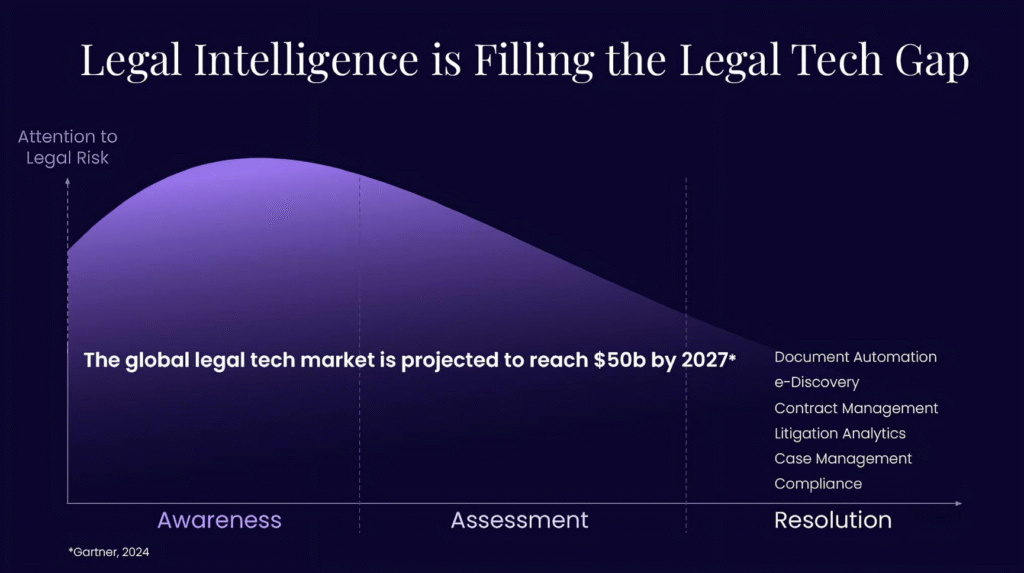
Our team at Darrow is seeing firsthand how legal intelligence is changing this dynamic. Instead of waiting for cases to find us, we’re using intelligence and AI to scan vast databases of public information, including regulatory filings, consumer complaints, corporate disclosures, court records, amongst many others, to look for and cluster patterns that suggest systematic harm.
We’re identifying potential violations that might never have been detected through traditional channels months or even years earlier than they would typically surface, allowing attorneys to move from reactive to proactive practice.
The challenge with front-end legal work has always been one of scale and signal detection. Consider the following scenario: a pharmaceutical company is generating thousands of adverse event reports, but they’re scattered across multiple databases and jurisdictions. Traditional research methods might uncover a handful of concerning cases, but miss the larger pattern.
This is exactly where machine learning excels. Our algorithms can process millions of data points simultaneously, clustering similar complaints and identifying statistical anomalies that would be invisible to human analysis.
I’ve seen our partner firms use this approach to uncover issues ranging from defective medical devices to securities fraud and environmental contamination. In each case, the legal merit was there, but it took a combination of intelligence, data analysis, and human judgment to connect the scattered pieces of evidence into a coherent picture.
Recently, we even built a custom medical liability violation detection tool for a leading plaintiff-side law firm. This tool now enables the firm to identify medical product and pharmaceutical violations at scale, assess potential case value and plaintiff volume, and prioritize the cases with the greatest impact.
One of the most expensive parts of plaintiff practice is the upfront case evaluation process. Partners typically spend weeks researching potential matters. But pursue the wrong case and you’ve wasted significant resources. Miss the right case and you’ve left money on the table.
Legal intelligence changes this equation by front-loading much of the analytical work. Instead of starting with a handful of complaints and working outward, attorneys can begin with a full picture of potential harm across multiple vectors. They can see estimated class sizes, damage calculations, and comparable precedents before committing significant resources.
Lawyers still need to evaluate law and assess risk, but they’re making those decisions from a position of much greater information density.
Let me be clear about something: AI will not replace attorneys. The front-end of legal practice involves interpretation and judgment calls that remain fundamentally human domains. What AI can do is one, enable attorneys to find legal violations that they otherwise would not have been able to detect by piecing together signals from multiple sources and two, handle the scale problem that has historically limited our profession’s ability to identify systematic harm.
Think of it as augmented intelligence rather than artificial intelligence: machines excel at processing data and finding recurring patterns. Attorneys excel at understanding context and creating legal arguments. The combination is more powerful than either could be alone.
The firms that embrace these capabilities early are already seeing competitive advantages. They’re identifying high-value cases before their competitors even know they exist. They’re approaching potential plaintiffs with research already completed. They’re making more informed decisions about resource allocation.
For the first time in our profession’s history, we have tools that can help us identify systematic harm at scale. We can move from reactive to proactive practice and surface cases that might otherwise never be brought.
But technology is only as good as the professionals who use it. The attorneys that will thrive are those that can combine AI’s analytical power with human judgment and client advocacy skills.
The future of legal innovation should be about helping our profession fulfill its fundamental promise: ensuring that harm doesn’t go unaddressed, and that justice isn’t limited by the constraints of manual research and reactive practice models.
That’s the opportunity in front of us. And that’s why I believe legal intelligence will define the next chapter of our profession’s evolution.
Curious how legal intelligence can help you uncover hidden violations and high-value cases? Contact Darrow for a personalized consultation. Learn more about Darrow at www.darrow.ai.
—
[ This is a sponsored thought leadership article by Darrow for Artificial Lawyer. ]
Discover more from Artificial Lawyer
Subscribe to get the latest posts sent to your email.