Fastcase, which is now part of Clio via its vLex deal, has filed a lawsuit against another legal tech company, Alexi, related to the use of legal research data. Alexi is based in Canada and provides a range of AI-driven skills, from legal intelligence to workflows.
The case is unusual in that legal tech companies don’t often go to court with each other, and also in that well-known legal sector experts and news sites, including Bob Ambrogi’s website LawSites and Matt Margolis, are noted in the filing in relation to describing what Alexi has been offering to the public.
Although the facts are obviously different and the case is not connected, the dispute follows a previous example of legal research businesses clashing, namely Thomson Reuters and ROSS, which came to light some years ago.
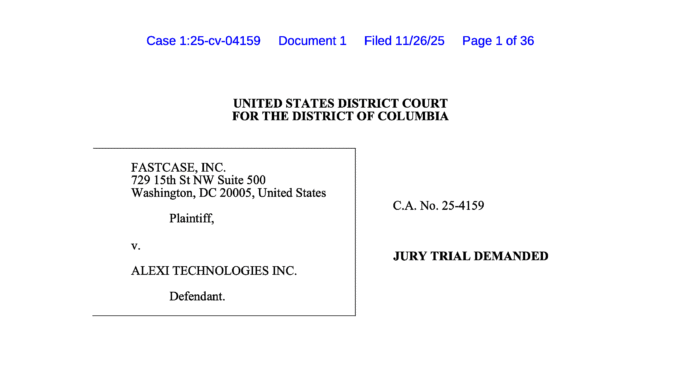
Below is the verbatim text of the initial part of the filing. AL has reached out to executives at Fastcase, now part of Clio, and also Alexi, for comment. Mark Doble, CEO of Alexi has this afternoon sent a statement to this site and it is directly below the filing snippet.
‘FASTCASE, INC.
729 15th St NW Suite 500 Washington, DC 20005, United States
Plaintiff, v.
ALEXI TECHNOLOGIES INC. Defendant.
COMPLAINT
C.A. No. 25-4159
JURY TRIAL DEMANDED
Plaintiff Fastcase, Inc. (“Fastcase” or “Plaintiff”), by and through its undersigned counsel, brings this Complaint against Defendant Alexi Technologies Inc. (“Alexi” or “Defendant”) and alleges as follows:
NATURE OF THE ACTION
1. Fastcase is a legal publishing and research technology company founded in 1999. It has spent decades building one of the industry’s most comprehensive and innovative legal research databases. In 2023, Fastcase merged with vLex, LLC (“vLex”) and became part of the vLex Group, which was acquired by Clio, Inc on November 10, 2025.
2. Alexi is a legal tech company that began as a research institution. Formerly known as “Alexsei,” Alexi was founded in 2017 and initially operated with a team of research attorneys who used a passage-retrieval AI system to help prepare legal memoranda for clients.
3. In late 2021, the Parties entered into a Data License Agreement (the “Agreement”) under which Fastcase granted Alexi limited access to Fastcase’s proprietary and highly curated case law database. The license was expressly restricted to “internal research purposes”—i.e., research performed by Alexi’s own staff lawyers in preparing client memoranda. Alexi agreed that it would not (a) use Fastcase data for any commercial purpose, (b) use the data to compete with Fastcase, or (c) publish or distribute Fastcase data in any form.
4. Fastcase’s database is the product of decades of work and millions of dollars in investment, resulting in one of the most sophisticated legal-research databases in the industry. That effort includes extensive text and metadata tagging, specialized structuring into HTML, and proprietary formatting and harmonization processes that require significant technical expertise and sustained investment. Fastcase entrusted Alexi with access to this highly valuable, unique proprietary compilation solely for the narrow internal research Purpose defined in the Parties’ Agreement. The uniqueness and economic value of the Fastcase Data—and the trust Fastcase placed in Alexi when providing it—underscore the seriousness of Alexi’s subsequent misuse.
5. The Parties initially explored a deeper partnership. In 2022, Alexi sought to integrate its passage-retrieval AI system with Fastcase’s database so Alexi customers could directly access Fastcase case law. That partnership never materialized. Instead, in 2023, Fastcase proceeded with its merger with vLex and expanded its own research offerings.
6. Alexi began pivoting into direct competition. On information and belief, beginning in 2023 and accelerating thereafter, Alexi expanded its use of Fastcase data beyond the license’s narrow internal-use limitations, using that data to build and scale its own legal research platform.
7. Alexi ultimately removed the “internal research” component entirely and began publishing and distributing Fastcase-sourced case law directly to its users—in clear violation of the Agreement’s core restrictions. Alexi also began holding itself out as a full-scale legal-research alternative to incumbent providers, including Fastcase.
8. Alexi acted knowingly and deliberately. On information and belief, Alexi used Fastcase’s proprietary database—acquired under a limited, internal-use license—to shortcut the massive investment required to build a comprehensive commercial legal-research platform. In doing so, Alexi used Fastcase’s data for the very commercial and competitive purposes the Agreement expressly forbids.
9. Alexi further misused Fastcase’s intellectual property. To bolster its own credibility and suggest an affiliation that does not exist, Alexi has used Fastcase’s trademark and service mark in promotional materials and product interfaces, implying that Fastcase data appears in Alexi’s product with Fastcase’s authorization.
10. Alexi also misappropriated Fastcase’s compilation trade secrets. By extracting the economic value of Fastcase’s curated, structured, and technically harmonized legal-research database—work it could not replicate itself—Alexi has appropriated Fastcase’s decades of investment while simultaneously damaging Fastcase’s market position and goodwill.
11. Fastcase brings this action to hold Alexi accountable for its contractual breaches, trademark infringement, and misappropriation of Fastcase’s proprietary compilation, and to protect Fastcase’s intellectual property and competitive position in the legal-research market.’
Statement by Mark Doble, CEO, Alexi, sent to Artificial Lawyer this afternoon:
‘As disclosed in the complaint, our license agreement provides certain rights to the caselaw data, and we have strong reasons to believe Clio only discovered this right in the final days/weeks leading up to the closing of their acquisition. Clio thought they had exclusive rights to the data, and then in closing discovered they didn’t. Now, they are trying to get out of the agreement.
Right from entering into the agreement in 2021, and throughout the subsequent 4 years, it has always been clear what we could and could not do with the data as between Alexi and Fastcase. Abundantly clear. And we have always been very careful to never act outside the scope of the license.
We have all the evidence we need to fully demonstrate this, and as such I am very confident we will have a full resolution to this soon.’
—
So, there you go. As you can see, the case was filed just before Thanksgiving in the US, and it’s not clear where this has got to. You can find the case here.
P.S. as mentioned above, within the filing there are references to how Alexi showed what it could do to the public, and in relation to that mentions both LawSites and Matt Margolis, as well as fellow legal tech expert Nick Rishwain. Obviously, none of the experts mentioned had anything to do with the case itself, and are noted in the filing simply as commentators on legal technology.
It appears that the law firm representing Fastcase is Wilson Sonsini, a firm with a deep knowledge of legal tech. As to why the case has been filed in the name of Fastcase, and not Clio – which it’s now formally part of after the M&A deal with vLex – is not known, but one could guess that it may be because of prior organisational structures.
If Fastcase/Clio respond with comments, AL will add them here, as it has with Alexi’s statement.
Discover more from Artificial Lawyer
Subscribe to get the latest posts sent to your email.