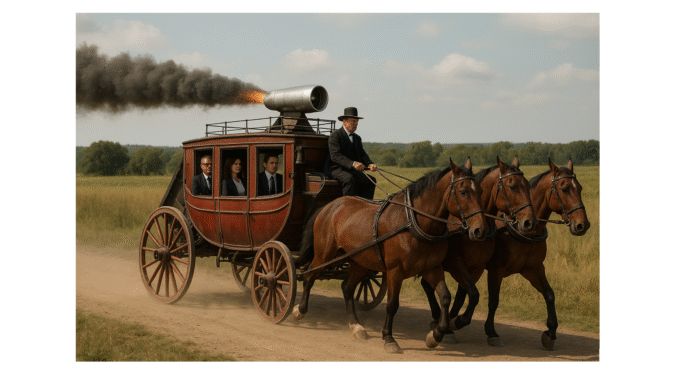
There are three main models for the deployment of legal AI in law firms. Here, with illustrations based on the metaphor of the carriage, are what is possible at present.
Model 1: The Big Law, High Leverage Approach
With this approach AI is ‘added to’ the existing model of using a large number of junior lawyers. While partners contribute expert input, their billables are a fraction of the total provided by ‘the workhorses’ that are pulling along the ‘carriage’ of the law firm.
Pros: this model allows for AI to be added in without causing any disruption. The ‘jet engine’ of AI added to the carriage helps the firm to move quickly over challenging terrain – such as work that is either not billable, or has very low value, or perhaps needs to be done super-fast during a client emergency.
AI here is not transformative, nor is it meant to be. The standard model continues much as it did in the 1980s, relying primarily on human labour, but it is ‘turbo-charged’ with AI as and when needed.
Cons: the main problem here is that if you put a much larger ‘AI jet engine’ on the carriage you’ll make life tough for the ‘workhorses’ who can only go so fast. I.e. the associates have a human pace, adding a small amount of AI helps them to get up ‘hills’, but if you really use a super-powerful AI deeply and broadly across the whole legal business then it’s moving faster than the horses and that will create havoc.
(Note: smaller firms may face the same challenges and benefits, although may be more agile in building out workflows where AI does not cause a conflict. Also, claimant / plaintiff firms that operate on a no win/no fee basis can see only upsides here, although most Big Law firms don’t operate that way.)

Model 1 above: horses = associate leverage, driver = partners, carriage = the business as a whole, jet engine = legal AI tools, passengers = clients.
Model 2: AI First ‘NewMod’ Low Leverage Approach
This ‘horseless carriage’ model combines AI and human lawyers on an equal footing, and seeks to remove any business barriers to this combination, often by offering fixed fees. Instead of multiple workhorses, there is much more AI. But, there is still ‘a driver’, i.e. senior, experienced lawyers who make sure the work product is high quality and who can also engage with clients.
Pros: this model seeks to utilise AI to its fullest and removes any obstacles to efficiency. The model seeks to crystallise knowledge in workflows driven by AI, but is overseen and engaged with by experienced lawyers. If they can gain enough scale they could really take enough market share to change clients’ view of what is possible.
Cons: they tend to be deep, but narrow in approach, often founded by subject matter specialists. Big Law firms can provide a wide range of connected practice areas all at once if needed. The fixed fee approach can also perhaps not accommodate more complex needs when a client wants legal help above and beyond what is normally offered.
Note: such approaches could become part of Big Law, i.e. they hive off certain parts of the firm to the Model 2 way of doing things, much as they have in the past developed ALSPs to counter rivals such as the Big Four.

Model 2 above, no horses, but much more AI (jet engines), therefore way faster and more efficient.
Model 3: The All-AI Approach
This is perhaps the most radical model and is based on the idea that AI alone – once built out with the right data, guardrails and workflows – can do a lot on its own without any lawyers involved. We see this at the consumer end of the market. I.e. no horses and no driver either.
Pros: it’s a very light model as it has no human lawyers giving advice, although they will be needed to make sure the outputs are right at least initially. It can be used at a low cost and that helps attract a wide range of clients.
Cons: without lawyers taking part in the daily advice it really reduces what can be done, as legal needs often escalate, especially for those clients in a dispute. There is also the risk that any outputs are not fully correct, as each and every output is not necessarily overseen. So, that creates a business risk problem as well.
Note: clearly this is the most radical and risky approach for all involved. But, it may also be the most economical and many people will choose it for that reason.

Model 3 above: no horses and no driver, i.e. no leverage and no partner-level lawyers steering things either. It goes very fast, but it’s also more risky than models 1 and 2.
—
Conclusion:
There are pros and cons to each model. Plus, this is not over yet. A combination of NewMods to offer multiple practice groups, and both volume and more complex advisory work, that operate all-in-one would be a formidable entity. Law firms, as noted, also can separate parts of their business and operate both model 1 and 2 at the same time – and even 3 if they wanted to.
The models therefore can be combined to make yet more ways of doing business in the legal field. Also, for inhouse lawyers what they can build internally will be different as well. The key point here is that there is more now than Model 1 and what’s possible will keep evolving.
–
Richard Tromans, Founder, Artificial Lawyer, December 2025.
Discover more from Artificial Lawyer
Subscribe to get the latest posts sent to your email.