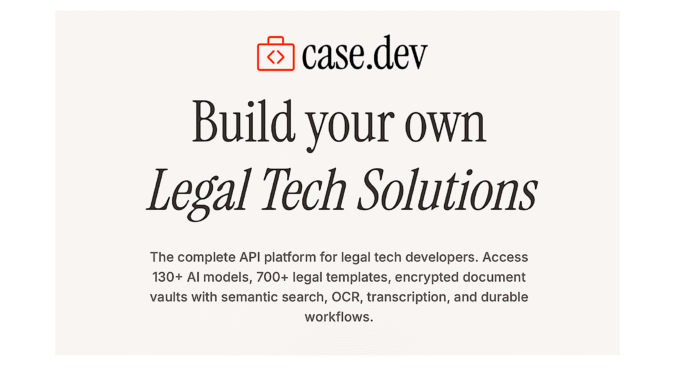
As vibe-coding for lawyers gathers pace, a new platform – Case.dev – is coming to market, designed to help you develop your own legal tech products, or customise a range of pre-built options. Founder, Scott Kveton, already runs CaseMark, a litigation lifecycle business, but this new venture lets lawyers build what they want. AL interviewed Kveton about the platform and the ideas behind it.
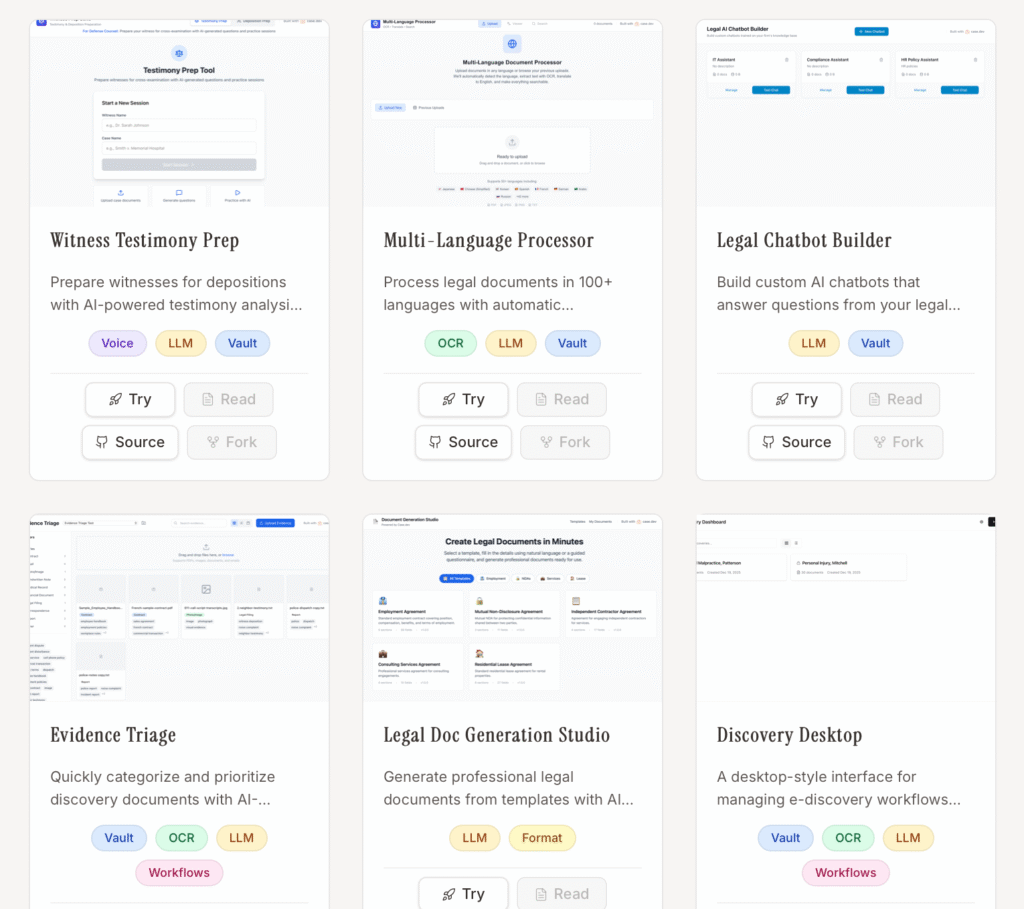
Before the interview, here are some of what’s already been made. As you can see, you can use ‘as is’, or take these apps and adapt them as you wish. Kveton noted he has made sure there is ‘legal-grade compliance and security’ built in. He also added that he can see legal tech companies using it as well to build products. Plus, as mentioned, this follows Monday’s Artificial Lawyer article about Jamie Tso and vibe-coding – see here.
Interview with Scott Kveton
What is case.dev and who is it for?
Case.dev is a unified API platform for legal technology developers. Instead of stitching together 5-8 different vendors for document processing, AI, storage, and search, legal engineers get 13 specialized services through one platform; OCR, transcription, 130+ AI models, secure file storage, semantic search, workflows, and more. It’s for legal tech startups, law firm IT teams, legal ops professionals, and this new breed of AI legal engineers building software for the legal industry.
Can you tell us about your background and path into legal tech?
I’m a serial entrepreneur having sold my last company about 2 years ago. My wife is an insurance defense attorney running a practice of 80+ attorneys, associates and paralegals covering Oregon, Washington and Idaho in the US. When I went to start a new company, moving into legaltech + AI made a lot of sense. Being married to a practicing lawyer gave me a front-row seat to what actually breaks when software isn’t built right for legal workflows. She gave me the best product feedback I’ve ever received: ‘Stop making software that tells me what to do. I know how to practice law. Just give me tools that help me do what I want to do.’ That philosophy shaped everything we build at case.dev; tools that empower lawyers rather than dictate how they should work.

How difficult will it be for any lawyer to use this collection of tools? Do you need coding support?
For non-technical users, we built Thurgood.law (we’re launching this next week actually). It’s an AI coding assistant that lets you describe what you want in plain English and builds production-ready legal applications for you. No coding required. You can say ‘build me a client intake form that stores documents and sends notifications’ and get a working app in minutes. For developers, we have comprehensive APIs and SDKs. Either path works.
One of the trickiest parts of building your own apps is getting wrapped around the axle with the details; things like authentication, storage at scale and dealing with AI model context windows can slow down development to a crawl and gets away from the “this is what I want to do” aspect of vibe-coding. We’ve done our best to solve for those problems and make it easier to deliver production-grade solutions very quickly.
Will you manage and update all of these?
Yes, we maintain and update the platform continuously. That said, we haven’t built everything from scratch. We’ve strategically partnered with best-in-class providers for certain services (transcription, AI models, etc.) while building proprietary technology where it matters most, like our file storage architecture that delivers 90% cost savings. You get enterprise-grade infrastructure without managing any of it.
Do you expect large law firms to use these tools at scale, or is this more for people who have a special interest in tech?
I firmly believe AI is the forcing function that’s going to change not just how law is practiced, but the entire business of law and legal tech. This fundamental shift means we need a new set of tools that quickly adapt to this changing landscape. The massive, all-encompassing platforms try to handle everything themselves. We’re focused on filling the whitespace they leave behind.
Large firms will absolutely use these tools. Their innovation teams are already building custom solutions, and they need flexible infrastructure to do it. But we’re also democratizing access. Solo practitioners and small firms can now build the same caliber of tools that previously required million-dollar budgets.
What’s exciting is that AI is creating entirely new categories of legal applications that didn’t exist two years ago. We’re giving people the building blocks to go after those opportunities.
How many staff are you and where do you want to get to by end of the year?
We’re currently 7 people based in the US. We spent December building a series of applications on the platform, and we’re launching several open source tools this month.
The goal for 2026 is to prove our hypothesis: a new breed of builder is emerging who needs tools like this to actualize what they want to create.
We’re looking to grow responsibly on the backs of real revenue from paying customers using our solutions at scale. Right now, a lot of companies are raising at lofty valuations driven by AI FOMO. They’re building against where the puck is. We’re thinking about where it’s going.
Thanks Scott and congrats on the launch.
Discover more from Artificial Lawyer
Subscribe to get the latest posts sent to your email.