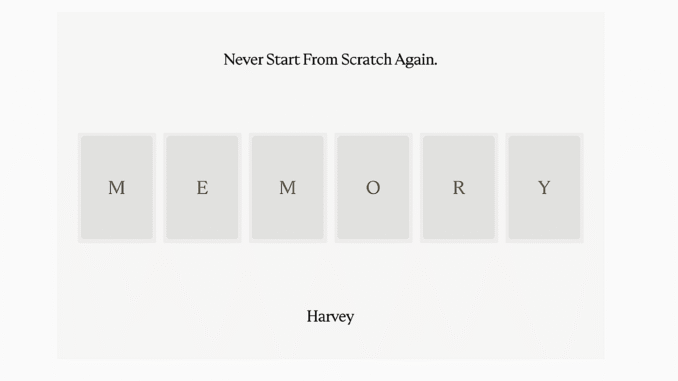
Pioneering legal AI platform Harvey has reached a new milestone by hitting $190m ARR since its launch three years ago, in what is possibly the fastest revenue growth trajectory in legal tech history, (see AL interview with CEO, Winston Weinberg below). It’s also building a new capability: ‘Memory’, which will help to personalise the use of Harvey.
The company told Artificial Lawyer that Memory will be ‘co-built with significant input from the industry’ and that it will ‘carry forward the context users choose, including matter details, relevant precedent, working preferences, and approved best practices, enabling more consistent, connected, and efficient work’.
Personalisation, and retention of previous styles and approach, is an area that was discussed by several figures in legal AI last year and it makes a lot of sense. Lawyers all have their own preferences, so do firms and inhouse teams as a whole. Having that ‘persona-level’ shaping of outputs is therefore very useful and avoids the scenario where every AI output seems a bit too generic, or totally new, even when tilted toward focused and well-developed legal contexts.
The company, which has also just opened in Ireland with an office in Dublin (see more below) and reached 1,000 clients in total, added that they are ‘taking a deliberate build in public approach over the coming months by hosting customer listening tours and working sessions with firm innovation leaders and corporate legal teams to understand what should be remembered, where it should apply, and how access should be managed’.
They also stressed that this personalisation can be turned on and off, as desired, and that as always any sensitive information will be protected.
Customers interested in participating in their listening tours and co-building sessions are encouraged to contact Harvey, they added.
And here’s a short video of how it will work.
This latest development follows the launch of their ‘multi-player’ system Shared Spaces, which allows for direct collaboration between law firms and clients via the Harvey platform.

Interview with Winston Weinberg, CEO, Harvey
First, congrats on the revenue growth – that must be one of the fastest growth trajectories in legal tech history. What does this mean to you personally?
Mostly, I’m proud of the Harvey team. Growth is incredibly exciting, but it’s also really hard, and I continue to be impressed by how much they care about our customers and the company as we grow. To me, revenue is a byproduct of customer impact, and I’m proud that our revenue growth includes some meaningful new deals and customers but also renewals and expansion with the likes of CMS and Hengeler Mueller and DLA Piper.
Re. Memory – personalisation makes a lot of sense, given how every lawyer is different, was this led by client demand?
Very much so – as you know well, security and governance are a primary concern for any legal team, so we’ve always been super mindful of ensuring that’s our top priority. But it’s been interesting to hear the perspective of lawyers change significantly over the last year, with increased demand to see more customization at the firm level and the individual level. In parallel, we hear a significant amount of requests for this from in-house teams.
To that end, our goal is to build a product that meets the personalization demands of lawyers while matching the governance concerns for firms, and that’s no easy feat. As a result, our plan is to build this with the industry, and we are scheduling working sessions with Innovation teams to help ensure we get this right. That starts with listening sessions with our current customer base and includes spending time listening to, learning from, and adapting our approach based on feedback from legal teams and industry experts alike.
How close to the ‘persona’ of a lawyer and their style will this be able to go?
The way I see it, there are four specific types of memory:
- Personal lawyer memory: continuous context across matters and interactions
- Matter-specific memory: historical data and decisions tied to individual engagements
- Institutional memory: firm-wide processes, terms, and precedents
- Client-institution memory: codifying the relationship knowledge in the platform.
I think to your question on personal lawyer memory, it can get really accurate, and equally as importantly, if I’m a firm it codifies ways of working in a manner that feels notably more modern than traditional training methodology, so to me there’s massive opportunity on both sides there. And finally, for clients and firms, many of these relationships are decades long in the making–to be able to institutionalize that memory using AI in a secure manner is a game changer for that dynamic.
How has the multi-player / collaboration launch gone so far?
Really well. The feedback from firms and their clients using it has been really positive. I think there’s collective relief that something that has been talked about for so long is actually happening, and now we just have to keep refining it with their feedback. I’m excited to share some of the case studies with these use cases in Shared Spaces in the coming months.
It’s also worth mentioning that these products are complementary: I think of a firm/client relationship as a form of memory, where the firm and lawyers learn the preferences of the client over a matter or period of time and it’s built into how they collaborate. Part of our commitment to co-build Memory with the industry is watching in real time how these organizations collaborate and what context is missing that could be helpful to each party as we scale both products.
And, congrats on Ireland – why open an office there?
A few reasons: we are lucky to have some great customers there with firms like A&L Goodbody, Beauchamps, and Maples Group, so we want to support our growing customer base there with local support. Also both our Chief Business Officer John Haddock, who came from Stripe, and our Chief Operating Officer, who came from HubSpot, have had great experiences building teams there, so the talent there was a big draw. Finally, this is a big year for us in EMEA more broadly and this is just one of the many indicators of our intentions to support the region in a meaningful way.
Thanks, Winston and congrats!
—
More about Harvey here.
Discover more from Artificial Lawyer
Subscribe to get the latest posts sent to your email.