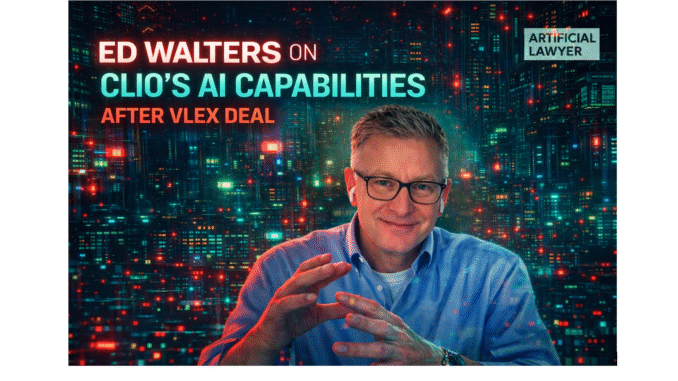
In this interview, Artificial Lawyer talks to Ed Walters, Vice President of Legal Innovation and Strategy at Clio. We discuss the integration of vLex into Clio after the acquisition, which completed in November, the launch of Clio Library, and explore the newly expanded business’s AI advancements.
We look at the comprehensive nature of Clio Library – see more information about this here; the deployment of Vincent’s AI capabilities; the development of transactional tools, and more. To watch the short video please press Play. There is also a full transcript below.
AI Transcript
Richard Tromans (00:01.962)
Hey everybody, Richard Tromans here again. With us is Ed Walters, a man who you know well, who is… Ed, what’s your new title?
Ed Walters (00:18.888)
Vice President of Legal Innovation and Strategy at Clio.
Richard Tromans (00:23.294)
Fantastic, which as you all know is the result of the acquisition by Clio of the vLex company that you know very well also. So we’re just going to talk briefly a bit today about some of the fruits of this combination of this integration between two companies. Let’s kick off with Clio library. So what is Clio library?
Ed Walters (00:45.899)
So Clio Library is the, I suppose the new name for the legal research service that was fast case many years ago in the US, VLex in Europe, that most people came to know as VLex. This legal research library now lives natively in Clio. You’ll see it as Clio Library. And this is the full legal research database in the US, but also in 110 countries around the world.
in Spain and the UK and Ireland, in France, Italy. It’s a quite comprehensive library across the world. It’s very strong in Europe and Latin America, in the US, and increasingly in Asia. So that now lives in Clio as Clio Library. And Richard, you and I have talked about this little bit in the past, but Clio has polled its users for many years to say,
you know, what’s the most important thing that we could add to Clio’s practice management suite to make it more compelling for you? And for years, the number one thing in that list, every year, year after year, has been legal research. We want to be able to do this kind of research into the precedents inside of Clio. Today, they get to do it in Clio library.
Richard Tromans (02:09.874)
Interesting, interesting. And we’re going to come on to the other skills in a moment, but just staying with legal research, what kind of cases are there? mean, people who don’t know haven’t used it yet. I mean, what kind of spread of the case? It’s all types of cases. It’s minor court, Supreme Court, everything. Or is it particular types of case?
Ed Walters (02:29.096)
Yeah, it’s, it’s look, it’s the most broad, deepest, most comprehensive law library in the history of the world, maybe in the history of the universe. I mean, it’s, there’s never been a single law library. That’s this comprehensive under one roof. and so it’s, you know,
Richard Tromans (02:38.686)
I mean, without mentioning names, but we know who we’re talking about, the other two large legal data providers who focus on legal research. mean, how would they approximately, without getting into too much detail, how would they approximately stack up against what you’re offering?
Ed Walters (03:04.798)
Well, look, for the traditional legal research players, you can have a comparable scope of primary law in the US. If you wanted to search the UK or something, you’d have to log out of one system and log into a different system. And I think they might have like, I don’t know, 13 different countries in one and like 12 in the other, the biggest countries in the world.
Well, what’s interesting is that, you know, I Fastcase and Villex started as small firm alternatives to, you know, the traditional research services. But as we grew in scope, they became very important to the world’s largest law firms because their clients aren’t like geographically bound to one country. You know, if you represent Salesforce,
Salesforce doesn’t have just US legal problems. If you represent Nestle, Nestle’s problems aren’t limited to France or the UK. And so the global law firms really found Vincent AI, but Villex also very popular because of the breadth of that scope. But it’s depth also, right? So if you are a lawyer in California,
You know, we have the full research database in Clio Library, judicial opinion, statutes, regulations, court rules, constitutions, law review articles, secondary materials. They go back to before the founding of America as a country in the UK. They go back to the 1500s, I think. So it’s quite an extensive database.
I think for people who are watching artificial lawyer, maybe especially in Europe and the US, it’s a very, very compelling offering, even stacked up against the traditional kind of duopoly for legal research.
Richard Tromans (05:13.61)
Gotcha, gotcha. And let’s just talk a bit about AI and AI skills. mean, Vincent is something that VLex had and was developing year on year. Has that changed what is now available through Vincent’s and Clio library?
Ed Walters (05:28.842)
Right, so Vincent AI was the AI platform that we built on top of that legal research library. And it wasn’t like one tool or a search box or something or a chat box. It is like 24 different workflow tools for litigation, yes, but also for transactional, for contract, and a bunch of different kinds of work. That now is also integrated into Clio.
And what’s cool about this is that it’s no longer just grounded in authoritative law, which already was a superpower. It is now also grounded in the context of the matter from Clio’s managed product. And so the combination of all of this very rich context from Clio, maybe the billing guidelines from the client, maybe the intake interview with the client.
maybe all of the documents that have been filed and all of the email in this matter, all of that becomes context for AI. And AI thrives on context, right? So even the best systems in the world, I think the best AI systems in the world that are grounded in actual law are kind of limited to the actual law. So now Clio Work becomes this intelligent legal work platform
that has context not just from the law, but also from the client, from the firm, from this individual matter, from all of the dockets that were from similar cases. Context becomes like an interesting new product. And context feeds AI in this way that makes Clio’s offering unique. I’m obviously very proud of it. But what I think is exciting about it
is that it’s a totally new category of software. And I don’t think anyone else in the world can offer this. I even the biggest kind of AI providers in the world who have the research libraries, sold their practice management companies. So they don’t even have that capacity anymore. And so I think that that context offers a really interesting opportunity for users to be able to create new types of work and to not…
Ed Walters (07:57.044)
constantly shift back and forth between their billing system and their file system and their research system and their AI system. Having all of that in one kind of consolidated, intelligent legal work platform, I think is gonna be super powerful.
Richard Tromans (08:13.874)
Yeah, it’s very, very interesting. Yeah, yeah, yeah, absolutely. I mean, there are many, many, many types of legal data, the operational data, legal data itself and so forth. Indeed, indeed. And then the interactions with the clients and so forth, having all of that available in one interface. I mean, is it all available in one interface or do you have to go off into different parts of the Clio world?
Ed Walters (08:35.7)
So it will be all available from one interface and that context sort of carries forward from one type of work to another. And this is what Jack Newton was talking about in his 2025 ClioCon keynote. It’s bringing together the business of law where Clio was the operating system for many, many law firms and the practice of law where I think Villex was really helping both small and very large law firms to
practice better, Vincent AI was giving all kinds of superpowers to law firms. When you bring those two things together, it’s an unparalleled offering and the kinds of things that you can do with it are amazing. It’s pleasantly surprising and I think you’ll see all through 2026, the Vincent AI team was already pretty quick. We were already rolling out things as fast as anybody in the world.
Now with the resources of Clio behind us, with the extraordinary development team that Clio already brings to bear, man, I can’t wait for it. There’s going to be so many interesting new superpowers that we unlock for lawyers and law firms and corporate legal departments because of this context.
Richard Tromans (09:50.09)
Interesting, interesting. Well, let’s just briefly look at the transactional stuff before we wrap up. So, know, VLX was just starting to build out a range of transactional tools away from its core traditional world of legal research. How does, you know, how does that evolve from here and how does that integrate with Clio?
Ed Walters (10:10.44)
Yeah, so I think the tools that we’ve been building in Vincent for transactional work are awesome. Things like diligence or contract analysis or redlining. I’m surprised at how much the grounding in actual law matters for that. But it matters quite a lot. So one of the things we discovered in this process was when you analyze a contract. I think the traditional AI tools
when you analyze contract would sort of say like, you know, this is unfavorable to a client or this clause is sort of non-standard. Because, you know, Vincent by Clio is grounded in the law, it’s also doing issue spotting. You know, so if you have like an asset purchase agreement for a company in the state of New York, they might say like, hey, you know,
while we’re analyzing this contract, yes, this provision is not super favorable, this isn’t really market, but it will also say, hey, look, there is a pension obligation that you’re not even thinking about. And New York law requires an asset purchase agreement like this, that you deal with the pension in a special way, and this contract doesn’t do that. And it will ground it in the law and offer, give you kind of a brief of what New York State requires.
Look, this is…
Richard Tromans (11:37.674)
So very interesting. So do you have to preempt that or so, you know, I’m reviewing some contracts and it just feeds that in automatically. It kind of goes, this is a New York contract by the look of it. You appeared not to have a pension’s clause and it just pops it up. How does that work?
Ed Walters (11:55.53)
Yeah, you’ll have to excuse me. I’m irrationally exuberant about this. I’m really excited about it. What is cool about it for me is that you don’t have to do a whole lot of prompting. You don’t have to say, look, this is a contract. It does this. Here’s the kinds of things I want you to look for. In Vincent, you can just upload the contract. And then it will say, look, I’ve read the contract. looks like an asset purchase agreement for assets in New York acquired by a company in London.
Ed Walters (12:24.818)
In circumstances like this, here are the kinds of things you might want to do. Pull out the definitions. Tell me who the dramatist personae are. Figure out which clauses are advantageous or disadvantageous to my client. But then it will automatically suggest, hey, look, by the way, I did some background research into the jurisdictional law that governs this asset purchase agreement.
And I’ve spotted some issues in the way that a good transactional lawyer might. A good transactional lawyer has a checklist in her head where she knows New York State has this frozen pension requirement and statutes. And when I look at an asset purchase agreement, I know from my experience that I should look for it. Vincent does it automatically.
Richard Tromans (13:14.45)
Interesting. you’ve blended the legal research side with the transactional side. Interesting. Well, look, Ed, I’m going to leave it there. There’ll be, as I just explained, there’s going to be a lot more coming this year. And Artificial Lawyer will be very excited to cover it. But thank you very much. And we look forward to hearing more about Clio in the future. Thanks, Ed.
Ed Walters (13:37.054)
Thanks Richard.
—
Discover more from Artificial Lawyer
Subscribe to get the latest posts sent to your email.