If you believe that the future of legal AI is all about turning lawyers’ day-to-day work into digital, AI-backed workflows then you’ll like this one.
The basic gist of it is as follows: LexisNexis has built a range of genAI-powered workflows, which you can use ‘as is’, adapt, or also build your own. For now, it’s still early days and they’ve launched this via a limited US Commercial Preview Program, with a wider roll-out scheduled for later in the year.
The workflows, which will operate via its Protégé assistant, ‘combine prompts, drafting, review, and citation checking into scalable, repeatable legal processes’. They also stressed that as they’ve got a dragon’s treasure trove of verified legal data, backed by Shepard’s citations, then you can trust the output of these AI-driven workflows.
(Note: they are not calling these things ‘agents’ and are instead sticking to more mundane terminology – which is interesting from a marketing perspective and also makes AL wonder if this is also because there is a bit of nervousness about agents in the legal market.)
All well and good. So, what’s on offer at present? Here’s some of their ready-mades:
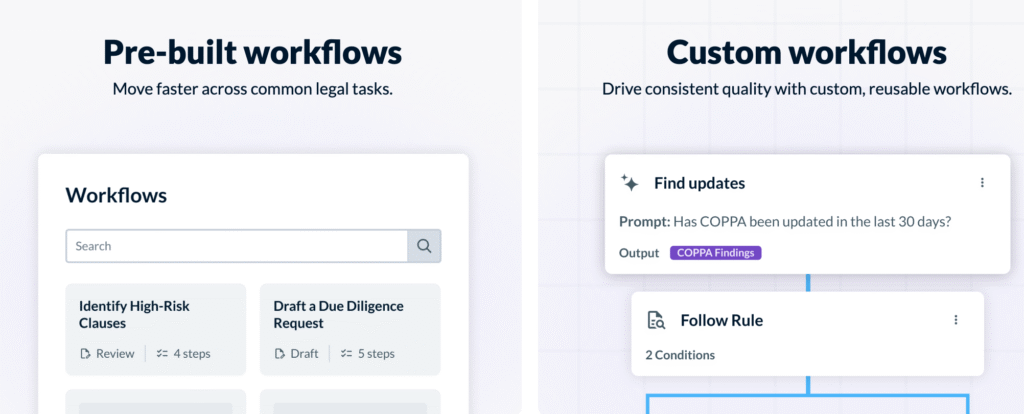
- ‘Litigation Workflows – Workflows designed to support disputes, motions practice, discovery, and case strategy. Examples include draft a motion to dismiss, draft full discovery and deposition documents, identify top cases by fact pattern or legal concept, extract facts, and compare similar arguments or laws across jurisdictions.
- Transactional Workflows – Workflows focused on contracts, deal execution, and risk assessment. Examples include draft a transactional document or clause, generate first- pass agreements from term sheets or templates, redline agreements against internal standards or playbooks, analyze key provisions and identify high-risk clauses, review contracts for diligence risks, and extract key obligations and liabilities.
- Broader Legal AI Workflows – Designed for daily legal tasks in a private, secure workspace, powered by the latest AI models from Anthropic and OpenAI and, in the U.S., integrated with LexisNexis primary law and Shepard’s Citations. Examples include draft a client alert, extract a timeline of key events, summarize an interview, and transcribe audio to text.’
And, if that doesn’t work for you and you fancy a more vibe-coding approach, then you can use their Custom Workflow Builder.
They explained that this is a ‘no-code builder’ where users ‘can choose their preferred AI model and design custom, multi-step workflows’. Workflows can be tested prior to publishing, saved to a personal Workflow Library, and shared across teams, turning organizational knowledge and legal best practices into repeatable systems.
(Note: naturally, companies such as Neota and BRYTER have been offering no-code workflow building for many years, but Neota has gone a bit quiet, and BRYTER ironically has gone very much into AI. Maybe ‘no-code’ is coming back…? Or has vibe-coding just superseded it? )
Now, you could say, ‘But, this is ultimately all about a prompt, right? Like we do already?’ Well, kind of, but not really. There is much more going on. As noted it’s multi-step, it also connects internally to verified data, and you can save and share these ‘programs’ as well. So, think complex task prompt, plus data, plus multi-step ‘no-code’ design, and portable.
Sean Fitzpatrick, CEO, LexisNexis North America, UK & Ireland, commented: ‘We’re focused on delivering easy, powerful workflow capabilities for legal customers wherever they work, and whether they prefer to start by using their own internal documents or trusted LexisNexis content. Customers have asked us for legal workflow solutions they can trust that naturally integrate with their existing processes, and we’re delivering that with Protégé workflows.’
Is this a big deal? As noted above, many companies would have been tempted to call these agents. But, they’re going with workflows – a more modest and down-to-earth take on things. They’re also not suggesting the whole thing is automated – instead it’s partly automated and with you very much in control of things, as you set the parameters and what data these ‘progams’ connect to.
What this does is give lawyers a more powerful way to get things done, while keeping them very much in the loop and in charge. Plus, although they’ve not used the term vibe-code, the ability to build your own things is very much in keeping with the current mood in the market.
Overall, a very useful development and given the interest in taking control over how AI works, then it’s likely to get solid interest.
More here.
—
Discover more from Artificial Lawyer
Subscribe to get the latest posts sent to your email.