The legal tech phrase of the month has got to be vibe-code. After Clifford Chance lawyer Jamie Tso blew the doors off – (see AL article here) – with his homebrew AI tools, here comes Vibecode.law.
The new Vibecode.law is the brainchild of three legal tech experts: Chris Bridges, Co-founder at Tilder / Tacit Legal; Matt Pollins, CPO of Lupl; and Alex Baker, a legal tech consultant.
So, what is it? ‘Vibecode.law is a new open platform for the legal community. We’re launching in the coming days and all projects will go live together,’ they explain.
Nice, but why? AL asked Bridges, a lawyer and an engineer, some questions about the new project.
Why do this?
‘Vibe-coding amongst lawyers has gone crazy on Linkedin, but the Linkedin algo being the Linkedin algo means you don’t always see them.
We wanted to create a space where those in the industry can showcase their projects in one place – whether that is just as a personal portfolio, to find help or what have you.
It really started as a fun weekend project after impromptu buying the domain!
But we’ve been blow away by the response and will be looking to make this as much of a ‘run by the community, for the community’ thing as possible.’
How big an impact will vibe-coding have?
‘We’re realistic about what vibe-coding can achieve. Projects built by non-developers through AI-assisted coding aren’t production-ready out of the box.
But that’s not the point. Vibe-coding is a catalyst for change: it lets domain experts (e.g. lawyers) demonstrate ideas rather than just describe them, validate concepts before investing in full development, and communicate precisely what they need through working prototypes.
The cost of experimentation has collapsed, and ideas that would have died in committee can now be tested in reality.’
Will DIY tools ever really supplant big platforms?
‘No, we don’t think so.
However, we do see a world where firms build safe sandboxes for ‘vibe-coded’ apps – whether that be for experimentation or building limited use apps that are low risk with low or no maintenance burden.
We do also see huge potential for vendors to use vibecoding – in one form or another – to collaborate with clients on product ideas.’
—
And here is a post on LinkedIn from Bridges about all of this.
–
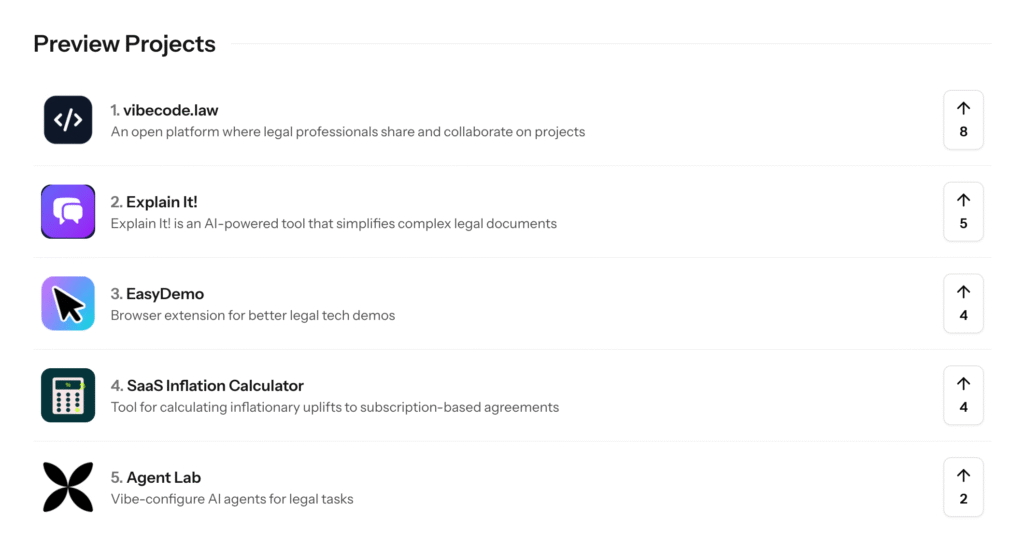
So, there you go. Some of the recent projects – see above – include an agent lab for legal tasks and interestingly a SaaS Inflation Calculator.
The big question is: will vibe-coded tools really be used at scale? The short answer is that we don’t know yet, as the current DIY wave has only just got going.
But, overall, AL feels that the vendors will not see that much impact, instead areas that are super-niche and they don’t cover, or are so commoditised and easy to build there’s little value there, will be cannibalised by vibe-coded apps. Broadly, the vendors will continue to develop new capabilities and large firms and inhouse teams will continue to rely on the continuity and security provided by established companies. But, vibe-coding will continue to gain interest, that’s for sure.
More here.
Discover more from Artificial Lawyer
Subscribe to get the latest posts sent to your email.