A new survey by LexisNexis has found that although AI is clearly helping lawyers to be more efficient and productive, some systemic issues remain: namely around developing judgment and verification skills as AI use chips away at these professional building blocks.
While junior lawyers are increasingly using AI for tasks such as legal research, first drafts, and document review – activities that have traditionally played a central role in early legal training – the profession is worried about whether new lawyers are developing the ability to use critical judgment, as well as how and when to verify AI outputs. (See below – not that older lawyers don’t also make mistakes with hallucinated outputs as well…)
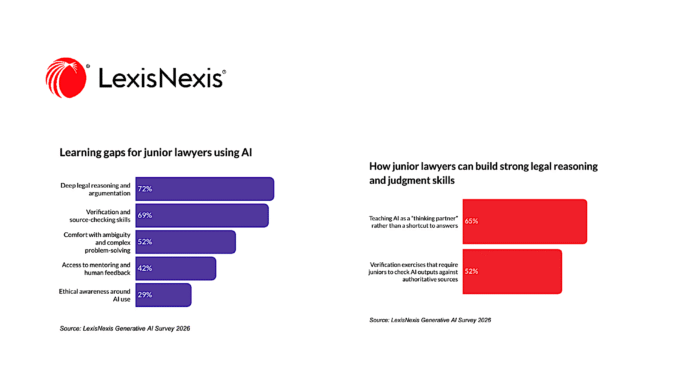
The survey found that the biggest skills gap among junior lawyers is deep legal reasoning and argumentation, cited by 72% of respondents.
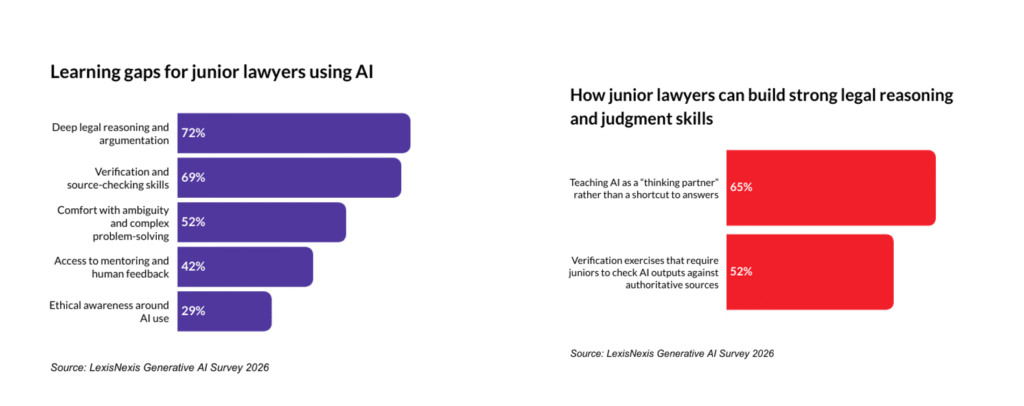
‘Verification and source-checking skills are also a concern, flagged by 69%, pointing to ongoing challenges around how judgment and critical thinking are built,’ LexisNexis said.
When asked what would help junior lawyers to build strong legal reasoning and judgment skills while using AI, nearly two-thirds (65%) of respondents selected positioning AI as a ‘thinking partner’, rather than a shortcut or replacement for legal expertise. But this is not always easy to do when the work is under time pressure, or high volume. Also, a ‘thinking partner’ could still erode a lawyer’s ability to evaluate legal issues for themselves.
An additional half (52%) said verification exercises that require juniors to check AI outputs against authoritative sources would help.
Plus, the survey found that you get what you reward when it comes to lawyer behaviour – with over half of law firm leaders focused most of all on revenue growth for the whole business, while over half of associates put the main emphasis on billable hours – but also client feedback. And it’s nice to see that client satisfaction is as high as billables for junior lawyers.
Dylan Brown, Editor of ‘The mentorship gap‘ report at LexisNexis, commented: ‘The data shows a clear productivity upside from AI, but it also highlights a tension around how legal judgment is developed. As routine tasks change, firms need to be deliberate about how junior lawyers build the confidence and critical thinking that have traditionally come from experience.’
—
Overall, what is this telling us?
Fundamentally what this shows is that the use and onboarding of AI is moving faster than law firms can adapt to shifting training requirements. AI use inevitably means needing to build up core legal skills at one’s early training stages in new ways, as the tech will do a lot of the work where before a young lawyer would have sharpened their legal mind.
It’s understandable and also points to a scenario seen across the wider economy: experienced professionals adopt AI relatively smoothly as they have all the skills they need for judgment already in place – although as seen, even experienced lawyers can still be lulled into making bad mistakes with hallucinated outputs. But, at least they have those judgment skills in place, even if they don’t always use them. Younger lawyers on the other hand will be ‘fast-tracked’ into handling work where they inevitably have skipped some of the more basic, but formative steps. So, they don’t even get a chance to develop such core skills in the first place.
In turn, law firms will have to figure out ways to handle this training gap. Luckily, there are a growing number of ways to do this: check out Besavvy, or Hotshot, for example.
See AL TV Product Walk Through below of Besavvy, which creates training simulators for lawyers. And also check out Hotshot, which also provides a range of training capabilities for young lawyers.
—
More about LexisNexis and the issues above explored here.
Discover more from Artificial Lawyer
Subscribe to get the latest posts sent to your email.