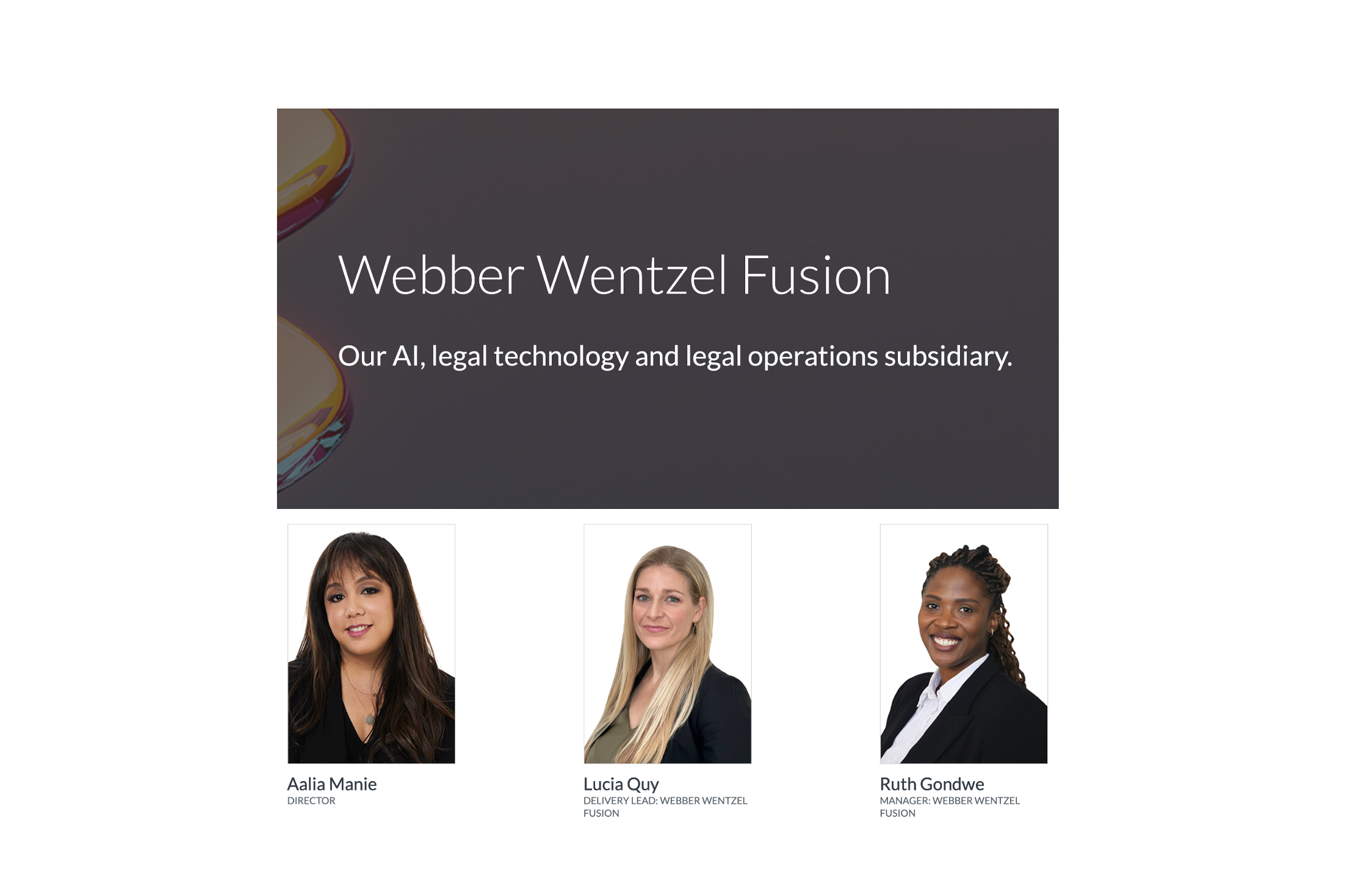
Linklaters’ ally Webber Wentzel (WW) has reshaped its Fusion technology and legal operations group into a standalone subsidiary, marking a new phase of expansion as AI tools are adopted by its clients across Africa.
South Africa-based WW said that the move came as inhouse lawyers across the ‘continent confront increasing regulatory complexity, cost pressure, and accelerating AI adoption challenges’.
In turn, Fusion – now as a separate entity – will ‘operate with a broader mandate and suite of solutions’. The Fusion group was initially launched in January 2024 within the main firm. It will now be a limited liability Private Company.
Fusion’s offerings include the development of custom digital playbooks, tailored AI workflows, and prompt libraries, ‘supported by comprehensive benchmarking, business cases, team training, change management and roll-out support’, the firm said.
The leading South Africa-based firm added that ‘its partners’ include the following tech providers: Legora, Luminance, Harvey, Clio, Definely and Wordsmith, and of course Microsoft. I.e. these are not just vendors they may use, but ones they recommend to their own clients and help them to leverage.
Interestingly, they added that ‘for selected vendor partners, Fusion has negotiated preferential commercial terms and pricing for the African market’.

Aalia Manie (pictured with colleagues), Partner and the Director of Fusion, commented: ‘Our AI solutions are built around how legal work actually gets done. By embedding legal expertise directly into AI delivery, we help organisations move beyond experimentation to AI solutions that are both governable and effective at scale.’
Safiyya Patel, Webber Wentzel managing partner, added: ‘Our offering is unique. We do not offer legal services or legal tech in isolation. By combining the product and operational mindset of a technology company with the authority and accountability of a leading law firm, we enable organisations to move faster and more innovatively without compromising trust or professional standards.’
And here’s a wider list of what they offer:
- ‘Advanced Delivery, Project Management and Flexible Resourcing – We leverage a blend of legal project management, flexible resourcing, technology, data, and process improvement to deliver advanced solutions that are smart, effective, adaptable, and digitally enabled.
- AI and Legal Technology Advisory – Webber Wentzel Fusions offers AI and legal technology consulting services to help in-house legal teams modernise their operations. We assist teams in enhancing their efficiency, consistency, and risk management through strategic use of technology.
- Contract Management, Review and Analysis – We offer a specialised suite of Contract Lifecycle Management (CLM) solutions designed to enhance your operational efficiency and manage your contracts with precision and foresight.
- eDiscovery and Data Analysis – We offer end-to-end eDiscovery and Data Analytics solutions to help our clients and legal teams manage digital information in a complex and evolving legal landscape.
- Intelligent Document Reviews – Webber Wentzel Fusion provides advanced document review services, combining legal expertise with AI and machine learning technology.
- Legal Operations and Process Improvement – The Webber Wentzel Fusion team specialises in crafting actionable plans targeting key areas of improvement to deliver clear organisational returns.
- Transaction Management, Due Diligence and Virtual Data Room Support – Webber Wentzel Fusion enables legal teams and clients to manage complex deals effectively. Our services include project management, collaboration tools, and technology platforms designed for the efficient coordination of transactions and AI-powered document reviews.’
Is this a big deal?
Other law firms have done similar things in the past. Reasons for doing so can include:
- Enabling the group to operate as a truly separate business unit with its own P&L accounts, i.e. it’s designed to generate significant revenue on its own, not just support the main firm.
- Allowing experts in the group to have a profit share, which may not have been possible if it were still part of the main firm.
- Separating risk and insurance aspects.
WW’s Manie told AL that for Fusion: ‘It’s about how we can operate, price and support clients, (the economics and structure of law firm partnerships vs tech startups), are different. It does somewhat help with risk, but we are led by the commercial realities of responding to clients with greater agility.’
The move comes as the question was raised last week: what are clients getting back from law firms when they leverage AI? In this case, the answer would be not just AI-supported work product, but a range of consulting and efficiency-driving offerings as well.
—
Legal Innovators Conference News
Legal Innovators California, the landmark West Coast legal tech event, will take place on June 10 and 11, in the heart of the Bay Area, the home to many of the world’s leading AI businesses – and plenty of legal tech pioneers as well! More information and tickets here.

Discover more from Artificial Lawyer
Subscribe to get the latest posts sent to your email.