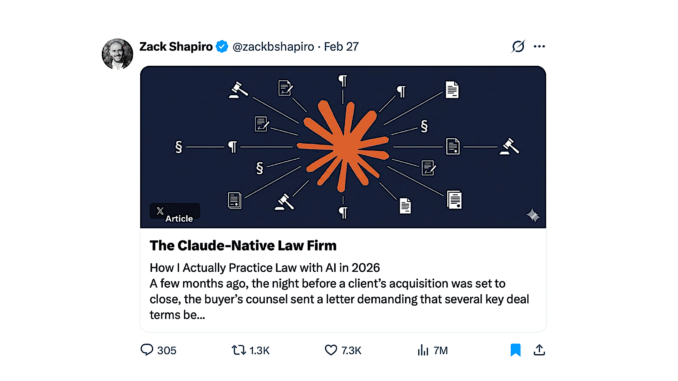
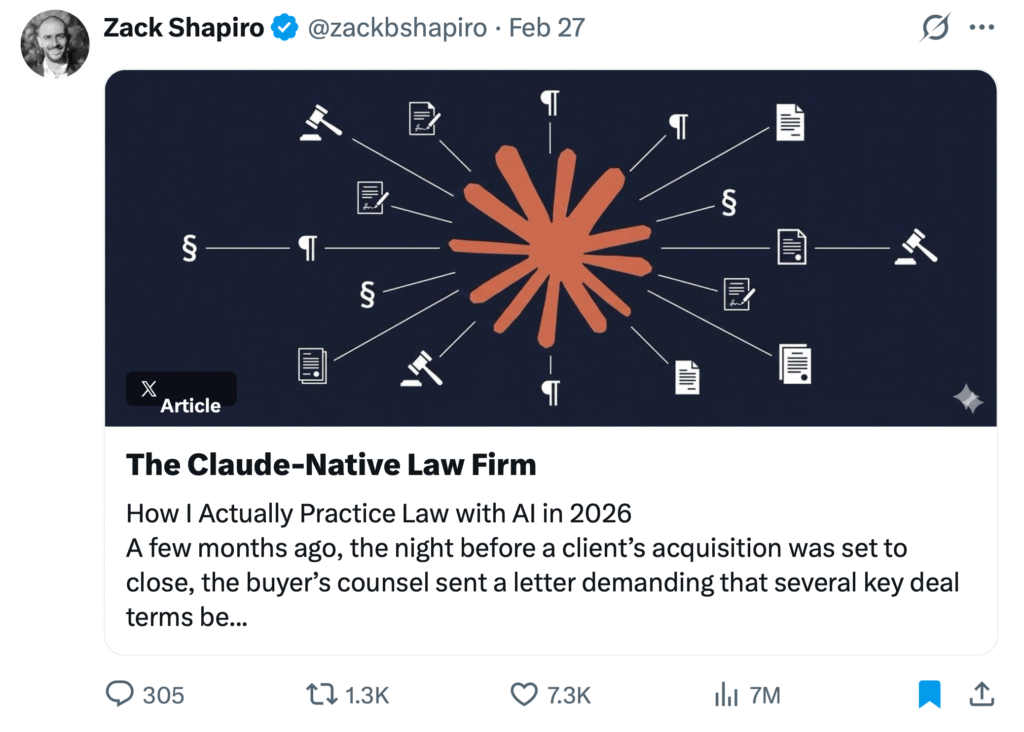
A few days ago, lawyer Zack Shapiro published an article on X titled: ‘The Claude-Native Law Firm’. It has been viewed over 7 million times and primarily covers the fact that at his small US firm he used the ‘Skills’ facility in Anthropic’s Claude. The reaction was incredible. What does this tell us?
First, here’s part of the article, which more broadly covers how he used Claude rather than a mainstream legal tech tool for some transactional work. There’s been some debate about how it was written and Shapiro’s use case, but that’s not really the key thing here. Read on:
‘I’ve created custom instruction files, called “skills,” that encode my analytical frameworks, my preferred formats, my voice, and my judgment about how specific types of legal work should be done. When I upload a contract for review, Claude doesn’t apply a generic framework. It doesn’t even apply my firm’s framework.
It applies my framework, the one I’ve developed over a decade of practice, automatically. The difference between a firm playbook and an individual lawyer’s encoded judgment is the difference between giving someone a recipe and teaching them how to cook.
Every lawyer reading this has lost hours to Word formatting. Paragraph numbering that breaks when you paste from another document. Styles that refuse to cooperate. Track changes that corrupt across versions. Cross-references that go stale. Bluebook citation formatting that requires manual attention on every single period and comma. These are not legal problems. They are software problems. And Claude solves software problems by writing software.
When I tell Claude to apply tracked changes to a contract, it doesn’t use a plugin or a macro. It opens the .docx file at the XML level and writes the exact markup that Microsoft Word expects, attributed to my name, preserving every formatting detail. When I tell it to standardize the citation format in a brief, it writes code to parse and reformat every citation in seconds. The result is indistinguishable from expert manual work, delivered in a fraction of the time.
This is the capability gap that no specialized legal AI product can match.’
–
What does this mean?
AL has got to say that unlike most of the commentators who either supported the insights as a sort of polemic vs legal tech, or instead tore into them as only a group of highly stimulated lawyers can…..this site saw something much simpler: that most lawyers still have not used Claude, or its Cowork features, or its Skills, or Plugins.
So, what are Skills? The short version is to think of them as small, but distinct workflows. And then after that, to think of the Plugins as a collection of these Skills – or at least that’s one way of looking at them (there are other analogies out there…). In turn both of these can connect to Cowork, which in turn connects to both the files in your computer, and can connect to other SaaS solutions – including legal tech ones.
As has been said online, think of it this way:
- Claude is the brain, i.e. the LLM that can do the thinking.
- Cowork’s ability to tap your work and files, and connect to other tools are the hands; and then,
- Skills are the recipes to make certain specific things happen, but are more than a one-off prompt.
- A Plugin is a cookbook, or a collection of recipes, but ones focused on a specific area.
What Shapiro explores is building out contract Skills to help with a transaction. As of 2026 this is not rocket science, it’s not even world-shattering. It’s what anyone can do now, if they want to.
Is that the end of legal tech…? As with the earlier frenzy about the legal plugin, the answer is a hard ‘no’. Why? Because the ability to customise some rules for how to handle a contract based on your past work is not the same as a broad platform packed to the rafters with carefully maintained tools and sub-tools, and agents and carefully built and maintained workflows, all with a great UI/UX designed to help you with a range of needs and that can safely live inside your law firm or legal team.
Instead, think of the above as a way to extend what you can do with legal tech, not as a replacement. Thomson Reuters and LexisNexis are seeing it this way. Harvey and LegalZoom now have connectors to Claude Cowork as well.
Conclusion
As noted, the incredible thing here is not that 7 million people – many perhaps lawyers – read the post, but that possibly 7 million people didn’t know you could do the above things with Claude.
Well, now they do.
But, as mentioned, this is not the end of legal tech. It’s just an extension of what you can do – and most legal tech companies are working out how to wield the above capabilities. The net result is a win-win for the legal sector.
Here’s the whole Shapiro article. And here’s more on Claude Skills.
—
A Legal Tech Conference For ALL of Europe
Legal Innovators Europe – Paris – June 24 and 25 – tickets now available.

If you would like to be a speaker, especially if you are at a law firm or inhouse legal team in Europe – from Alicante to Amsterdam and beyond…..then please contact Phoebe at Cosmonauts: phoebe@cosmonauts.biz
Note: if you are a legal tech company, please contact Robins: robins@cosmonauts.biz or Anjana anjana@cosmonauts.biz
—
Legal Innovators California, the landmark West Coast legal tech event, will take place on June 10 and 11, in the heart of the Bay Area, the home to many of the world’s leading AI businesses – and plenty of legal tech pioneers as well! More information and tickets here.

Discover more from Artificial Lawyer
Subscribe to get the latest posts sent to your email.