By Jake Jones, Co-founder, Flank.
A head of legal operations at a global manufacturer told us recently that her team of 500 lawyers processes over a thousand NDAs a year. The CLO had mandated they move to AI. She had evaluated three copilot platforms. Her lawyers liked all of them. And yet, when she looked at the numbers, the backlog had not changed. The turnaround time to the business had not improved. The outside counsel spend on overflow contracting was exactly where it was twelve months earlier.
We hear versions of this in almost every enterprise conversation we have. A hospitality group whose legal team spends the majority of its time on franchise agreement renewals. A consumer goods company where 60 to 80 emails arrive daily for triage, and a senior lawyer spends 45 minutes each morning just sorting them. A tech company processing 5,000 legal requests per month with a team that has not grown in two years. In each case, the same structural problem: inexpensive, rules-based, playbook-driven work is being done by expensive resources, and the tools they have been given do not change that equation.
The gap between adoption and impact
The industry data confirms what we are hearing in these rooms. The ACC/Everlaw survey shows corporate legal AI adoption doubling from 23% to 52% in a single year. Only 7% report a reduction in total matter cost.
That gap is not because the tools are bad. Copilot-style AI genuinely delivers speed gains for the individual lawyer using it. The problem is that a tool does not change who does the work. The lawyer still picks up the request, opens the tool, reviews the output, and sends the response. You have made an expensive resource slightly faster at inexpensive work. The department’s throughput, the number of requests it can handle concurrently, has not changed.
This matters because of where the real money sits. The technology budget for an enterprise legal department is typically £100K to £300K. The spend on getting routine work done, encompassing outside counsel fees, ALSP contracts, managed services, and the team’s own salary cost allocated to this work, is 10 to 50 times larger. For every pound spent on legal software, ten to fifty are spent on legal services. Tools solve a real problem, making individual lawyers more productive. But it is a different problem from the one consuming most of the department’s capacity and cost.
What is actually working
The conversations that go differently are the ones where the GC or head of legal ops stops thinking about tools and starts thinking about services.
One enterprise buyer we spoke to was days away from purchasing a copilot when they changed direction. The reason, in their words: “I don’t want to look at DPAs and NDAs anymore. I want it done. And I still want control.” They did not want a faster way to do the work. They wanted the work done, under their supervision, against their playbooks, without their lawyers needing to touch it.
This is the shift we are seeing across the market. Coherent Corp’s CLO described their experience with Eudia publicly: “Eudia is not a software provider. It is headcount I don’t have to hire.” At a recent legal ops event we hosted in London, a senior in-house lawyer from a FTSE 100 company described the concept as an “engine room”: agents handling the 80% of high-volume, low-complexity requests while lawyers focus on the complex work that falls out. The session was scheduled for twenty minutes. It ran close to two hours.
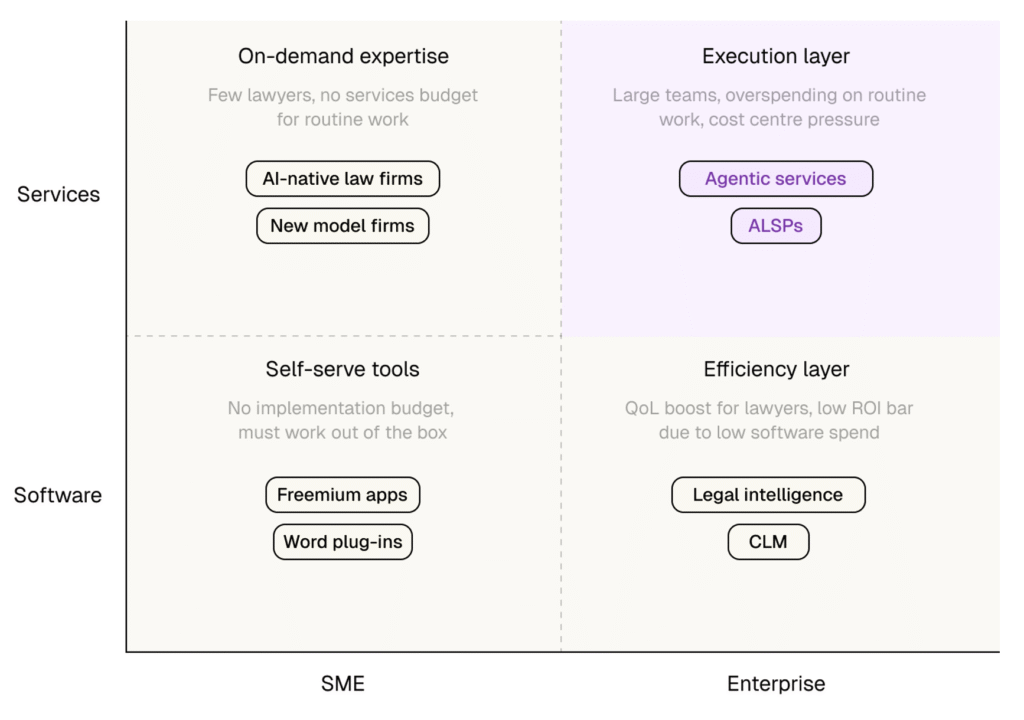
The software quadrants, both SME and enterprise, share a characteristic: the lawyer remains the operator. The services quadrants are where the work actually moves off the lawyer’s desk. The enterprise services quadrant, what I am calling agentic services, is the one I find most underexplored and most consequential.
What agentic services means in practice
An agentic service is not a tool that a lawyer uses. It is a service that gets the work done, with human supervision built into the delivery model as a structural component. The buyer purchases the outcome: contracts reviewed, intake triaged, NDAs turned around. The routine volume does not reach a lawyer’s desk. A lawyer supervises the exceptions.
For enterprise buyers, the critical question is who supervises. Some want their own lawyers reviewing output directly. Others want a law firm partner managing the service on their behalf. Others are comfortable with a vendor’s supervision team ensuring the work meets their standards, provided the playbooks and rules remain theirs. The flexibility to choose matters, because the enterprise buyer wants the economics of a service with the governance of an in-house operation.
The ALSPs have been providing a version of this for years, using cheaper humans. What has changed is that AI can now deliver the same service at a fraction of the cost, or absorb considerably more volume without proportional hiring. The ALSPs know this. Some are building agentic capabilities internally. Some are partnering with technology vendors. Some are being acquired.

What Flank is doing about it
We built Flank for this quadrant specifically. Not as a tool that makes lawyers faster, but as a service that gets routine legal work done for enterprise teams, under their supervision, against their playbooks.
The work arrives through the channels the business already uses, usually a shared Outlook inbox. Agents pick it up, process it against the client’s templates, preferred terms, and escalation rules, and route completed work to a supervision queue. Lawyers review exceptions. Everything else is handled, logged, and sent.
We offer three delivery models: the client’s own lawyers supervise, a partner firm such as Simmons & Simmons (with whom we have a strategic partnership, alongside a growing network of other firms) manages on their behalf, or Flank’s supervision team ensures the work meets their standards. The client chooses how much they run themselves.
If this is the conversation your legal department is having, or should be having, we would welcome the chance to show you what this looks like in practice.
–
Jake Jones is co-founder and CPO of Flank, an agentic AI service for enterprise in-house legal teams. Flank is backed by Insight Partners.
—
[ This is a sponsored thought leadership article by Flank for Artificial Lawyer. ]
Discover more from Artificial Lawyer
Subscribe to get the latest posts sent to your email.