By Antti Innanen.
I recently founded a ‘law firm’. It is not my first. But this time the office is in my Mac Mini and the workers are AI agents. The firm works while I sleep.
We are a mid-size firm, with a headcount of 66 experts: lawyers, engineers, designers. Or maybe 67, because I do the orchestrating.
Of course, it is not a real law firm. But it behaves like one.
I am not entirely sure what to do with it. Can you sell an agentic legal team? Or should I just let it work for everyone?
I am giving it around thirty days to find the right home. If it does not, I am releasing the whole thing for free.
‘It is like an associate’
Every legal tech tool is built on old metaphors: lawyers, law firms, associates and partners, prestige, hierarchy. Wooden panels and cigars. AI is like an associate. Like a caddie on a golf course. AI augments lawyers.
The centaur model, human lawyer plus AI, became the dominant frame because it asked nothing difficult of anyone. The lawyer stays in the loop. The billing model survives. The org chart survives.
But what if we started building from a different metaphor?
I started with a simple idea: a law firm. Not an AI-first law firm, but a law firm. That just happens to live in your computer.
Funny thing is that agentic systems and human law firms kind of behave the same way. When you evaluate agents, you can ask the same questions you would ask about a professional team.
Ok, not everything translates. And the law firm metaphor might also restrict our thinking. But my experience building real law firms turned out to be useful preparation for building an agentic one.
What happens in a law firm?
Work arrives. Someone has a problem they cannot solve alone. The firm takes it in, understands it, breaks it apart, and hands the pieces to the right people. Those people work, argue, check each other, and escalate when they are out of their depth. At the end, something coherent comes back out.
Intake → decomposition → specialist routing → internal debate → escalation → synthesis.
I found five things from real law firms that translated cleanly into design decisions.
Context first: Lavern has a partner agent that interviews you before any assignment begins. The team: good legal work involves non-lawyers too, and with agents that is easy to arrange. Internal debate: agents argue their findings and an orchestrator synthesises the result. Checking loops: four eyes on everything, built in. And the ability to scale up: if better results are available, cost is secondary.
Not all of my design decisions were optimal. Agents can talk past each other. Checking loops catch mistakes but sometimes introduce new ones. Adding more agents does not automatically produce better output.
And like in a real law firm, the problems are mostly in communication.
But some things work surprisingly well. Law and agents are both context games. Talking to a ‘partner’ before starting is a genuinely good way to reduce ambiguity. The output is endlessly modifiable. You can get different versions of the same document, shaped to your own templates.
The agentic ‘law firm’ works.
How does an agentic law firm work?
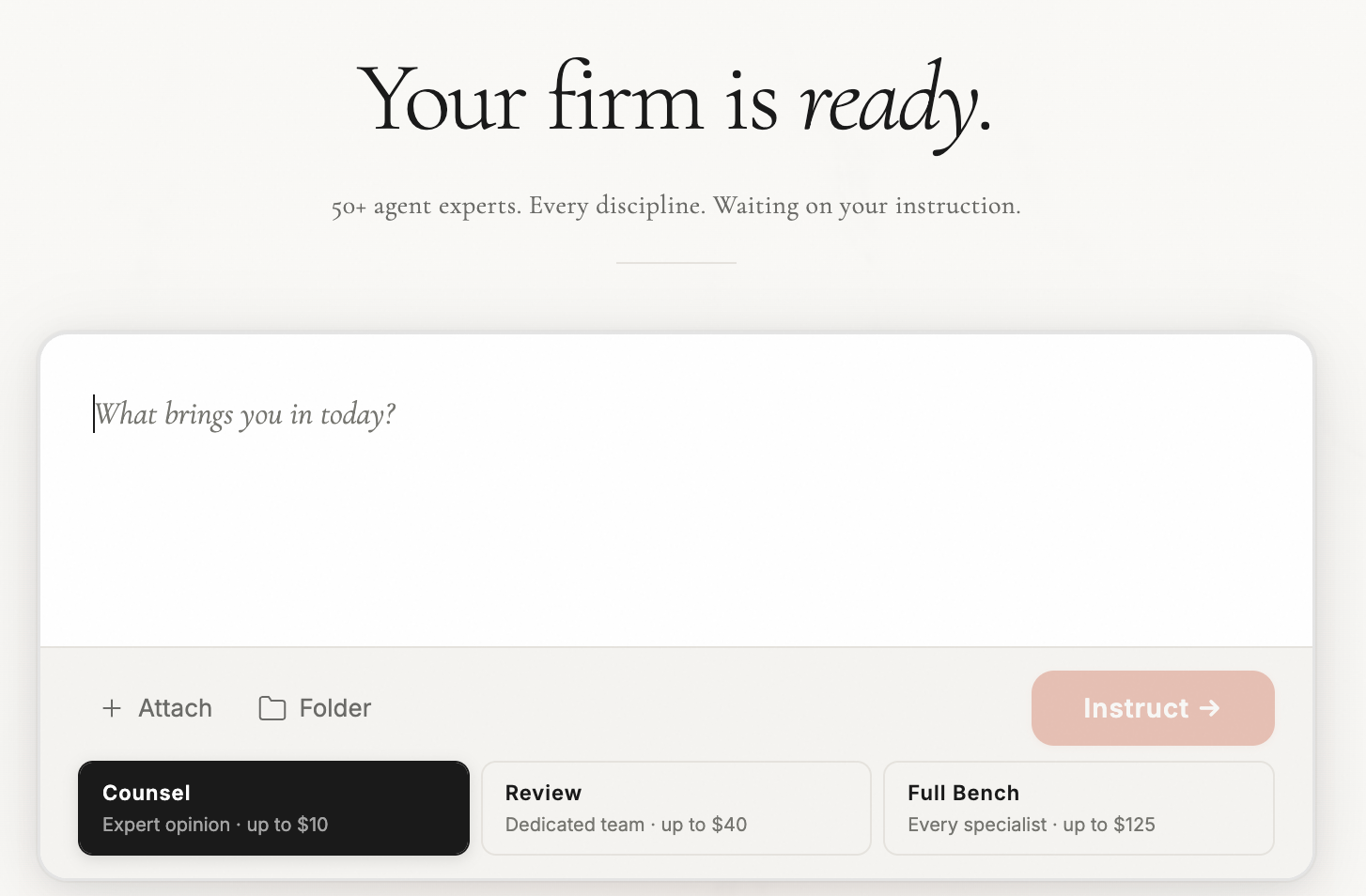
Lavern operates in two modes. The first is straightforward: a capable legal tech tool, much like any other. But the work is done by a team of agents, debating and checking each other.
The second is more ambitious. An independent mode. Like operating on retainer.
Legal tech has always struggled with privacy and cost. Every time you run something through Claude, GPT, or Gemini, you are sending client data to a US tech company. And using frontier models at scale adds up fast.
Lavern addresses both. Local model, local machine, nothing leaves it. Processing costs are negligible. It runs continuously, reviewing whatever has arrived every thirty minutes. Not all legal work needs a frontier model. Classification, tracking, housekeeping: local is more than sufficient. There is also an EU mode that escalates to Mistral when needed.
The independent mode is called Clawern. You get the idea.
–
And here is a short video of what it does:
–
Lil B Strategy
There is a new kind of strategy forming in the AI world. Call it the Steinberger strategy. Or the Lil B strategy.
Peter Steinberger built Clawde, watched it go viral, renamed it a few times, got hired by OpenAI, handed it to a foundation, and moved on. Three months, start to finish. He did not sit on it. He released it and let the world figure out what it was.
This mirrors what happened to music. When production costs collapsed, the old strategy of sitting on material and perfecting it stopped making sense. Lil B understood this before almost anyone: just release, build in public, let the audience decide. The same logic now applies to software. A program that would have taken a team months can be built in a weekend, but it also becomes obsolete in months. The window closes faster than you can polish.
I have a hunch this is really good. At least it is very ambitious. And if I sit on it, it will go stale.
That is why I am giving this until May 2026. If the right conversation happens, great. If not, the whole thing goes open source. Good work tends to find its audience.
I want to build this with someone. My team and I are ready to talk about everything.
The product is at lavern.ai. The architecture is at lavern.ai/claw/how-it-works. The demo runs without an API key.
If this is interesting to you: Knock Knock.
—
More here about Lavern.
—
This is an educational guest article by Antti Innanen. Lavern is a legal tech tool, not an actual law firm, and does not provide legal advice or employ lawyers. It is on closed demo.
Discover more from Artificial Lawyer
Subscribe to get the latest posts sent to your email.