
Anthropic has launched Claude Managed Agents, which provides ‘everything you need to build and deploy agents at scale’. Put simply, that means you can build a complex agent way more quickly than before – but, via Claude. Will this impact legal tech?
The move follows the development of its Skills capabilities and the recent Plug-ins, which sent the software world into a spin.
In a nutshell what Anthropic is doing here is providing a ‘fully managed agent harness’, i.e. all the bits and bobs, all the infrastructure needed, to set up and develop an agentic tool that can run on its own. But, it’s happening within the Claude universe. I.e. you go there and you can stay there, even if the agent is linking out to other tools and data outside of Claude.
So, it’s not just a question of a legal tech company tapping Claude LLMs’ reasoning capabilities and trying to build agents in their environment, which eventually become new features in their legal tech product. It’s a move by Anthropic to say: ‘Hey, you don’t need to use all of these other specialist software companies to build agents for your domain-specific needs, just use us, we have all the tools and infrastructure necessary – and of course the essential LLM parts – that go into building agents.’
Or, if you want to use the lingo, they’re selling ‘the whole managed runtime for enterprise agents’.
And if you’re wondering what ‘runtime’ means in this context: ‘An AI agent runtime is the execution layer that hosts and runs AI agents in production. It provides the process environment, state management, tool access, and lifecycle management that agents depend on to function autonomously.’ [ Agenuity.com ]
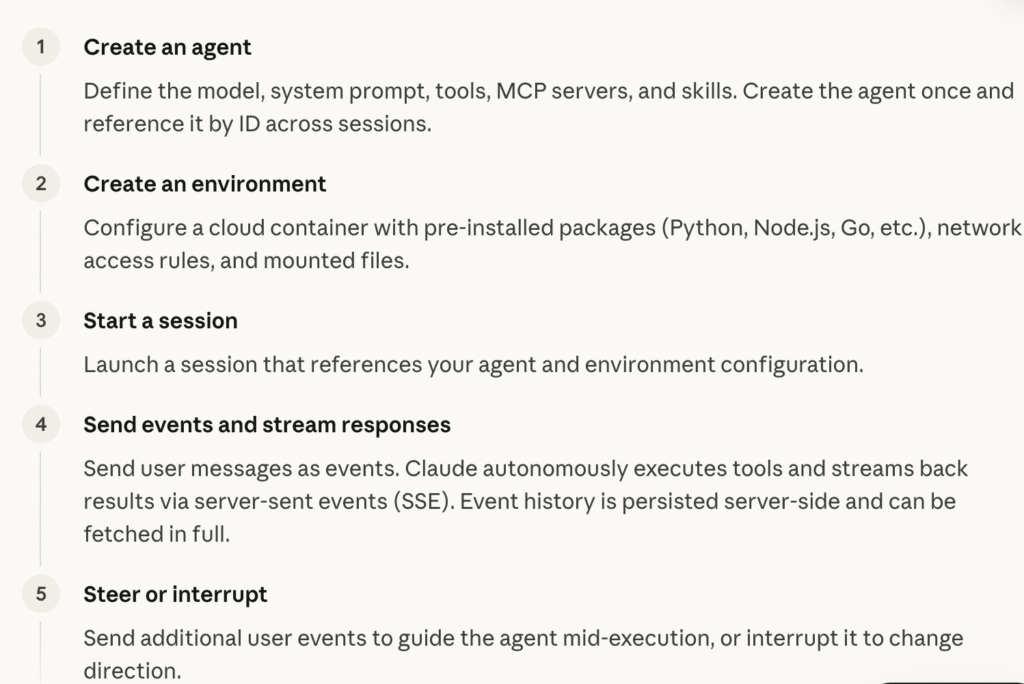
And this is how Anthropic sees the Beta release working:
And here’s a video of how it works.
Will This Impact Legal Tech?
Social media is already filling up with memes about the end of startups that have been offering to help you make agents. But, does this impact legal tech?
As with other ‘general LLM’ inroads into the enterprise world, including legal tech, the arguments tend to break into several key groups.
First, this is manna from Heaven for vibe coders, who have no loyalty to legal tech platforms and want to build their own tools. In this case, developing effective agents that can operate long-term and do plenty of connected tasks, just became a lot easier.
Of course, anyone doing a DIY agent still needs the right data, and will need to understand in great detail what all the legal workflows are that they are trying to build for, and also know what ‘good looks like’ – as agentic outputs are no more guaranteed to be accurate than jumping into an LLM chatbot and just asking a question will be. They can be refined, but it’s not a given that any agent you build from scratch, even with a very useful environment, will work exactly as planned. So, no magic bullets here for vibe coders, but in sophisticated hands this could really speed things up for DIY developers.
For the legal tech companies, the knee-jerk response might be to say: ‘Oh no! People will just build their own agentic stuff now.’ But, in reality law firms and inhouse teams buy trusted brands, they want vendors to manage the products, and to give data guarantees. So, that won’t change.
Plus, as noted above, you still need the data, and all the skills around whatever you’re building. So, ironically, having a faster way to develop agents may actually help legal tech companies, rather than create competition for them. How the legal AI platforms and the new Claude agent environment now mesh together is not known, but one would guess they’ll figure it out. (Please send answers on a postcard to AL HQ.)
Conclusion
Overall, this is Anthropic trying to do what it has been doing for a while now: supporting the enterprise world and the specific verticals within it, while also making it easier for DIY developers to do their own thing. This twin-strategy seems to be fundamentally in conflict, e.g. wanting legal tech companies to use Claude, but also creating a legal Plug-in that seems to undermine them. But, for now, legal tech is simply getting stronger as a result of the improving AI technology on offer, despite a small, but energetic group of legal vibe-coders. So, if the current pattern continues this is likely to be a win-win for legal tech, despite any initial tremors.
One thing we can be sure of: as such tools become easier and easier to create, there will be more and more agents operating around the world, and that will include within the legal sector.
—
Here’s A Legal Tech Conference For All of Europe
Legal Innovators Europe – Paris – June 24 and 25.

Note: the conferences are organised by Cosmonauts – please contact them with any queries.
If you would like to be a speaker at Legal Innovators Europe, especially if you are at a law firm or inhouse legal team in Europe – whether based in France, Belgium, Spain or Germany, or beyond…..then please contact Phoebe at Cosmonauts: phoebe@cosmonauts.biz
Note: if you are a legal tech company, please contact Robins: robins@cosmonauts.biz or Anjana anjana@cosmonauts.biz
–
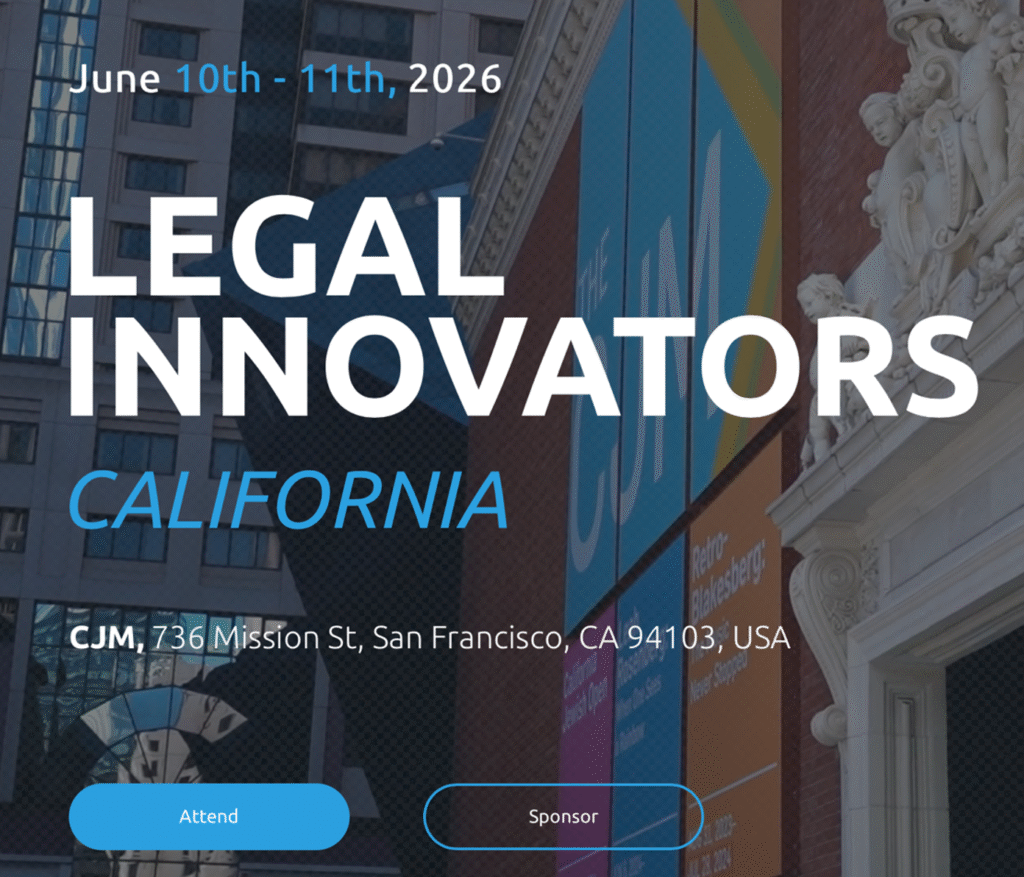
And if you’re in the US and looking for the next major event to join after Legal Week, then see you in California this June!
Legal Innovators California, the landmark West Coast legal tech event, will take place on June 10 and 11, in the heart of the Bay Area, the home to many of the world’s leading AI businesses – and plenty of legal tech pioneers as well! More information and tickets here.
Discover more from Artificial Lawyer
Subscribe to get the latest posts sent to your email.