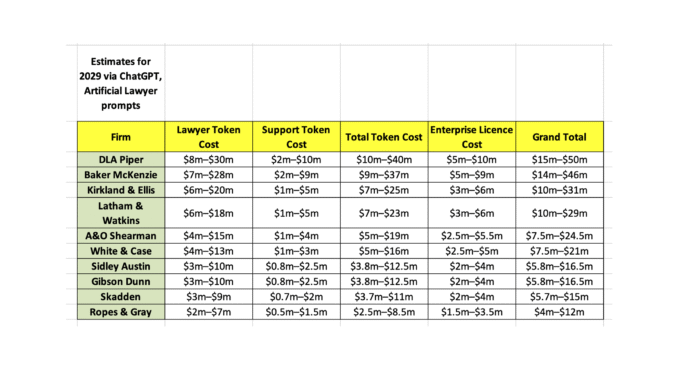
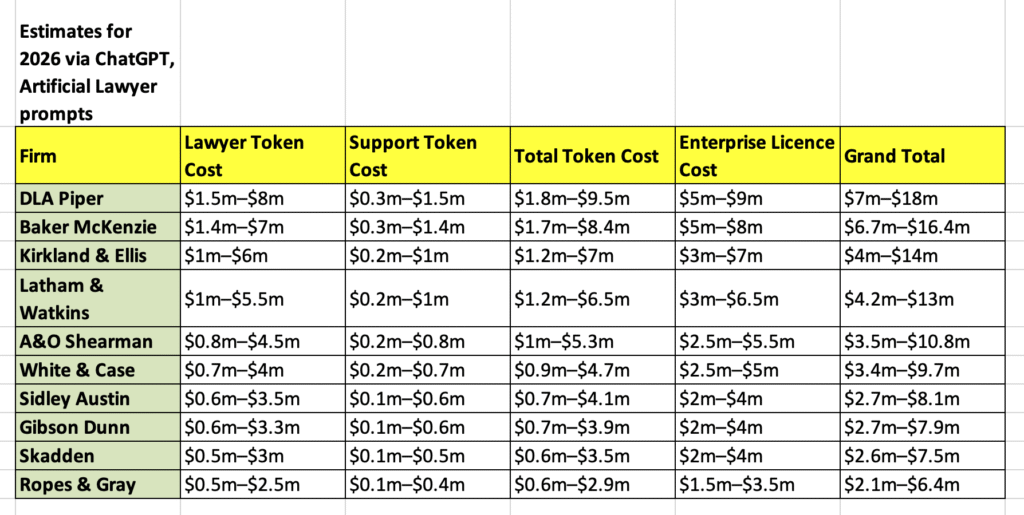
First, this is a thought experiment, so take a deep breath and a large pinch of salt….Artificial Lawyer asked ChatGPT to estimate the total token costs, plus enterprise licence fees, for 10 of the largest law firms, for today, and in three years when usage has increased. The data is based on the idea that law firms use the frontier models as their primary AI productivity providers, and are not using most legal tech tools except where needed, e.g. for legal data, a DMS, and billing software.
(AL also rejected the first estimates because they seemed too high and asked the LLM to be more realistic and conservative, taking into consideration that many lawyers even in top commercial firms are still not using AI that much. AL also asked Claude to do parallel calculations, but ironically this site had hit its limit with that LLM !)
Now, these are estimates, and they are estimates with wide ranges. The reason for the wide ranges is that law firm use of AI tools is extremely non-uniform. A 3,000-lawyer firm may see only half of those attorneys using AI daily in an intentional way, e.g. to do a productivity task such as redline a contract, and of that group perhaps only a quarter or fewer are ‘power users’. Plus, support staff use of AI will also not be uniform or necessarily as great as the lawyers.
The estimates also have to sit alongside the spending on all the other things in a law firm’s tech stack that they cannot lose, even with the most advanced LLMs, e.g. MS Word in all its glory and the related tools in the 365 suite, a DMS, the many (and not cheap) legal research providers, plus billing and other operational software, and much more.
And then we come to the key point: it’s not – in this imagined scenario of going ‘all in’ with primarily general LLM makers – that the costs are so massive for the largest multi-billion dollar revenue law firms, it’s that when you add these numbers to their current legal tech budgets, then those budgets balloon outwards. That’s the takeaway here.
Can a $5 billion revenue law firm afford millions of dollars in combined token and enterprise AI costs? Yes, it can.
On its own that cost is swallowed up easily. In fact, one could argue that as law firms keep putting up their own prices then it would be snuffed out without noticing. But… law firm tech costs are not just AI, all the rest of it totals to a large amount. AI costs then swell those total numbers.
In short: can massive law firms afford to go large with AI spending? Absolutely they can. But, that also means expanding their tech budgets beyond where they are today to accommodate this, and that is something they may not yet have planned for in detail.
The next key point before we look at the estimated data, is that at present – and as noted – lawyers’ use of AI tools is still very limited. Readers of AL may be power-users, but of the millions of lawyers on this planet, (about 12 million), how many are really at your level of usage?
AL would estimate that of these 12 million, fewer than several thousand are true legal AI power-users. And that’s a tiny percentage. (Although, long term, that’s good news for Harvey and Legora, who clearly have a massive TAM to grow into still.)
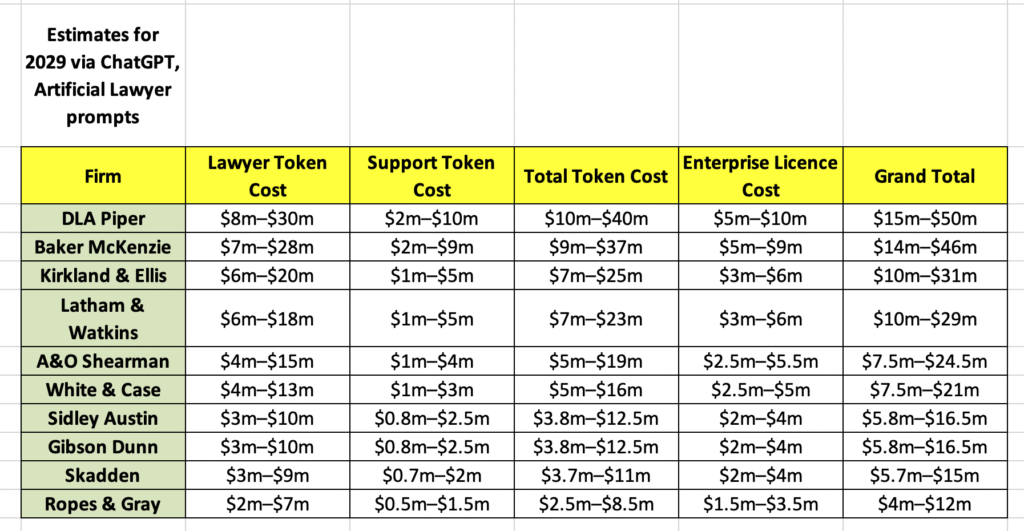
AL also did an estimate for 2029, when far more of a firm’s lawyers will be ‘power users’, the cost of frontier models will be even higher, and the total quantity of tokens used in this far more data-heavy and agentic workflow environment has upped the ante even more. As you can see below, the costs have grown a lot – at least via the estimates.
I.e. whatever law firms spend on AI today, is really just the beginning of their cost profile for this technology. As an analogy, imagine a learner driver using just a little bit of fuel as they drive around local streets; and then some years later they become a confident motorist who likes to drive across the country, zooming down the fast lane for 100s of miles. Right now, most law firms are learner drivers. But that will change. In fact, it’s inevitable it will change, just as it will for their clients, and the wider economy as a whole.
OK, with all of that in mind, let’s look at the tables. First today, and then in three years in a more mature – and expensive – AI environment. And as a reminder, take these numbers with a large dose of salt. They represent an imaginary scenario. But, they help to illustrate the direction of travel in terms of cost growth.
Conclusion
As mentioned, this is a hypothetical scenario, few firms will go all in with just the general LLMs as modelled here, even if they are providing legal plugins and other tools.
Yet, the legal tech providers are also tapping those models – or at least mostly are. So, the cost profiles above are in some ways the estimated costs to the sector as a whole. I.e. someone, somewhere always pays the token bill.
Or to paraphrase Isaac Newton: tokens cannot be destroyed, only who pays for them changes.
And so, eventually, the legal AI companies will have to start billing law firms and inhouse teams on a more direct and visible token basis, above and beyond any other fees for their platform and tools and support. This would be more like buying an iPhone from a telecoms company and also paying that same company for the data usage, and perhaps a special insurance and service package as well.
One irony of this is that if a large firm spent $1m on a firm-wide deal today with a major legal tech AI platform, they may think that is expensive, but in reality this may be a good deal. If they went all-in with Claude alone, for example, and used only its top models across the firm and for plenty of token-heavy work, the costs could be higher.
The legal tech provider meanwhile is having to swallow those rising token costs, because of the more expensive models, and higher usage rates, especially as more reasoning and agentic workflows arrive. I.e. a platform that offers you a package deal today may be making a good profit on it, if you don’t use it much; but when you become a firm filled with power-users in a few more years, then the equation goes the other way.
The legal tech companies can at least ‘route’ your needs to the best model, across a wide range of LLMs, making sure you get a good response, but that doesn’t always cost the most. If you are all-in with Claude or OpenAI, then you are mostly stuck with one provider, unless you then also create your own routing system, but then that becomes expensive and complex for law firms with lots of power-users.
And the final point: while the above is a thought experiment, it suggests that ‘tokenomics’ will become a key part of legal AI’s future. CFOs of law firms and CTOs will want to look into this. So too GCs and legal ops heads. Legal tech CEOs will also need to address this emerging picture – and some already are.
For now, the saving grace of legal AI is that – again ironically – most lawyers are still not using it either deeply or that effectively. So, today, the costs are relatively low on the token count side of things. But, as the world moves forward and usage grows and becomes more meaningful, plus more agentic, so too will the overall costs rise. That seems unavoidable.
In short, most firms don’t need to panic on this, but they do need to think about projected costs in the near to medium term, and plan ahead.
Richard Tromans, Founder, Artificial Lawyer
—
Legal Innovators California Conference is Next Week – June 10 and 11 in San Francsico.
For the first time at the California conference, we are providing complimentary tickets, which includes all sessions, breaks, lunch, and the evening networking drinks reception in the heart of the Bay Area, which in turn is the bustling centre of the global AI industry – and which is now changing the legal tech world itself.
Legal Innovators California is also the largest and most pioneering legal tech event on the West Coast of the USA – but we only hold it once per year, each June. So, if you’d like to join us next week, then get your skates on and claim your ticket! There’s so much happening now in legal tech and AI, this is an incredible opportunity to be right at the center of the action, with those who are shaping the future of our industry!

Discover more from Artificial Lawyer
Subscribe to get the latest posts sent to your email.