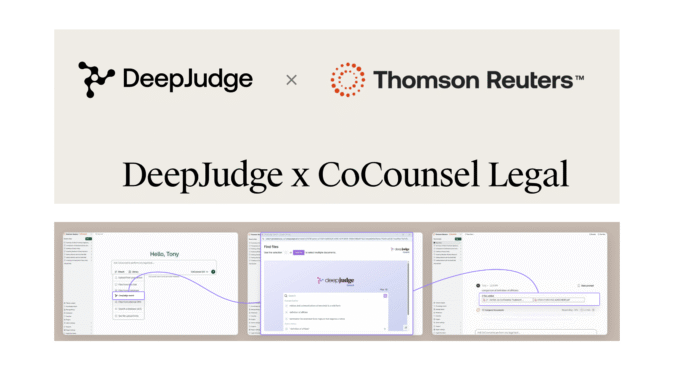
Thomson Reuters is today announcing the general availability of their DeepJudge-CoCounsel integration. To mark the occasion, Artificial Lawyer spoke to DeepJudge co-founder Paulina Grnarova at the Swiss KM pioneer. In this in-depth interview we explore what the relationship means for customers; subjects such as accuracy and token costs; and much more.
—
DeepJudge and TR previously announced the partnership in October. What’s new with respect to where the partnership stands today?
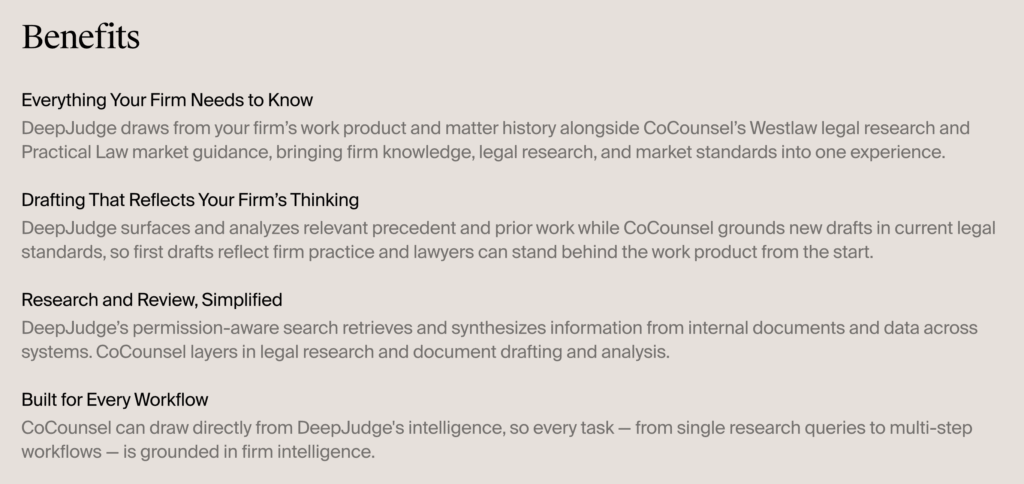
The integration is now generally available, which means our customers can find and use their institutional intelligence directly within their CoCounsel experience. Lawyers can now get the complete picture for their matters, with firm-specific work product and precedent, Westlaw legal research, and Practical Law market standards, together in one experience for the first time. That’s the 360° view we’ve been working toward.

On a technical point, how do Practical Law and Westlaw combine with DeepJudge’s ability to search a law firm’s DMS? How ’seamless’ is this?
We’re bringing a firm’s institutional knowledge from DeepJudge into the same experience as Westlaw and Practical Law, while keeping that knowledge securely governed in the systems where it already resides. There is no need to migrate content or create a separate knowledge store, and existing permissions and ethical walls remain intact. Lawyers shouldn’t have to think about where knowledge lives. With this integration, they can access the right context — from prior firm work, authoritative legal research, and market standards — in a single experience.
How does DeepJudge ensure accuracy?
A big part of accuracy is finding and using the right information for any given question and fact pattern a legal team is working with. DeepJudge is designed to do exactly that — at scale and while respecting all access rights permissions.
The platform deeply understands the full picture of a law firm’s internal knowledge by indexing all data sources across the firm. We also focus on navigating the internal world that contains multiple versions, duplicates, unstructured data, outdated information, and more. Accuracy and ranking are the art of a search engine and we’re proud that DeepJudge has named the top recommended legal AI vendor for two years running in the SKILLS.law survey.

What do you think about token costs and model usage? How does this play into what DeepJudge offers and how it works with TR?
Token costs matter because context matters. Most firms have enormous amounts of relevant context that never makes it into an AI model’s window because it’s fragmented across systems. MCP and connectors can provide access to those systems, but without a purpose-built context layer, the model is still assembling fragments on its own at inference time. That means more tool calls, more reasoning loops, higher token consumption, and ultimately, weaker results.
DeepJudge solves that problem by surfacing and synthesizing the most relevant firm knowledge across systems, before the model is even involved. Firm knowledge is already unified, normalized, and permission-aware, so what goes into the model is precise and purposeful. DeepJudge also provides its own agentic layer, so firms can run multi-step tasks directly on top of their institutional knowledge, from matter research to business development, client intelligence, and strategic analysis.
Legal repositories are uniquely messy, involving redlines, executed versions, duplicates, matter-centric organization, and strict ethical walls. That context cannot be reconstructed reliably at inference time. It has to be understood ahead of time, across the full enterprise.
Better models make this even more important. The firms that get this right will get more value from every interaction.
And how does this connect to Harvey, with which you also have a deal?
With AI constantly expanding in legal work, every firm is now thinking about how to stay competitive and how to differentiate. AI models are now virtually ubiquitous, so it is very clear that their institutional knowledge is their competitive advantage. Those that leverage that knowledge and judgment will not only maximize the ROI of AI within their organizations, but will also build their AI strategy on top of the right foundation.
DeepJudge has solved the institutional intelligence problem that is so critical. It is the platform that scales the judgment of a firm, so each lawyer is equipped with the knowledge of everyone else internally! And that judgment is needed to make any workflows or agents downstream reflect how the firm practices. We build with our customers and partner wherever institutional knowledge needs to be found, applied, and put to work.
–
Thank you Paulina and congrats!
–
More about DeepJudge here.
—
Discover more from Artificial Lawyer
Subscribe to get the latest posts sent to your email.