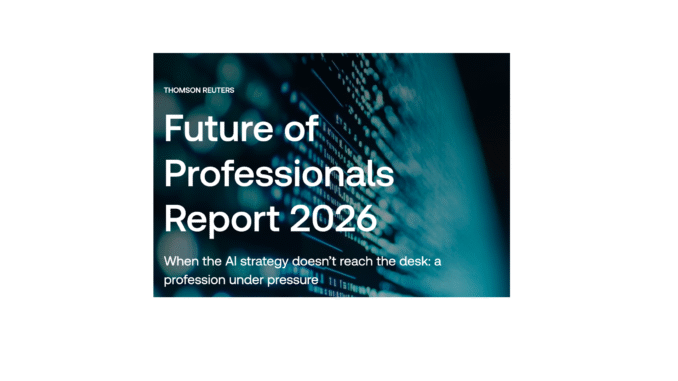
A new survey by Thomson Reuters on the adoption of AI among professionals suggests that the current state of play is often slow and chaotic. One third of lawyers, accountants and compliance professionals sampled are using unapproved ‘shadow’ AI; meanwhile a quarter want to leave their jobs in the next two years because their firm isn’t providing AI tools.
And it gets worse. Of those using shadow AI, i.e. tools that are not officially part of your tech stack and thus don’t have proper security and data barriers in place, the number rises to 41% ‘among those who say their organization is moving too slowly on AI’.
Despite the slowness of adoption, which is triggering risky AI use and thoughts of departure, the survey also found that ‘almost half of senior leaders believe meaningful talent pressure is still at least three years away’.
AL would say that in three more years of doing very little you will be so far behind the AI curve you risk harming your business in ways that management may not be able to come back from – not just losing some talent.
There were also some TR calculations as to the financial impact of all this, but let’s stick with the more objective facts, namely: AI adoption is both sometimes slow and chaotic across parts of the professional economy as a whole, creating dangerous behaviours and disgruntled staff – while the C-suite seems to underestimate the growing problem. Naturally, Big Law firms and the Fortune 500 are (often…but not always) more likely to be on the ball here.
Steve Hasker, President and CEO of Thomson Reuters, commented by way of providing a solution to the problem: ‘Not all AI is created equal. In professions where there is real liability, the standard has to be much higher. When outputs shape legal judgments, regulatory filings, or client advice, ‘almost right’ isn’t good enough. That’s why we build what we call Fiduciary-Grade AI, technology professionals can verify, trust, and ultimately stand behind.’
(Conference advert)
Come and join us in New York and London this November at Legal Innovators!
Legal Innovators New York – Nov 17 and 18.

Legal Innovators UK – London, Nov 4 and 5
—
What does this all mean?
Well, as noted, the problems are self-evident: the technology and expectations among staff as to AI’s use are moving far faster than some C-suites can cope with.
TR understandably believes the answer is to bring in well-developed AI tools, such as their own range of CoCounsel products, which are ‘safe’ to use – even if they mostly tap the same general models everyone else is using. The added security comes from the fact that they – and every other legal tech company – are providing an enterprise offering. And when it comes to legal data they’re trying their best, with RAG and other methods, to ensure you get the right answers.
But, the overall takeaway is this: if you are too slow to adopt AI then your talent might A) use it without your permission and put your business in jeopardy as a result (at least in those organisations where people are daft enough to do that….which is not all); and B) either way many people will get fed up with having to do routine tasks that in the middle of 2026 they know can be done – at least partially – with AI, which leads to reduced morale and the desire to leave.
Does this track across to Big Law? Yes and no. Many associates do want to use the latest legal AI tools – although AL has also met some young lawyers (and older ones….) who are clearly very dubious about AI and view it as a threat still. It all depends on how law firms roll AI out and then how this helps or hinders the careers of the lawyers.
When a framework is in place (both in terms of training and economics) which supports AI use – and the right AI tools are brought in – then Big Law associates can be happy. At least that’s what AL has seen, with the converse true as well.
AL doesn’t see many associates or inhouse lawyers at major organisations using shadow AI for client work – as that would in effect result in their immediate termination if found out. But, some may want to leave to those firms and teams that have a more developed legal AI offering and approach.
Overall, the message is: AI has proven many times over now that it’s not going away. It’s just embedding deeper and deeper as each month goes by, albeit in a chaotic fashion it would seem. Law firms and corporations of all sizes need to keep pace. Many of them are. And as seen above, equally many are not.
—
Read the full Future of Professionals report 2026 here.
—
Survey info: ‘Now in its fourth year, the Thomson Reuters Future of Professionals Report is an annual study of how technology is reshaping professional work. The findings in the 2026 report are based on a global survey of 1,816 professionals across law, tax, audit, accounting, compliance, risk, and global trade, conducted in March – April 2026. Respondents span private practice firms as well as in-house corporate and government departments across 62 countries.’
—
(Conference advert)
Come and join us in New York and London this November at Legal Innovators!
Legal Innovators New York – Nov 17 and 18.
Legal Innovators UK – London, Nov 4 and 5
Discover more from Artificial Lawyer
Subscribe to get the latest posts sent to your email.