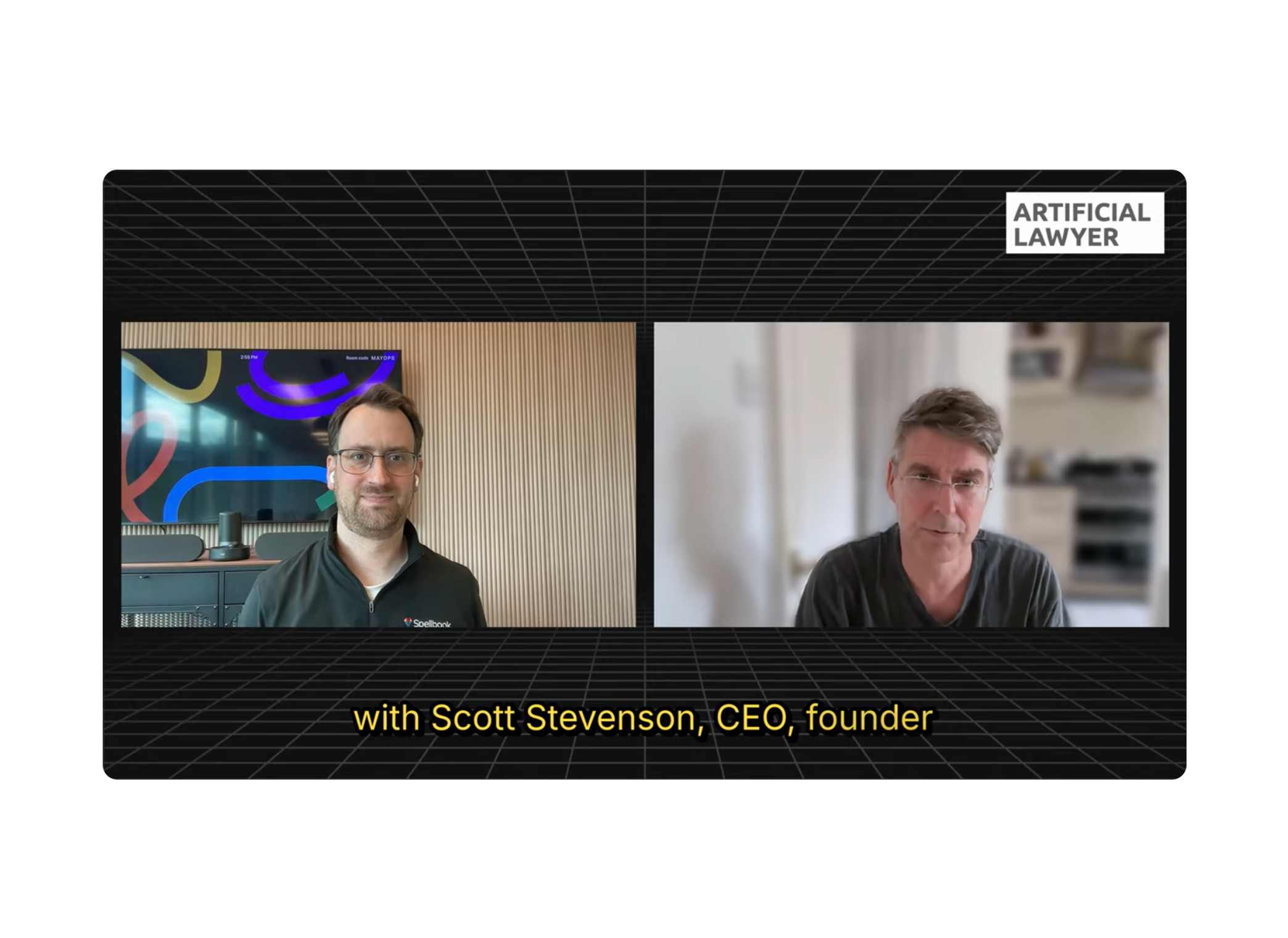
And now the in-depth AL interview with Spellbook’s CEO, Scott Stevenson, all about the ACM launch, what it means, how AI contract review is at the heart of it, how this works in terms of acting as a DMS, how Radar will operate, and much more.
Press Play to watch inside the page, or you can also go to the AL TV Channel. There is a full interview transcript below.
—
Come and join us in New York and London this November at Legal Innovators!
Legal Innovators New York – Nov 17 and 18.

—
AI Transcript.
RT (00:12.598)
Hey everybody, Richard Tromans here again, Artificial Lawyer TV today with Scott Stevenson, CEO, founder of Spellbook. Scott has got big announcement, as you will see around this video, with a major launch. Scott, tell us all about it.
Scott Stevenson (00:31.702)
Sure. thanks for having me, Richard. so we are launching autonomous contract management. it is the biggest thing we’ve launched since the inception of Spellbook. if you remember, Spellbook was you know probably the first Gen AI product for lawyers back in 2022, really focused on contract review, and Artificial Lawyer was one of the the first publications to cover it. And you know happy free to to snag this as well.
Yeah, today Spellbook has grown to be probably one of the most used AI contract review tools in the world for redlining and reviewing contracts. And with autonomous contract management, we are delivering what we see as the really the first full end-to-end infrastructure for contracts that’s really been built from the ground up for AI. So it on one hand automatically sucks in deals from across the organization, from email, Microsoft Teams.
Slack without anyone having to lift a finger. the lawyer can wake up in the morning or the contract manager can wake up in the morning to docs that have already been reviewed and redlined and actioned by AI, figured out you know whether they need to be escalated or whether they’re low risk. so we’re automatically doing all that overnight, all the way to the storage of those agreements and you know maintaining intelligence.
about those agreements and information about those agreements long term. And then later this year we’re launching something we call radar, which is really tracking risks and you know regulatory changes and things like that that might impact your entire historical portfolio of agreements. So we really see this again like the first real end-to-end built from the ground up for AI system for contracts.
RT (02:19.746)
Fantastic. Let’s just say, just to reiterate to people. so intake, the AI sounds quite agentic to me is going through it. Obviously you’ve got some kind of playbook system in the background, because otherwise it wouldn’t know exactly what type of red lines I guess to go for. It’s preparing everything. There’s a human sign off. I guess there could be some back and forth with other parties. You can keep that going a bit if you want to.
Scott Stevenson (02:46.218)
Exactly, yeah. So we’re actually sync syncing all the way th from the deal’s inception to it closing, we’re syncing every communication that’s related to the deal. So every turn of the documents, we’re automatically doing version tracking. every every time it you know an update comes in or a negotiation point happens, we’re keeping that in the history of the deal, and really helping, you know, organizations track the the full you know life cycle.
negotiation automatically. And you know this is really in contrast with I think a lot of systems that were more manual. Like I think CLM you know was kind of designed to for this pain you know a a long time ago. I think in many ways had the right ideas, but we didn’t really have the tech and the AI. And so what that meant is that in the CLM world you had to do a lot of manual configuration that took a long time to get these systems up and running. And then
you know, telling your sales team, you have to, you know, submit your contract request through this portal, you know, would slow down the sales team and they would end up just going around the systems. And so what makes this really special is it’s just kind of working like twenty four seven in the background, proactively pulling in what its needs what it needs and proactively reacting, reviewing, and you know, bubbling up risk where necessary automatically. And I think this is like a
It’s a big shift in in in how AI tools are are used, going from like a co a copilot to this infrastructure that’s kind of proactively operating twenty four seven.
RT (04:22.656)
Yeah, yeah, yeah, no, totally, totally. It’s more like the sort self-driving car analogy, isn’t it? In that it’s a complete system. It’s not just one little bit of it. It’s not like a lane deviation device that tells you if you’re going, it’s like, we’re actually gonna drive you pretty much all way there.
Scott Stevenson (04:34.741)
Yes. Yeah.
Scott Stevenson (04:39.957)
Yeah, exactly, exactly. I mean I would still I still think, you know, l like a lawyer’s judgment is still very necessary within our system. but there’s so much in everyday in especially in house counsel, you know, contract management and contract review that is not requiring real human judgment, that is, you know, fairly scripted, you know, requires a lot of just drudgery in Microsoft Word editing these documents. and so, you know, our view is like, you know, automate
all the automatable stuff that really is not requiring, you know, a very smart human’s judgment, and then bubble up the stuff that does require human judgment.
RT (05:18.466)
And I mean, in terms of just, we’ll just look briefly at the intake and it will get onto storage and so forth. But the, will fill it, it will go through pretty much everything. So, you know, you’re getting emails left around the center, you’re getting, you know, returns on your own paper, you’re getting third party paper, you’re getting God knows what paper just suddenly landing on you. Maybe different types of templates from other parts of the organization. You know, like the office in Taipei.
It’s just contracts, you’re like, this one of ours really? So I mean, it can ingest all of these different formats and types.
Scott Stevenson (05:48.256)
Mm. Yeah.
Scott Stevenson (05:56.714)
Exactly, yep. It can in ingest all all of the things that you just went through automatically, automatically routing it to the right place. so someone doesn’t even need to know, you know, where does this where do I need to submit this? Where does this need to go? We have a sort of AI for routing, intake and triage to kind of get all of these matters where they need to go. And if you think of like a lawyer’s day, especially in-house, you know, there’s so much time spent when the lawyer, you know, first sits down at their computer.
and they’re just triaging their inbox, figuring out well what what should I tackle first? What what needs my attention, what doesn’t, what is urgently needs to get done today, what can wait a week. so even just all that mental work of figuring out like where should I start and laying out all the pieces and getting it all loaded up is like an enormous amount of work. so we’re we’re excited to really tackle that part. So again, like the
Laura can just kinda hit the ground running with a prioritized list of you know, kind of pre re pre reviewed documents almost like an associate has already, you know, reviewed everything.
RT (07:04.174)
And like people watching this will go, okay, this sounds very cool, but how much preparation does the system need? How many hours, days, whatever do I need to put in? So of course, this is, know, we could, well, we’ll get into is this a CLM system or something else? But people who’ve worked with CLM systems, as you know, the first thing they’ll tell you is, my God, the setup takes some time.
Scott Stevenson (07:14.242)
Ha ha.
Scott Stevenson (07:23.181)
Mm-hmm.
Scott Stevenson (07:27.541)
Yes, yeah. So I mean we we have nearly five thousand customers and a lot of them have talk spoken to us about the pain of implementing CLM and other types of systems and how long it’s taken or how difficult it’s been to get to where they want. So honestly our first priority at Spellbook and almost everything we built, not just this, is like how do we get people to value really, really, really fast? and luckily AI and agents enable you
to get there much faster because with Spellbook, one, we have like pre built agent definitions, which are really just documents or text files describing how, okay, if you know, a new sales agreement comes in, for I don’t know, selling spellbook, like how should we treat that? Who should it escalate to? What’s the playbook? you know, and you know it’s it’s quite easy to put that prompt together and and we have lots of defaults that are available on day one. So it’s it’s yeah.
RT (08:19.854)
And then they can modify those. So it’s in the same way that, you you might say, you know, if you were using like an anthropic skill and then you can modify that, it’s the same with you guys.
Scott Stevenson (08:22.497)
Yeah.
Scott Stevenson (08:27.979)
Mm-hmm. Exactly. It’s modifying text at at the end of the day. And so
you know, and there’s a bunch of tools we have that are in that text that allow it to do very you know unique things, like you know, playbooks for instance, the things that you couldn’t do in something like Cloud and then like multi-party collaboration, you know approval flows and things like that. So all of these unique tools for dealing with contracts. but yeah, it’s very easy to edit. Whereas historically, you know, what you would typically have to design is sort of like this chart and layout of kind of
if then statements and you know drawing out boxes and diagrams to figure out how to route things around and that stuff’s been historically difficult to implement and difficult to update. Yeah.
RT (09:11.374)
Yeah, and he goes back to the birth of CLM, which is that the tech just wasn’t there. I mean, a lot of people are going, oh no, we need deterministic systems. But the truth is, is that deterministic systems are clunky. They’re brittle. They only fill the space where the roads go. Whereas on the LLM side, yes, there might be some errors around the edges, which need a human to check.
Scott Stevenson (09:31.361)
Yeah. Right.
RT (09:41.13)
you have a much, much wider spectrum of opportunity to address different issues because you can put effectively your programming in ideas, not specific pathways. I guess that’s a fundamental difference.
Scott Stevenson (09:57.193)
yeah, I mean b bang on. That’s that’s exactly how I I would pitch it this to our team when I talk to like our engineering team about it as well. you know there’s there’s upsides and downsides to the deterministic approach versus you know the the AI approach and I think you know one of the things legal AI companies have to do is find the right balance. You know, if you you know are using something like Claude, you’re getting you’re not really getting a lot of determinism. It’s gonna do the same thing different times every time you run it, and it’s great great tools and it’s very broad.
but you do need some level of predictability. Like you need some level of like, okay, here’s our policy and playbook for routing agreement for reviewing agreements, and here’s how we surgically redline documents. And there’s certain things you want to be fairly deterministic, and then but there’s a lot of things you actually don’t like, because yeah, the upside of you know these AI-based systems is they can they can review context in a much more human-like way. It’s much more like having you know an assistant look at your inbox. And even if you think about the problem of like routing email.
emails. So we’re get we have all these deal emails coming in and we want to route them to the right place. Well if you look at what each of those emails one at a time and c try to like deterministically route it, you know, it’s okay. But you know if you if human looks at your inbox, you know, they can say, these three emails are related. I should merge those together into one deal rather than creating three deals. And you know, these things are important, but maybe this one actually isn’t. That was just a calendar invite and maybe we don’t actually want that. so yeah I think I think there’s a
a huge magic you get when you start to use AI AI systems for yeah intake, routing, triage and and so on.
RT (11:33.486)
Yeah, no, totally, totally. Well, we can have a debate another day about determinism. But let’s look at storage, which is the second part, then we’ve got radar. Let’s briefly look at storage. Obviously, that’s a key factor of all contract management, particularly for large corporations. Where do these contracts get stored? And how are they then available for Spellbook to tap back into them?
Scott Stevenson (11:45.834)
Mm-hmm. Yeah.
Scott Stevenson (11:59.403)
Yeah, so we have a feature called repository, also called tables, which enables you to store agreements long term. it’s one of the cool things, a lot of people are using disparate systems for like the intake and AI different AI systems for drafting and review, and then different systems for storage. And some teams are using ticketing systems, and so you end up kind of re-extracting all of this information from the agreements at every single step.
the cool thing about using this system is we have a model of what what imp what is the important information in each document that kind of follows the document the full way through. So if you’re doing a sales Yeah. Exactly, yeah. So what what are the connected agreements? What are the you know, if it’s a sales agreement, like what’s the the contract value, like what’s the jurisdiction or what are the jurisdictions? you kinda want this intelligence to kind of flow the whole way so you’re not constantly re-extracting data and
RT (12:35.608)
like a knowledge graph that comes with it.
Scott Stevenson (12:56.702)
moving stuff from system to system.
And so yeah, we can store and we can, you know, extract data from your historical agreements and allow you to, you know, mass extract from thousands of agreements, you know, the important information that you care about that you might want to filter on. Maybe you want to know which agreements are expiring this quarter, or maybe you wanna know maybe employment law has changed in certain jurisdictions and you want to know which employment agreements you now need to update. Spellbook can help with all those things through its its data storage, data extraction and
and contract storage. And yeah.
RT (13:30.78)
So does that mean you don’t need a DMS anymore?
Scott Stevenson (13:35.184)
it’s a great question. I mean I think it it totally di it totally depends on the organization. I think you know a lot of our law firm customers will use a a DMS and need that to work across many practice areas and and we synchronize with DMS systems like like I manage. So I think there’s there’s a place for DMS systems as well because there’s more beyond contracts that people want to track. yeah, but for for contracts you know we aim
RT (13:36.961)
I’m gonna now.
Scott Stevenson (14:04.991)
Yeah.
RT (14:06.766)
Gotcha, gotcha. And then third leg, which you mentioned earlier is coming down the line soon, which will be this radar. So effectively it’s a sort of permanent sort of, well, radar that keeps you up to date any changes. So these are external changes that may impact something that’s in your store. And does it also pop up, I don’t know, if a certain condition has been met inside one of the contracts?
Scott Stevenson (14:14.859)
Yeah.
Scott Stevenson (14:35.444)
Yep. Yep, i i exactly. So I mean you could use it for simple things like conditions that you set. maybe you want to know any time a contract is up for renewal, you know, ninety days in advance or something like that. which you know I think sist th those sorts of reminders have been around for some time. but what we’re really excited about is really ongoing monitoring of your full contract portfolio.
long long term. So for you know risks that are a little bit more fuzzy, again we we have that subjective power of AI and not just deterministic sorts of alerts. So again, maybe employment law changes in one of the jurisdictions that you’re operating in and now you have a you know, twenty percent of your employment agreements are actually not enforceable anymore. so wouldn’t it be great yeah.
RT (15:24.942)
Could you kind of say like kind of gradations like, you so for example, if, you know, if law in New York changes with regards to blah, please highlight what you think could be a risk. So again, moving between deterministic actual risk and perceived risk, which perhaps actually may be more helpful.
Scott Stevenson (15:40.394)
Yep. Yep. Mm-hmm. Yep.
Scott Stevenson (15:49.088)
Yep, yeah. So it is very cal calibrateable, so depending on the level of noise and the le the level of alerts that people want, yeah, it’s configurable to be able to have different types of alerts at different severities. Yeah. So some people may want, you know, to know every possible thing that impacts them, some people might want to know just kind of a smaller subset and you know, we’ll kind of allow for for any of those. And and just to be clear the the the go ahead. Yeah.
RT (16:13.263)
And so you’re to need links out to data libraries, Data providers to do this.
Scott Stevenson (16:21.397)
That’s right. Exac exactly. Yeah, so we have a number, yeah, if you check out Spellbook, we actually have a number of legal data sources built in already, actually over a hundred. so
although it’s been more of you know for asking it a one-off question. but now it’s going to we’re gonna do more live monitoring of all of those sources as well and we’re gonna continue to build more of those out and even allow teams to just kind of create their own sources if they want or point point to certain websites or other data sources they want to monitor as well and and just see, you know, for I think re regulatory is just another you know thing to monitor, you know, updates to things like GDPR and how that might impact your your data process.
agreements, things like that. we want to be able to monitor. And yeah, just to be clear, the radar component is a Q Q4 launch for us. So that’s coming it gonna Yeah. Yeah. We’re we’re working deeply on it and that’s kind of something we’re really excited about that’s gonna be sitting on top of all this.
RT (17:13.23)
Right, if you’re watching this, don’t expect it next week, it will be later on.
RT (17:26.122)
Sounds fantastic sounds fantastic. So question of the century. Is this a CLM tool?
Scott Stevenson (17:32.875)
I mean we’re not calling it we’re not calling we’re not calling it CLM. we’re calling it auto ACM autonomous contract management. people can can determine what what they think about that. I s I still think you know there’s there’s a place for CLM tools. I think
You know, most CLM providers also recognize the need to innovate and the need to kind of get to the the next level. I think AI has really just changed how all software works. So I think, you know, customers are looking for a signifier that you know this type of software has gotten so much better that it’s actually something else now. because it just you know that category was around for quite some time and
you know, I think AI is just dramatically changing like what what we’re actually able to do and I think, you know, ever every company is is thinking a about that.
RT (18:27.628)
Yeah, totally. And I guess, mean, for me, one of the key aspects is your starting point. mean, one of the, you know, some companies have come out here from show me all your past contracts. know, this is like early days, you know, machine learning, language processing, show us all your early contracts. We’ll try and strip out some of key data. We’ll stick it into a digital, you know, storage system of some kind, and then we’ll build templates. And that’ll probably be like doc automation of the old school style.
You guys are obviously focused very much on the generative AI, LLM based contract review. you’ve kind of, that’s the center pillar. And then you’ve built outwards from that into these other things. And you could argue fairly convincingly that actually contract review is actually the strongest part of this system. Cause if you, can’t do the contract review, all the other bits don’t really work very well.
Scott Stevenson (19:14.911)
Yeah. Yeah, I mean
Yeah, I mean it it it is it is the work, it’s like the workhorse of the system. And it wasn’t doable before large language models. So you know there’s there’s no I don’t blame anyone for not having that, but it we just weren’t able to to really review in redline agreements before LLMs. So that I think that is where s an enormous amount of value is created in eliminating that drudgery of redlining, which you know so many lawyers don’t want don’t want to be in Word doing that all day, every day.
so yeah, I I do think it it makes sense as the core. And then if you think about it, there’s also this incredible feedback loop of
Okay, if we know how every historical negotiation has gone and what’s been accepted and and what hasn’t, you know, we can use that intelligence to better inform future reviews. So there’s this sort of virtuous cycle. As I talked about at some of the Legal Innovators conferences of kind of the money the money ball for contracts that if you get enough if you get enough of this information over a long enough period
RT (20:14.318)
Yeah.
Scott Stevenson (20:18.819)
it allows you to make better predictions on which red line should you make, how likely are they to be accepted by the counterparty, and so on.
RT (20:28.558)
Fantastic. And very last thing, just a very practical question, which is if someone’s watching this or reading the text and they’re like, well, okay, this sounds cool. I would like this, or at least I’d like a POC or something. How does this work? Do they just continue with their spell book contract and expand it? There’s like a expand button. And if they don’t have spell book, what happens next?
Scott Stevenson (20:49.599)
Yep. so in either case they can like if they if they’re a spellbook customer, just reach out to your rep and let them know that you’re interested and we’ll get you in queue for early access. we also have a website, spellbook.com slash acm. you can sign up for early access there.
And yeah, we’re onboarding our first users now, and we’ll slowly kind of be opening up the gates as we get first feedback from our customers and yeah, improve the the platform and improve you know the number of integrations we have and you know everything that we’re doing.
RT (21:25.016)
Fantastic. Thanks, Scott. Really looking forward to seeing this roll out and to all the new features that are no doubt be rolling out for out. Yeah. Thank you.
Scott Stevenson (21:33.621)
Great chatting, Richard.
Discover more from Artificial Lawyer
Subscribe to get the latest posts sent to your email.