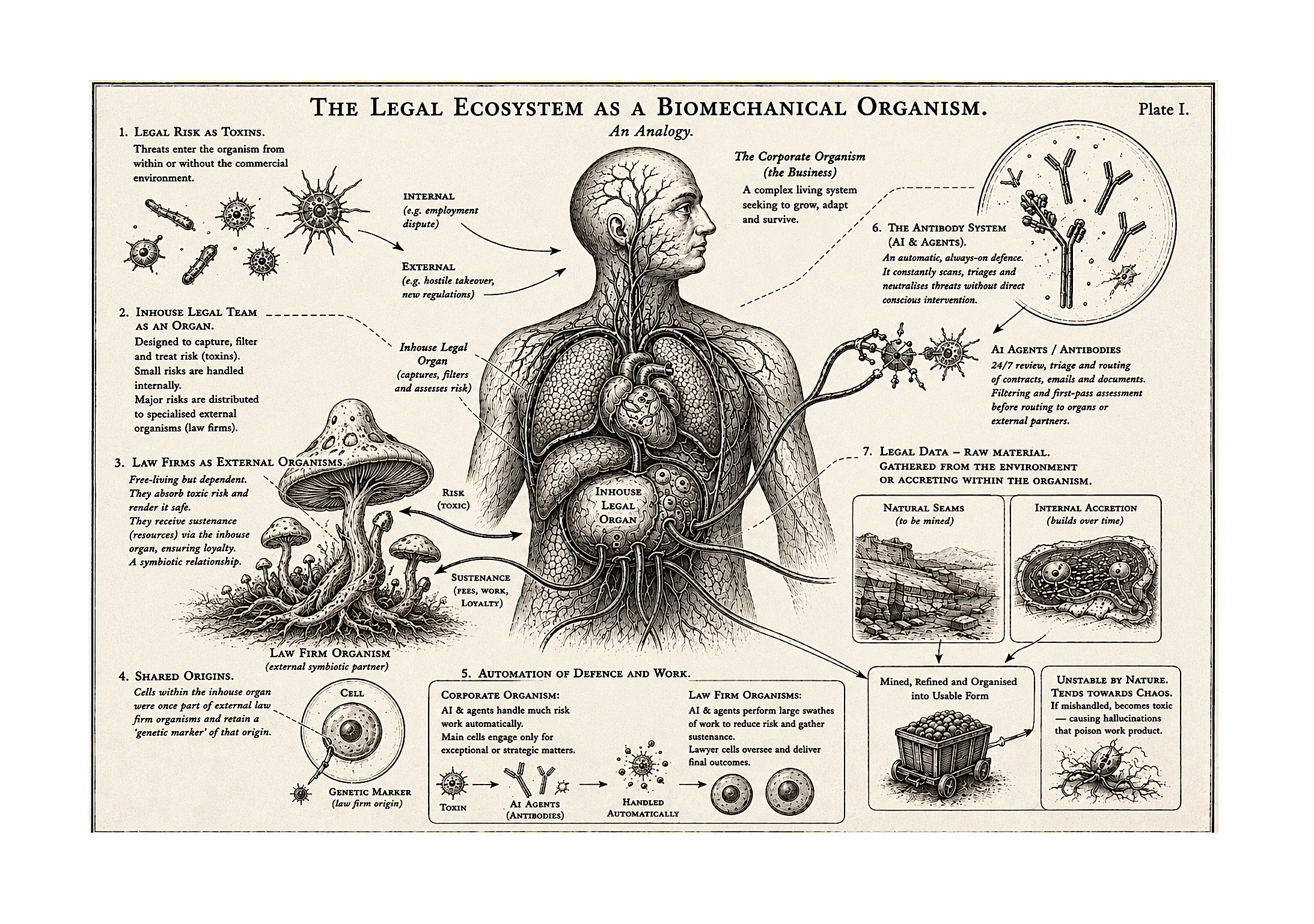
If you’ve seen me give a talk, then you may have noted my framing of companies as organisms that use their inhouse legal function to contain risk, or ‘toxins’ in the commercial environment; and how law firms are in a symbiotic relationship with them, absorbing and killing that risk. In short, it’s a biomechanical framing of how the legal ecosystem works.
Yesterday, I was chatting with Scott Stevenson, CEO of Spellbook, about how their new Autonomous Contract Management system uses AI and agents to provide a 24/7 review and triage service, which constantly filters incoming documents and emails, then routes them to the correct place – after also giving them a once-over.
We both sought to try and find a good analogy to describe this. Scott noted that rather like the human body, not every action that matters needs to be a conscious one. E.g. we do not need to think about breathing in order to breath. I then suggested that this constant triage and monitoring was like antibodies, continually at work inside us.
And that then made me blurt out: ‘You know, it’s basically all about biomechanics’. And hence this missive today.
Some Thoughts on Legal Biomechanics
So, if we are to expand on this analogy – and AL loves a good analogy – then what can it describe? Here are some thoughts, and no doubt it’s a theme this site will explore again.
- If we think of all businesses as organisms, then legal risk is a threat, a ‘toxin’ if you will. That threat could arrive internally (e.g. an employment dispute), or from the outside (e.g. a hostile takeover, or new regulations that make the business suffer.)
- The inhouse legal team is an ‘organ’, designed to capture this toxin, this risk, and do something about it. If it’s a small risk then it can handle it internally. But, if it’s a major problem and needs specialist treatment then it has to ‘distribute the risk’, in this case to some amazing creatures called ‘law firms’.
- Law firms are organisms made up of similar cells to those found within the inhouse organs, but operate freely in the open environment. However, they are dependent upon the corporate organisms for sustenance that range around this ecosystem. They have evolved a very clever symbiotic relationship whereby they absorb toxic risk and render it safe, the corporate body in turn channels ‘sustenance’ via the inhouse organ to the law firm entities, ensuring their loyalty and survival.
- However, the symbiotic relationship goes deeper, the cells within the inhouse organ were actually once part of the external law firm organisms, and therefore always retain a ‘genetic marker’ from that time ‘gestating’ within these other entities. This means they tend to think the same way as law firms when it comes to sustenance, e.g. the billable hour. (Although, recent positive mutations are apparently starting to change this early ‘imprinting’.)
- In terms of what is ‘automatic’ and what is conscious, things are changing. For a long time the corporate organism often had to think very consciously about every action it took to handle risk. Now it is evolving. Agents and AI allow the inhouse organ to rapidly handle risk without engaging the main cells within it. I.e. it’s developing a fully functioning antibody system, which moves without the need for direct intervention all the time. In short, the inhouse organ is mutating (positively) into a new form with a secondary ‘nervous system’ that functions around the main cells.
- The same is true for the law firms that live symbiotically with the corporate bodies, with AI and agents handling large swathes of ‘work’ to reduce risk and gather sustenance, without the ‘lawyers’, or rather legal cells, having to oversee everything, and instead check the final output before it’s fed back into their symbiotic client.
- Much of the work here depends on raw materials gathered from across the environment, called ‘legal data’. Sometimes this data can be found in huge naturally occurring seams that then needs to be mined and organised into a useable form.
- In other cases, this ‘data’ accretes inside the legal business itself. However, legal data is unstable and tends towards entropic breakdown – if incorrectly handled. It can also become toxic itself when mixing with AI systems within the organism, resulting in ‘hallucinations’ that poison the work product sent out to corporate bodies.
And there’s more…much more. But, let’s leave it there for now. As you can see, analogies like biomechanics really can help to frame the picture of our legal and legal tech world, at least if you think in terms of connected systems.
Richard Tromans, Founder, Artificial Lawyer, July 2026.
—
Come and join us in New York and London this November at Legal Innovators!
Legal Innovators New York – Nov 17 and 18.
Discover more from Artificial Lawyer
Subscribe to get the latest posts sent to your email.