By Jesse Hampton, Draftwise.
‘You essentially pay for intelligence twice, once with money, and again with something even more valuable: the proprietary knowledge you must reveal to make that intelligence useful. The better you want the model to perform, the more of that knowledge you have to feed it!
The seller learns more and more about you as you use what you purchased, while you learn very little about what the seller is learning in return.’ – Satya Nadella, Microsoft CEO.
Frontier labs have moved into legal
Frontier labs like Anthropic and OpenAI have started to see their own customers not just as sources of revenue but as a way to directly transfer value and control their market.
At the beginning of 2026, Anthropic shipped Claude Cowork. Three days later, roughly $285bn came off software and professional services stocks in a single session: Thomson Reuters had its worst day on record, down about 16%; RELX fell about 14%; LegalZoom fell about 20%. Jefferies called it the SaaSpocalypse. Outside the public markets, law firms saw their clients shift their business to Claude and other AI competitors, cutting into their bottom lines.
The pattern didn’t stop there. Microsoft launched its own Legal Agent for Word in April. Claude for Legal followed in May, with a dozen practice-area plugins and more than 20 legaltech connectors built in. The month after that, OpenAI opened a legal vertical and hired Jason Boehmig, founder and former CEO of Ironclad, to lead it.
Anthropic’s own explanation for the expansion was telling: legal professionals had become its most engaged Cowork users of any knowledge-work function. No client data needed to leave a firm’s perimeter for them to draw that conclusion. Anthropic saw everything it needed from its own usage data, without needing to train on a single customer document upload.
NVIDIA’s Jensen Huang first used ‘sovereign AI’ in 2024 to describe countries building and controlling their own AI infrastructure, and Palantir’s Alex Karp has since applied the same idea to enterprises in the face of this threat: you need to reclaim your AI sovereignty.
Zero data retention won’t stop labs from using your data
Legal has made Zero Data Retention (ZDR) a baseline requirement for any AI vendor, for good reason. It’s still not enough on its own.
Three distinct opportunities allow labs to compete with their average customer. The first and simplest is data extraction: prompts and outputs are retained and folded into the next model. ZDR prevents this directly, but coverage narrows rapidly after that.
The second is capability absorption: even without touching a document, a lab can watch which workflows a firm spends the most time and money on. This is already happening. The usage signal alone was enough for Anthropic to justify building Claude for Legal, without ever reading a client contract. Usage data, feature adoption, and integration patterns are all it takes, and none of that is covered by a retention clause, because it was never ‘data’ in the way ZDR defines it.
Once a lab knows where the value sits, there’s vertical entry: the lab ships that workflow itself and becomes a competitor. Capability absorption and vertical entry are what the legal sector is living through right now.
Training your own model doesn’t solve ownership either
Some legal AI vendors are responding by training firm or legal-specific models, so firms can own their own intelligence instead of renting someone else’s. It gets at the right problem but it doesn’t go far enough. Firms won’t achieve their full corporate goals, and they risk adding a new black box that their lawyers don’t understand.
Consider model ownership. If the firm walked away from the vendor tomorrow, could it take the model, the weights, the training data, and the right to run it elsewhere? If the vendor trains and hosts the model, the firm’s own workflows end up sitting inside an artifact it can’t export. A document corpus is portable; a fine-tune generally isn’t. Switching cost moves from ‘re-integrate’ to ‘start over’ (also known as lock-in).
Whose material ends up in the model? Training it on how a firm handles a specific client means that privileged material, possibly the client’s own confidential information, is now baked into that model. There’s also the question of who grades the results. The benchmark used to prove the model works is usually built by the same vendor selling the model. That’s not an independent test, and it makes it difficult to build internal expertise.
The obvious workaround, training on anonymized or generic data instead, creates its own problem. Strip out anything client-specific, and what’s left is generic legal work, not the firm’s edge, which is hardly more useful than a general model. The value was always in the specific judgment, relationships, and precedent built with real clients over the years, and that’s now been removed.
Kirkland & Ellis recognized this gap and decided to build a $500m solution in-house with Palantir. Rather than a model fine-tuned and hosted by an outside vendor, it’s a platform backed by an AI team of more than 180 engineers. That approach works for Kirkland, but getting there doesn’t require that scale of investment.
AI sovereignty starts with an ontology
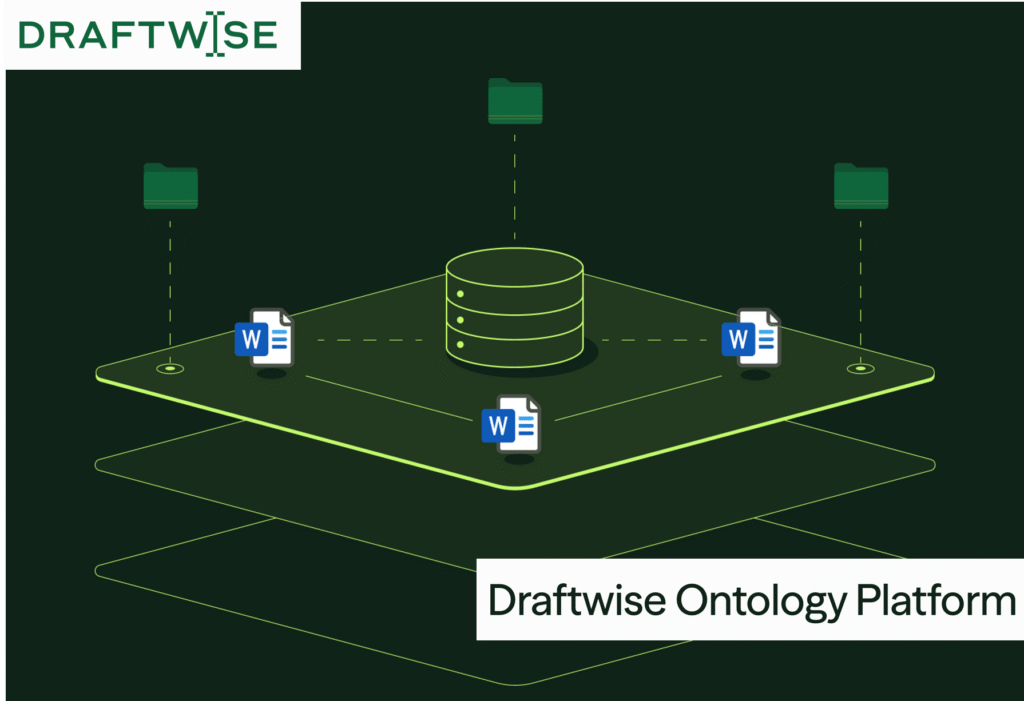
The key to unlocking your proprietary intelligence while still protecting your competitive edge is to build a structured ontology that allows lawyers, AI agents, and vendors to work using a shared language of quality data. Instead of document uploads and RAG wired to one or more labs’ models, the firm holds a structured representation of its own world (funds, LPs, side letters, obligations, counterparties, negotiation rounds, clauses, definitions, the relationships between them), and the model underneath becomes a swappable component rather than the technology the workflow depends on.
An ontology also functions like an API for a firm’s data, not a firehose into someone else’s model. A firm doesn’t have to hand a lab its entire contract history to get a useful answer. The ontology layer makes the relevant calls on the firm’s own stack, privately, and only the narrow slice of data needed for a given task ever reaches a model. That’s a much smaller surface area than shipping full documents and prompts to whichever lab is doing the inference.
There’s a third, even more powerful effect of an ontology. When a firm produces a new negotiated outcome, it gets captured straight back into its own system and ontology. That means it sits within the firm’s ownership rather than the model’s, so it can retain that data and immediately enhance the value of its own solutions.
This asset becomes something the firm definitively owns. It’s a data format – open and exportable – so they can use it for any project. No vendor or lab can take it away or hold it hostage. No other firm can replicate your proprietary ontology and unique view of the market.
What building an ontology actually looks like
The idea of an ontology sounds abstract until you start building one. Draftwise has advised senior technology leaders and managing partners on ontology often enough to see the same misconceptions come up again and again.
The first is assuming that an ontology is the same as documents. It isn’t. Documents are the source material. The ontology is the structured representation of the concepts inside them and the relationships between them. A document management system stores files. An ontology models the business.
The second is assuming the answer is to model everything at once. The firms that achieve impact fastest start with a narrow domain where institutional knowledge already compounds: precedent, negotiated positions, clause libraries, or playbooks. Once that foundation exists, the ontology expands alongside the firm’s work rather than requiring everything to be modeled up front. Real Ontologies are flexible and evolve alongside your business – they’re not static schemas imposed by a vendor.
How to Reclaim Your AI Sovereignty
Reclaiming AI sovereignty starts with one question: if you had to leave your AI vendor tomorrow, what would you be able to take with you?
Zero data retention doesn’t answer that question. Neither does a firm-specific model trained and hosted by someone else. AI sovereignty means your institutional knowledge and value remain yours, regardless of which vendor or model you use next.
That’s the standard we believe in at Draftwise. If you build an ontology, it should belong to your firm. You keep the ontology, the knowledge you’ve modeled, and the work you’ve invested in it. We don’t believe your competitive advantage should depend on staying with a vendor; it should stay with your business.
Learn more about the Draftwise Ontology Platform here.
—
About the Author: Jesse is the Director of Product at Draftwise. Prior to that, he spent nine years as a Forward Deployed Engineer at Palantir, building and deploying their ontology Platform for some of the world’s most critical commercial and government institutions.
Sources:
- Sn scratchpad, ‘The Reverse Information Paradox’
- Law.com, ‘Anthropic Releases Legal Plugin for Claude as Part of Agentic ‘Cowork’ Capability’
- AInvest, ‘What’s Behind the ‘SaaSpocalypse’ Plunge in Software Stocks’
- Artificial Lawyer, ‘Microsoft Launches Its Own Legal Agent For Word’
- Artificial Lawyer, ‘Claude For Legal Launches, May Reshape the Legal Tech World’
- Artificial Lawyer, ‘Ironclad Founder Jason Boehmig Joins OpenAI For Legal Vertical Launch’
- PYMNTS, ‘Anthropic Scales Legal AI as Lawyers Become Cowork’s Top Users’
- Palantir, ‘Institutional Sovereignty in the Age of AI’ (whitepaper)
- Kirkland & Ellis, ‘Kirkland & Ellis to Spend $500mn Building Its Own AI Technology’
- CNBC, ‘Palantir’s Karp Bashes OpenAI, Anthropic Token Model: ‘Something Has Gone Completely Wrong’’
—
[ This is a sponsored thought leadership article by Draftwise for Artificial Lawyer. ]
Discover more from Artificial Lawyer
Subscribe to get the latest posts sent to your email.