By Donna Carpenter.
This week, Anthropic announced that all of its Claude products released from 2 August 2026 onwards will now include machine readable marking in all of its AI generated content. However, the company has until 2 December 2026 to roll out watermarking for older Claude models.
This change has been implemented in order to comply with the EU AI Act (specifically Article 50(2)). Under the Act, ‘providers of AI systems, including general-purpose AI systems, generating synthetic audio, image, video or text content, shall ensure that the outputs of the AI system are marked in a machine-readable format and detectable as artificially generated or manipulated.’
The EU AI Act was adopted to ‘promote trustworthy artificial intelligence’, and to support technological advancements while at the same time ensuring the protection of fundamental rights as set out in the Charter of Fundamental Rights of the European Union (CFREU).
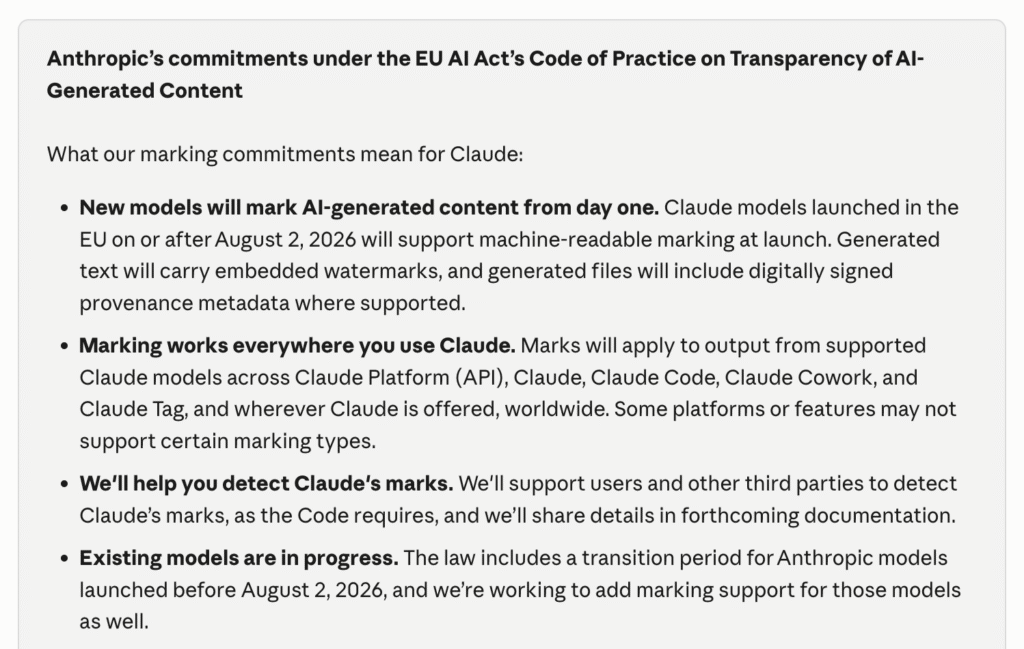
Anthropic has assured its users that the watermark will be invisible and shall not affect the quality or readability of the LLMs output. The watermark can either be placed in the text of the output that has been produced, or it will appear in the metadata of audio files, images, or videos.
However, Anthropic has confirmed that it will assist its users and other parties to detect whether a piece of work contains a watermark. Although the company has yet to elaborate further on this, it will be interesting to see how the system will work in practice. This move could also potentially have wide-ranging ramifications for the legal and other industries where confidentiality, accountability, and data provenance are of paramount importance.
Perhaps surprisingly, Anthropic has confirmed that this new feature will be rolled out globally and not just within the confines of the European Union. This is a prime illustration of how EU law and the ‘Brussels Effect‘ can influence global standards and practices. This can easily be compared with the adoption of the General Data Protection Regulation (GDPR); whereby some multinational companies adopted higher data privacy and protection standards on a global scale rather than just the European Union, as maintaining different systems would prove inefficient and expensive.
As part of their announcement, Anthropic flagged that there are certain constraints to the newly developed feature. For example, it is possible for users to extract watermarks from metadata. This could potentially be done through resaving and reformatting the output material. Furthermore, many people use Claude to assist with proofreading, translating, and summarising documents.
In this context, Claude has not generated the original text, although a watermark might still appear if for example a summarised text has been copied and pasted. Additionally, the absence of a watermark does not definitively signal the fact that AI has not been involved in the production of certain work. However, the EU AI Act has recognised that ‘this obligation shall not apply to the extent the AI systems perform an assistive function for standard editing or do not substantially alter the input data provided by the deployer’.
Article 99 of the EU AI Act sets out the penalties for non-compliance with the Act. Depending on the nature of the infringement, if an entity does not strictly adhere to Article 50 of the Act it could potentially result in administrative fines of up to €15 million or up to 3% of its total worldwide annual turnover for the preceding financial year (the highest value will apply). Other AI companies such as Google DeepMind have developed a tool called ‘SynthID’ that also embeds invisible watermarks into various mediums such as images, audio, and text.
Also interestingly, the voluntary Code of Practice on Transparency of AI-generated Content was developed to complement the legal obligations as set out in Article 50 of the Act. As it stands, over 190 organizations have signed. This includes many key market players such as Google, Meta, OpenAI, and Microsoft.
—
About the author:
Donna was recently admitted as an attorney in the State of New York and currently works in-house at a veterinary pharmaceutical company in Ireland. She holds a LL.M. in Intellectual Property and Information Technology Law from Trinity College Dublin, as well as a Bachelor of Civil Law from Dublin City University. Her interests include legal technology, artificial intelligence, and technology law.
All views or opinions expressed in this article are the author’s own.
—
[ This is a pro bono, educational guest post for Artificial Lawyer. ]
—
Two Major Legal Innovators Conferences this November
Come and join us in New York and London this November at Legal Innovators!
Legal Innovators UK – London, Nov 4 and 5
And, then Legal Innovators New York – Nov 17 and 18.
After another fantastic Legal Innovators California, where we had speakers from OpenAI, Y Combinator, Google, Meta, and many more pioneering organisations; and our stellar inaugural event in Paris this June, we are now looking forward to the landmark conferences in London and New York, both in November, and both across two days: Law Firm Day, and Inhouse Day.
Discover more from Artificial Lawyer
Subscribe to get the latest posts sent to your email.