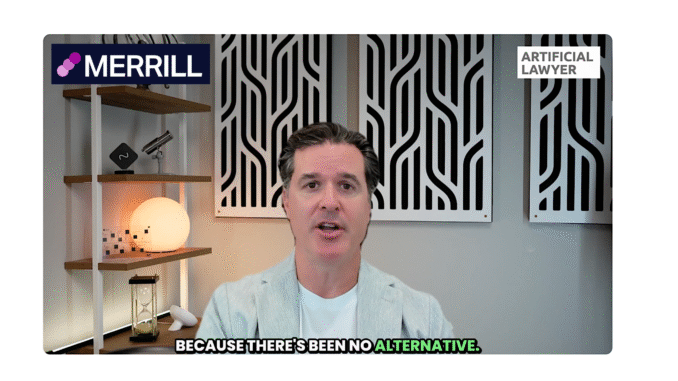
‘Companies are very frustrated because there’s been no alternative,’ says Rick Merrill, co-founder of NewMod firm Merrill. Traditional law firms remain expensive and hourly-based, yet corporates with a high volume of litigation matters can’t rely on ALSPs or an AI tool alone either.
Merrill, which has been formed alongside James Lee and Thomas Suh, the creators of LegalMation, aims to address this litigation defence need and do so with significantly lower prices by tapping AI and deploying experienced lawyers in a highly efficient combination. (Note: LegalMation remains a separate business.)
‘We’re going to do even better work, but for less money. That’s not a message that really anyone leads with, in large part because it hasn’t been possible,’ Merrill told Artificial Lawyer in an AL TV in-depth interview, (see below).
He noted that they offer fixed fees for handling high volume claims that companies have to deal with. They have their own tech stack and will use data they collect on handling those matters to improve their price model and workflows. That means that they could actually reduce their fees as they grow.
Merrill – whose experience running litigation analytics startup Gavelytics feeds into this work – underlined that in most traditional law firms if you announced to your fellow partners you were reducing what you charged clients, then you would not last long.
— Advertisement —

—
Whereas, in a NewMod, using AI on the basis that it allows work to be handled by its lawyers more rapidly, there is no billable time, and so there is no barrier to sharing the benefits of efficiency.
Merrill – the NewMod, which uses an MSO structure of a tech company and a law firm, and is based in California – wants to launch eventually across 10 US states and grow rapidly, perhaps to 100 lawyers in the next few years. They’re also looking at taking funding, which would go into the tech part of the MSO.
The focus on litigation represents a new growth market for NewMods, given that many are focused on startups and handling their corporate needs. It also comes at a time when AI itself is leading – at least in some parts of the economy – to an increase in claims brought by individuals who feel empowered by AI tools. Meanwhile, a growing number of startups are seeking to help the plaintiff law firm sector improve their efficiency and bring cases against large corporates.
And this comes at a time when despite plenty of discussions about the end of the billable hour, rates are going up in leaps and bounds, and as noted above, Merrill believes that many inhouse legal teams have had enough when it comes to paying the current fees for legal matters that are not ‘bet the company’. Moreover, as said: now there is an alternative.
In fact, Merrill is totally frank about pricing. I.e. this is all about the cost. If a NewMod can handle the same matters, with the same or better net outcome for the client, but at a far lower price, then that is their compelling USP. Why would a GC not use a NewMod if that is the case?
All of this reminds AL of the famous Jeff Bezos comment: ‘Your [profit] margin is my opportunity.’ And NewMods – which deliver the benefits of AI unhindered by the need to accumulate billable time via manual labour – are there for this in a way we have not seen before.
To watch the video inside the page, please press Play, or you can go directly to the AL TV Channel to watch over 230 other interviews and product walk throughs.
AI Transcript of AL TV Interview
Richard Tromans (00:00:01)
Hey everybody, Richard Tromans here again, Artificial Lawyer TV, doing another special interview. today we’re looking at another new mod or whatever you want to call them. I’m calling them new mods. with us to tell us about Merrill. He’s none other than Rick Merrill. Hey Rick.
Rick Merrill (00:00:17)
Hey Richard, how you doing?
Richard Tromans (00:00:18)
Pretty good, pretty good. I’ve known Rick for a long time. probably ever since they started artificial Lawyer I think we bumped into each other in an enormous conference center somewhere in America about ten years ago. back in the days when you were running Gavelytics
Rick Merrill (00:00:36)
That’s right. So it must have been at Legal Week probably in twenty sixteen or twenty seventeen that we first met.
Richard Tromans (00:00:42)
Yeah, yeah, yeah, yeah. But things have changed. Gavelytics is history, in a good way. Rick is now the CEO. CEO.
Rick Merrill (00:00:54)
Technically the managing partner.
Richard Tromans (00:00:56)
Managing partner, managing partner of Merrill, which is as mentioned, a AI native, AI first, new mod law firm. Slightly different from most of them in that it’s focused on litigation, but enough from me. Rick, tell us about Merrill. What is it?
Rick Merrill (00:01:13)
Yeah, th thank you, Richard. So Merrill has been founded by myself and also James Lee and Thomas Suh the two founders of LegalMation. they are two legal legal tech and legal practice luminaries here in Los Angeles that I’ve known just about as long as I’ve known you, Richard. they started their business, LegalMation, around the same time that I started,
that I started Gavalytics and I’ve stayed in touch with James and and Thomas quite closely over the years and there’s that actually a quick fun origin story here. We had dinner, the three of us about a year ago and we were lamenting how hard it is to sell software to lawyers. it’s it’s just a a difficult thing, particularly if the software has anything whatsoever to do with efficiency. or
Richard Tromans (00:01:59)
Mm-hmm.
Rick Merrill (00:02:09)
improving processes. That’s that’s a tough that’s that’s tough sledding. It’s an uphill battle to go up against the billable hour. And so anyhow we were lamenting the the the struggles that that we’ve all endured in selling software and it occurred to us what would happen if we just started a law firm, a litigation focused law firm
that actually used all the wonderful software that’s out there, but importantly used it to do two specific things. So one is let’s make legal work better, which of course lots of law firms try to do with software. But importantly number two, let’s make it cheaper.
And so that that was the the birth of Merrill. And so what Merrill is, Merrill is a tech-enabled AI native, or as you like to call it a new mod. It’s it’s an AI native litigation defense law firm focused on defending the Fortune 1000 in high-volume, repetitive litigation. And again, importantly, the whole premise, the whole reason we exist is to reduce the cost of legal services. It’s it as as as everyone knows.
The cost of legal services has gone through the roof in recent years. It’s up nearly forty percent. The billable hour, the average rate in the M100 is up forty percent since since the year twenty twenty. Yeah, yeah, exactly. So since since Friday la last week. Yeah.
Richard Tromans (00:03:30)
L last Tues last Tuesday probably. But since like nine o’clock this morning. But no, absolutely. And and I think it’s great that you’re being so explicit about it, ’cause I think a lot of people understandably dance around and tiptoe around the money bit because you know it’s it it’s you know, it’s it’s like the ghost of the wedding, right? People don’t want to talk about it, right?
But I think it’s great you just said, look, no, look, it’s it is about economics. Absolutely. So it’s also unusual that you’re doing litigation. you know, as you and many of the viewers know, a lot of the new mods are focused on startups, on transactional and corporate work for them. there’s kind of like a like a nice fit ideologically. You’ve got startups who are very tech first, they’re short of cash, they don’t want to waste money, they don’t want to show their investors that they’re wasting money, they want to appear to be efficient.
So it’s a li it’s a nice mix. How did you come to the idea of working with large corporates?
Rick Merrill (00:04:34)
So they interestingly, lar large corporates have been
Been the clients of of Gatalytics, my previous software company, they’re they are the clients of Legal Nation. they they were the clients that I represented when I was a litigator here in Los Angeles at Greenberg, Troy. So all of our professional backgrounds, the three of us, really caused us to interact extensively with with the Fortune 1000. And in conversations with them, particularly with respect to
To y you know, lower complexity litigation, the high volume litigation stuff of the sort that say large retailers deal with or insurance companies on behalf of their insureds. With respect to those types of litigation, what we’ve heard from from our our current clients and the people we’ve talked to over the last year and a half is that the costs are out of control, which everyone already knows.
But the companies are very frustrated because there’s been no alternative. Or or we’re going to do the you know even better work, but for less money. That’s not a message that that really anyone anyone leads with, in large part because it hasn’t been possible, because litigation has been so laborious, it requires human labor, expensive lawyers, billing by the hour. There’s been no way around that. And for that reason, the traditional law firms.
Richard Tromans (00:05:48)
Yeah.
Rick Merrill (00:06:06)
And the AMLA 100 and and the whole galaxy of mid-size and regional law firms, they’ve been able to ratchet up rates just year after year after year indefinitely because there is no alternative. And this revolution in legal practice, driven by large language models and generative AI more broadly, th this for the first time ever is going to exert
Richard Tromans (00:06:24)
Mm.
Rick Merrill (00:06:29)
significant downward pressure on the cost of legal services. And so we we want to ride that wave. We we we want to be some of the first people to do this. And your observation is correct. I I’m not aware of any other high volume litigation defense law firm. Y you know it
Richard Tromans (00:06:42)
No. Well, the i interestingly, there are there are legal AI companies out there, there’s three or four of them now, that are helping on the plaintiff side. There’s a whole bunch of them. I won’t name them, but you know who they are, there’s a whole bunch of them. In fact, people like Thomas Royds and Alexis Nexus have actually got quite chummy with them because they need some of their services too. It’s very interesting. And that will actually accelerate, undoubtedly, the number of claims. Because if the c the plaintiffs are
Rick Merrill (00:07:09)
Yeah, y yeah, you you you you you raise you raise an important point. And so we actually see ourselves as the counterpoint, the natural response to those AI powered tech companies that aid the plaintiff’s bar. And what’s interesting, because of the different business model between the plaintiff side of the fence and the defense side of the fence, is is that the answer to the plaintiff tools is not just another software company.
Because the defense firms don’t want to buy it, because it would lower their rates. You know, no nobody wants to reduce their revenue, right? Well, why would you buy something that costs you time, right? That that reduce that reduces your revenue. So the the answer to the high volume plaintiffs firms is not another piece of software that makes the defense firms more efficient to work faster because they won’t do it, because it runs counter to their business model.
Our view, our thesis, is that the counterpoint, the natural response to the plaintiff’s industry is a modern, new age, new mod, AI native litigation defense firm along the lines of Merrill. You need both the the technology piece, which we have, but then also the actual law firm doing the work. Because if you just created some software that that allowed defendants to respond,
quickly and all that, no one’s gonna buy it. It won’t it won’t it won it won’t be a very successful, successful company.
Richard Tromans (00:08:30)
Yeah. Or they’ll they’ll people people will buy it but they’ll use it sparingly. But I mean this is the thing, isn’t it? You got you know, we had ALSPs, alternative legal service providers, sort of managed services and so forth. But the problem is is that they weren’t law firms with skilled lawyers in them. and they many of those actually charge by the hour as well, bizarrely. then of course you’ve got the AI systems that you could just go to directly, but then again there are no lawyers attached. So who’s gonna mo who’s gonna do quality control and all the other things?
And actually be a lawyer who’s responsible and legally takes the insurance, you know, responsibility for these things. so yeah, new mods make total sense. So a couple of quick questions. are you an MSO or are you structured in a different
Rick Merrill (00:09:14)
Yeah, good good questions. So Merrill the law firm. technically it’s Merrill, Lee, and S L L P registered here in California. that is our law firm entity. We do have an attached MSO, which we call Liram, which I I will give it away. Lyram is Merrill spelled backwards, but we dropped one of the L’s, so it’s just
Richard Tromans (00:09:36)
Okay. So you you could have called it d del d delirium, I guess you could have called it, but Yeah. Yeah.
Rick Merrill (00:09:41)
Yeah, and and what what’s and what’s inter what’s interesting, we we sort of created an origin story for the name, but but it actually works. So Lear, L I R is the old Irish word for ocean and so or or sea. and I’m largely Irish by by by background and so we we found that interest interesting. And then rem is the Latin legal word for place or thing at issue, so like in rem jurisdiction or you know, res judicata when when when you
When you conjugate REM RAM, it can become REST. But but it it it can mean you know the place or thing at issue. And and so so we we felt that that this ocean, you know, hitting the the legal system, you know, is is sort of an interesting you know metaphor that was that we sort of bootstrapped into the origin name of the MSO. But but yes, we we are arranged in in this this sort of new new fashion.
Richard Tromans (00:10:25)
Yeah.
Richard Tromans (00:10:34)
Because you for for people who don’t know, I mean, many people watching this will be in the US and as you all know, unless you’re in certain particular states, you cannot stick external money into a law firm, as you all know. Well, you can in the UK, of course. If Meryl existed in the UK, you could do this, take private equity investment and then float it on the stock exchange a couple of years later if you fancy that, but you’re not in the UK at the moment. what about the tech? Are you using well known legal tech?
tools, you know, without mentioning names that are out there and you’re just using them as any other law firm would, which is completely cool. Or are you using just, you might say, the vanilla open AI clawed offerings? Or have you built yourself your own open weights engine? Well what are you doing?
Rick Merrill (00:11:22)
Yeah, good good question. So we have built a proprietary technology stack and so we we are we are using some of the excuse me we we we are using some of the the large language models that are commercially available but we are not using in in indeed but we are not to be clear we are not using any of the off the shelf
Richard Tromans (00:11:38)
So the the open AIs and Clauds and so forth.
Rick Merrill (00:11:47)
you know, legal rappers that are out there. you know, the Harveys and the Lagoras and the, you know, the there’s of
Richard Tromans (00:11:52)
No. I mean you could, I I’m I’m sure they wouldn’t mind.
Rick Merrill (00:11:56)
I I’m sure they they would adore it, but but but no, so g given given the nuances of our practice, we we shopped around and spoke with a lot of people and looked at a lot of tools, and it occurred to us really that we had to build our own technology stack, sets of workflows, it it etc. Because one one of the things that we’re also trying to do is be highly efficient with respect to lawyer headcount. And so in order in order to do that, we have to have productivity tools and
calendar tracking and all this stuff that that actually is rather different than is is than than than what is readily available on the market. So the the Clio’s and other you know case man case management software tools out there are actually insufficient for what it is that we want to do. So we’ve the the the significant majority of our technology stack is proprietary and and built in-house.
Richard Tromans (00:12:51)
makes a lot sense. A and I mean in is legal mation, which belongs to Thomas and his co founder, that is that is being used within Merrill or that’s just not part of it at all?
Rick Merrill (00:13:05)
Yeah, to be clear, LegalMation is a separate business that is not in any way affiliate yeah, it’s not in any way affiliated with with what we do and we we do not actually use that that that wonderful tool.
Richard Tromans (00:13:08)
Completely separate.
You don’t. Okay. I think it’s because people might assume that you know the two. So so money, money, money. how you what are you charging and how are you charging for this? So let’s say you’ve got what we called in the UK slips and trips. I don’t know what you call them in America, where people go into a supermarket and a kid’s dropped an ice cream and they go, whoop-hoo, bang, and then out comes the claim, you know, because it’s kind of better course all, you know, billboard type thing, and off they go.
so one of these lands on the desk of, you know, the intake part of the inheritance legal team for Walmart or Target or one of these large companies. How do you get in there and help them and what are you charging them?
Rick Merrill (00:13:55)
Yeah, good good question. So we operate on fixed fees for tranches of litigation. And so what I mean by that is we we agree on a per price or excuse me, per case fee.
We deliver the outcome. We’re not just selling arbitrary units of time like like a traditional law firm does. And so and we operate in dozens or hundreds of cases. So we we do not handle you know cases you know ones and twos or threes. You know, we we work with very big companies with very, very big amounts of litigation and and we litigate up through a certain point for a fixed fee.
And and we found and we found that that’s very appealing for our clients because it delivers cost cost predictability. So, you know, it it it’s it’s no longer this wildly variable cost and you have no idea what yeah, what you’re gonna expect.
Richard Tromans (00:14:37)
Coach.
Richard Tromans (00:14:49)
Yeah, yeah. And of course you swallow if if if one of these cases turns into, you know, a gigantic test case that ends up on the s you know, in the Supreme Court, you swallow it basically. you because, you know, if let’s say each case ultimately costs you a couple of thousand dollars, you know, for you to operate it and I don’t know what you’re charging them, but
You know, that’s cool, you make you make a nice little profit margin on that. If one of those batch of a hundred cases escalates and becomes too complex, what do you do? Do you do you do you have a get out clause? Do you ring up the G C and say, by the way, case number X23? Wow, this is a bad one. We’re gonna have to detach this from our our schedule and this will go to Boxel Lipson or you know, whatever. Or how how does that how does that work?
Rick Merrill (00:15:38)
Yeah, if if Wachtel ever handles a personal injury defense case, you know, I I I I I s some something has gone very wrong somewhere. Yeah, so so to answer your question, y you know, a lot of what we do has been based on on the understanding that I’ve gained about
Richard Tromans (00:15:41)
Yeah. Well it would be a really bad one. It would be a really bad one. Yeah, with the entire world.
Rick Merrill (00:15:57)
litigation from a numerical perspective and a statistical perspective based on my experience running Gavalytics, right? Which for those that may not be familiar, built statistical models of judges and and lawyers and law firms and parties and all all through the the analysis of tens of millions of of dockets. And so you know with with that background, we we are are comfortable
are comfortable with the variance that can occur in large number of large numbers of cases. And and so as everyone knows, trials are rare, you know, even even even in personal injury cases, just on on a percentage basis, they’re single digit. you know
Richard Tromans (00:16:36)
Yeah, yeah. It’s not it’s not actually like we like you see in the movies in reality.
Rick Merrill (00:16:39)
It’s not it’s not like you see in the movies. And even when you go to the tri even when you go to trial, it’s not like trials look look look like in the in the movies. But but to answer your question succinctly, we eat a great amount of that variance. now now trials typically are a separate fee just because they you know they they can be rather unpredictable in in terms of time spent, but
But because because our clients know that that a single digit percentage of cases go to trial, they’re very, very happy reducing the cost for all of those cases that do not go to trial. And then the ones that do, you know, they’ll they’ll pay they’ll pay a touch more above the fixed fee. That’s that’s that that’s that’s the model. But we’ve we’ve found that that’s that’s been very, very appealing.
Richard Tromans (00:17:26)
So how how much more affordable are you than you know, let’s let’s pick an Amlor law firm, Amla one hundred law firm that’s I don’t know, it’s probably the lower fifty say, and they would deal with high volumes of litigation defence in the US. How much cheaper are you, do you reckon?
Rick Merrill (00:17:46)
Yeah, good good question. So to be clear, I don’t see us as a direct competitor with the MLA one hundred. They they tend to do higher complexity, larger cases. You know, we’re we’re doing lower complexity cases and so our our competition is more le is is more composed of regional firms and and that that is what we’re doing. In in in indeed, indeed. But you know, we we aim to be at least a third, at least a third cheaper.
Richard Tromans (00:18:04)
Mm. So it’s the bottom of the two fifty, you know, that kind of
Rick Merrill (00:18:15)
And then the benefit comes also not not just not just on the percentage basis, but also the predictability, right? So for budget for
Richard Tromans (00:18:23)
And also you’re collecting all their data and I guess I guess part of the benefit is if if you’ve got a very positive relationship with the client, you’re gonna be able to keep feeding back all that data, which will speed things up.
Rick Merrill (00:18:32)
Y yeah, I’m glad I’m glad you’ve said that. And so part of our thesis is that high volume litigation throws off a lot of data. And we are uniquely positioned to harness that data and use it to make our workflows better.
and ultimately further reduce costs. And so, you know, we we’ve only been operating you know since this year, but we want to be the the rare law firm that sends smaller bills year after year, not higher bills year after year. And so so we we actually see that as a as a as a goal.
Richard Tromans (00:19:00)
yeah.
Rick Merrill (00:19:08)
to reduce the fees you know paid by our clients year over year and not not just endlessly have them go up. And part of the way to the due to to do that is through the the the use, the harnessing of of the data that all these thousands and thousands of cases that we will handle throw off.
Richard Tromans (00:19:13)
Wow.
Richard Tromans (00:19:25)
Yeah, yeah, no, totally, totally. Yeah, I mean you’re you’re you’re I mean yeah. I mean how many lawyers who’ve actually worked at a big law law firm would like to say to the clients, We would we will actively seek to reduce your bills? I mean, how many people say that these days?
Rick Merrill (00:19:41)
Yeah, I mean and anyone that says it gets fired. So y you know, that that person does not make partner or is is is shown the door, you know, you know, and and and look, I mean the the Amla One hundred i has a tr a terrific business model. I mean truly it’s been b it’s been very, very successful for
Richard Tromans (00:19:45)
Okay.
Richard Tromans (00:19:58)
Certainly does. And they do and they do great work. It has to be certain they do great work.
Rick Merrill (00:20:03)
Yeah, yeah, and and and and and look, they’re they they have their place and and for highly complex cutting edge things, they’re the people to go to, but but most litigation is not that way.
Richard Tromans (00:20:12)
For sure.
Rick Merrill (00:20:16)
you know, it most litigation is not bet the company, multi-jurisdiction, cross border, you know, that this this and that. That that’s just not the norm in terms of litigation volume. Most of the volume is in relatively simple matters. When I say simple, I mean just factually and legally, right? So when someone when someone breaks their leg in front of a Walmart, you know, that that is not a complex case, factually or legally. It happens a a thousand times a year. many thousands actually, not not
Walmart in particular. But right, right. People get injured at retailers, you know, constantly. There’s there’s car accidents. the the auto manufacturers get sued over and over for lemon law matters. It’s the same facts, the same law, over and over and over. And that sort of work
Richard Tromans (00:20:47)
Yeah. In general. People people people fall over. It’s a well known it’s a documented fact. People fall over. Yeah. Yeah. Yeah.
Rick Merrill (00:21:06)
really lends itself to a technology solution rather than just you know forever having expensive humans toil away by the hour. You know, it’s it’s it’s a new it’s a new economic model as much as it is a new technology model.
Richard Tromans (00:21:16)
Yeah, yeah.
Richard Tromans (00:21:22)
No, absolutely, absolutely. Well, you what, all of this reminds me of two things. One is if you hadn’t started Gavalytics back in the day, back in the days of machine learning, natural language processing, which was all about data and analysis and predicting, in the case of litigation, this perhaps wouldn’t have been possible, you know, because I think you know that that almost provided it provided you a sort of great foundation for this. And I think the second thing is a phrase that always reverberates in my mind is the famous Jeff Bezos saying.
your profit margin is my opportunity. Right. And maybe I’m slightly misquoting him, but the the the the basic point is if you’re taking the Mickey, I’m coming for you.
Rick Merrill (00:22:07)
Yeah, he he famously said, Your margin is my opportunity. And and the practice of law, especially at the the higher echelons, is a very high margin pursuit. And and firms like Merrill and others will will chip away at that. And and the beauty of that of that arrangement from our perspective is that traditional law firms will find it really, really, really difficult, if not impossible, to change. it it will require a fundamental.
Fundamental business model shift far beyond buying a you know some new software and touting to the world that that you know they’re using AI now, that that’s that’s not going to cut it. to truly reduce the cost of legal services, M-law firms, for example, would have to fire two-thirds of their associates, right, which which
Richard Tromans (00:22:44)
Yeah.
Richard Tromans (00:22:55)
Or or or or they would have to expand their volume by, you know, three hundred percent to make up for a shortfall. Yeah. Yeah.
Rick Merrill (00:23:02)
Yeah, yeah, right, right. Or start litigating, you know, or or taking on new types of matters that they do not presently do. you know, th they’ll have to build the plane while they’re flying it and and just that that is that is really, really, really difficult. All of those businesses, and including small and mid sized law firms, the vast majority of them are built on the billable hour. They’re equity models, they’re comp they’re comp models.
Richard Tromans (00:23:24)
For sure. And and and that hasn’t changed. I mean
Rick Merrill (00:23:26)
Yeah, they’re they’re their staffing models, you know, down to what software they buy, the the the the offices they lease. I mean, just everything is predicated on the billable hour. And and to suddenly move away from that, which also by the way will reduce revenue. I mean, like let let’s let’s be clear, you to suddenly to suddenly move away from that or suddenly walk into a partnership meeting and say, Good news guys, we’re w my new plan is we’re gonna reduce our revenue by fifty percent You know, and and in so doing we’ll be more efficient.
Richard Tromans (00:23:52)
Like there’s a window.
Rick Merrill (00:23:56)
You know, take take take on more cases. Right. That that person that that that person will not be employed there there much longer. And and so he it it would it would take
Richard Tromans (00:23:58)
Hello.
Richard Tromans (00:24:03)
so what well let me let me ask you, l let me ask you running out of time, let me ask you. we we won’t mention the names of any particular firms just to spare any blushes, but when you hear of a a large law firm spending a large amount of money to, I don’t know, build some amazing AI tool for itself, what do you think? Do you just think this is marketing? Do you just do you think, well, good on you, it’s great, this is a positive sign, maybe things are gonna change? I mean, what what what are you thinking?
Rick Merrill (00:24:29)
it makes me giggle. to to be honest. Think of it from the client’s perspective. Okay. So let let let’s imagine you were were a large a a large corporate client of of you know any any big law firm. And that law firm puts out an announcement, hey, we you know, we’re spending a hundred million dollars on AI tools, you know, or we’re flying all of our associates to New York City to train on AI for a week or you know, you know, w whatever.
You know, so they they they make these big announcements about AI. So if I’m the client, you know, I will ask two questions. One, does this make your legal work better? Right. So in other words, is the quality of what I’m paying you to produce w does that quality go up?
And and and by the way, that’s a hard claim to truly make, you know, to truly objectively claim that that our legal work is now objectively superior to what it was before as a result of this new AI tool. That’s a really hard claim to to sincerely credibly make. So if if if question one is is is the work better? And the answer is maybe, you know, or or no, then question two is, does it make the work cheaper? And we all know the answer is no there.
Richard Tromans (00:25:33)
Yeah.
Yeah.
Rick Merrill (00:25:41)
And so that from the client perspective, if if the work isn’t better and if the work isn’t cheaper, then why are we having this conversation? You’re you’re wasting my time. I I I I stand by that and and have said that publicly for
Richard Tromans (00:25:41)
Yeah.
Richard Tromans (00:25:45)
Ha ha.
Richard Tromans (00:26:02)
It it’s it’s it’s it’s a persuasive argument because it it just sounds true.
Rick Merrill (00:26:08)
Yeah, yeah. And and and and so I’ve I’ve yet to hear a a persuasive rejoinder, you know, you know, to that. And and it’s possible there’s something I’m not thinking of, but but but but just from speaking to lots of clients. Well Thomas and I have been traveling the country all year, you know, w the this message has been very well received at the head offices of very large companies all over the country. And if if the work isn’t better or cheaper, then why do I care?
You know, it that’s that’s what they’re that’s what they’re all saying. And and into that void sales Merrill. You know, that’s that’s where we that’s where we want that’s where we want to be.
Richard Tromans (00:26:47)
Gotcha. And j just to wrap up, so where do you go from here? You you you’re gonna get external investment? Because you can take external investment into the tech company if you wish to. will you expand into other states, into other countries? What what’s what’s coming next?
Rick Merrill (00:27:01)
And i in in indeed. And and so we we do intend we we are actively raising money as we speak. we want to
Richard Tromans (00:27:10)
So you’re you’re at a pre seed or we wouldn’t even say that, you’re you’re a business that hasn’t sought external capital yet or or
Rick Merrill (00:27:16)
We’ve we we are bootstrapping at the moment. We we are, however, generating revenue. You know, what one of the joys of this business compared to most you know early stage software companies. Right, right, right, right, is money money comes in you know, month one. y you know, whereas in software, you know, you raise money, you build some software for two years and you hope, you know, someone’s gonna buy the software, you know, that that’s just not how it works for tech enabled service investments like
Richard Tromans (00:27:25)
If you’re making money.
Yeah.
Rick Merrill (00:27:42)
like this. Very early on. So so we are we are raising money. We are actively hiring lawyers. we we intend to operate in ten states by the end of next year. and you what one of the virtues of Gavalytics and and that experience
Richard Tromans (00:27:55)
Well cool.
Rick Merrill (00:28:02)
understanding litigation volume is that not all of the fifty states are equally as important with respect to litigation volume. And and and the and that’s that’s rather obvious, but but it is true. And so that the top ten states with respect to litigation volume account for about 80% of the United States all all the all the big all the big obvious states. All the big obvious states and so we we are poised to expand
Richard Tromans (00:28:07)
No. True.
Richard Tromans (00:28:18)
So like New York, Illinois, California, et cetera. All the big ones. Yeah.
Rick Merrill (00:28:27)
into some of those states before the end of the year, before the end of this year, but but certainly into next year we we intend to operate operate in ten states. And if we and if we what once we grow the firm to a hundred litigators, and even well before that, but but you know, one of our first big milestones with respect to profitability is is is at a hundred lawyers and and the numbers excuse me, the the numbers are are tremendous. They’re very compelling. So
Richard Tromans (00:28:54)
Fantastic, fantastic. And just the very, very last thing, you you and your colleagues wrote a paper recently about the Carmen line. In one minute, can you just explain what this is and how does this connect to Merrill?
Rick Merrill (00:29:07)
Yeah, yeah, thank you, Richard. so the legal Carmen line is something that we have devised. we just released a white paper on this. So if you if you find me on LinkedIn, I I posted about this last week, or if you go to our website, MLSLLP dot com, you you will find this white paper. But but we have devised a methodology that helps clients distinguish between legal work that is amenable to AI automation.
and legal work that is not. And that’s what the legal Carmen line is. And just to explain that that term, the Carmen line is in rocket science the dividing line between the atmosphere where where airplanes fly and there’s sufficient atmosphere to have lift. Yeah, right, right, air air breathing engines and all that. Above the Carmen line is more or less space where where now rockets are required. And so we’re big fans of science and and rocket science at
Richard Tromans (00:29:51)
Yeah.
Rick Merrill (00:30:05)
And so we we’ve adopted that. And so I encourage everybody to read the paper. But but again, the gist is that this is a methodology that will help.
help clients understand what can and should and ultimately must be automated or sent to firms like Merrill and and what what should not be. And and by and just backing up for a moment, one of the great joys of of AI technology with respect to legal practice is is I think it can make litigation fun again. Litigation as a litigator is a lot of fun. At least the the human element parts the being in court taking depositions, interacting with the client, interacting with opposing counsel, what’s not fun
or discovery responses and dragging and dropping, you know, pasting into Word documents and, you know, a a lot of that that work that that makes litigation less fun should be automated. It is properly the domain of software, subject of course to
Richard Tromans (00:30:58)
And and also that’s what the clients end up paying for and like nobody wants it, but it has to get done.
Rick Merrill (00:31:03)
It it it in indeed, indeed. And and that sort of work is properly the domain of software, subject of course to human oversight. Whereas the parts that that cannot and and might never be subject to AI automation, court hearings and trials and depots and and you know, all all of the human level stuff until we’re sending robots into court, which which might happen, but y yeah, yeah, yeah, who knows? That that that might
Richard Tromans (00:31:25)
Which will be next week, by a look at that, but yeah, yeah.
Rick Merrill (00:31:30)
That might be next year, but but in in in any event, it’s it’s a very interesting concept. I encourage people to to read the white paper. It’s written in a in a non-technical fashion. It’s supposed to be very accessible. It’s just seven pages, I believe. but anyhow, that’s that’s what that is.
Richard Tromans (00:31:47)
Fantastic, fantastic. And people who are interested in the space race will remember that the jet propulsion laboratory started in California, in Pasadena. So in fact really it it’s per and you are all Californians. So yeah, it’s it all makes sense. You see, everything c everything’s coming together, you see.
Rick Merrill (00:32:06)
It i in indeed, the JPL d is at Caltech. and so y yeah, yeah, it’s it’s in that that part of Los Angeles, yes, that that’s that’s right. So yeah, a great gr great history of the space race here in in Los Angeles, no no question.
Richard Tromans (00:32:13)
Yeah. Which is which is in Pasadena, right? Pasadena?
Richard Tromans (00:32:25)
Yeah. And now and now, from my perspective, the new mod race. Who is gonna win the new mod race? That’s that’s the question.
Rick Merrill (00:32:32)
Yeah, and and and and I do want to adopt your term. you know, I I have mixed feelings about the term AI native, even though we use it ourselves. My my s my suspicion is we’ll phase that out.
Richard Tromans (00:32:41)
Well, I mean, on that and I’m gonna write a paper about this myself, but we’ve got to wrap up, but just just one thought from me, and that is everyone eventually will be AI first. Everyone eventually be using so much AI, but to say that you’re AI native or not AI native will be a bit like saying, you know, whether you use the internet or not. I mean, like, you know, everybody uses the internet, right?
Rick Merrill (00:33:01)
We’re w we’re a P C enabled law firm, you know.
Richard Tromans (00:33:05)
Yeah, exactly. It it I mean, I think in three or four years it will mean almost nothing. And then the question will be so what’s the difference between Merrill and X Law firm in New York? And the the answer is is well, we operate differently. Our model is new. We’re a new model. All right, fantastic. It’s been a pleasure. Thanks, Rick. Good luck. And can’t wait to hear some more. Take care.
Rick Merrill (00:33:17)
That’s right.
Rick Merrill (00:33:25)
Thank you, Richard. Pleasure as always. Thank you for having me.
—
Discover more from Artificial Lawyer
Subscribe to get the latest posts sent to your email.