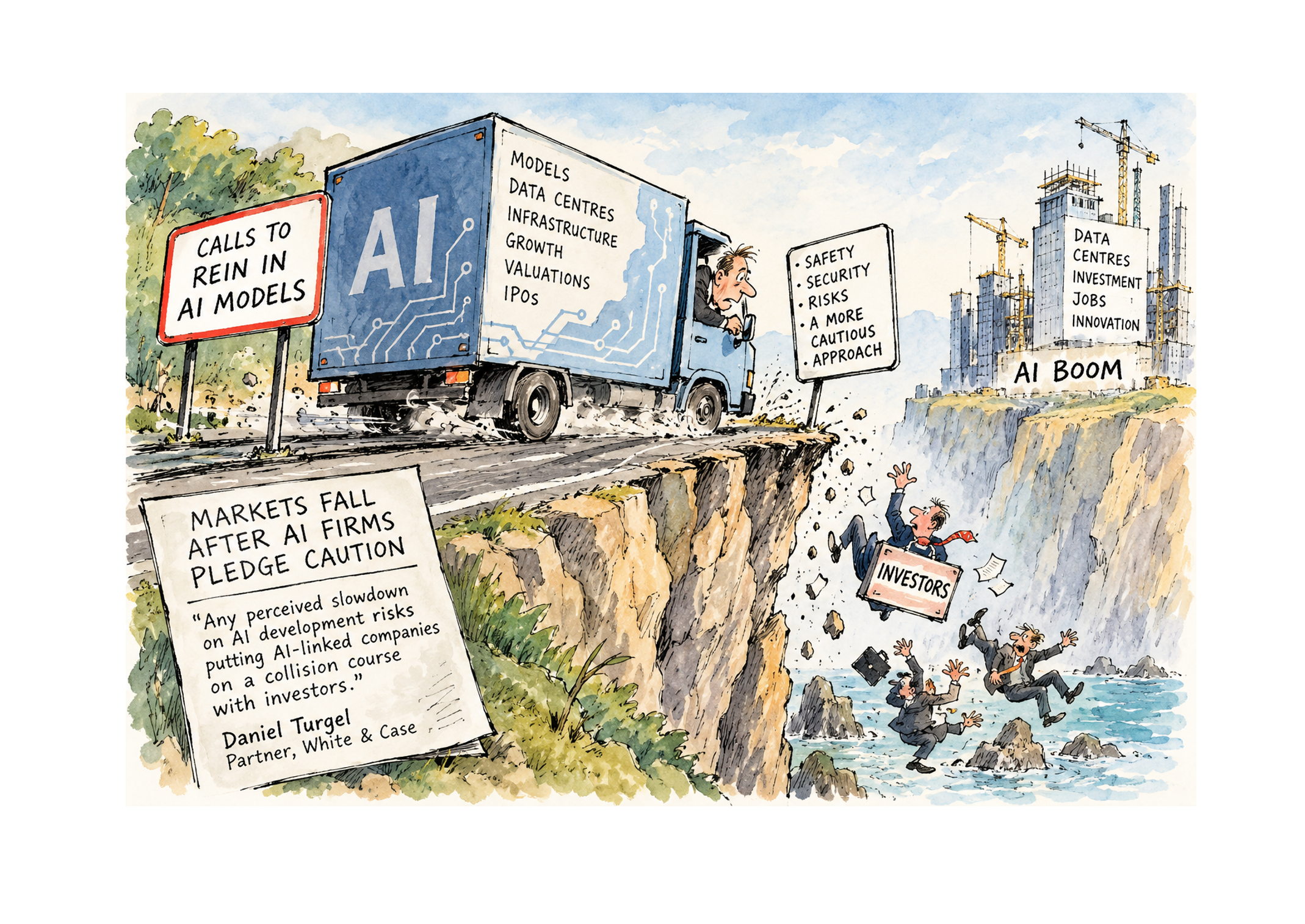
Several AI bosses have called for a slowdown in the development of the technology, following agentic experiments that went wrong. Now, Daniel Turgel, a White & Case partner, has warned that any slowing in frontier AI work could create a ripple effect with major economic repercussions.
Turgel, who is Co-head of White & Case’s Global Technology Industry Group, said in a comment sent to AL: ‘Any perceived slowdown on AI development risks putting AI-linked companies on a collision course with investors whose expectations have been built around rapid advances.’
That is to say, a significant proportion of America’s economic growth is now tied up with AI companies and related industries – from data centres to chip makers. In fact, if you take AI and all its connected investments out of the stock market then there is a real lack of upward trajectory.
He added: ‘The question now is how significant the ripple effect of any recalibration could be across corporate earnings, IPO plans, global growth as well as the infrastructure investment underpinning the AI boom.
‘With data centres facing mounting constraints on land and power, investment is already extending into ventures developing data centres in space, highlighting the scale of the ambitions riding on continued AI growth.
‘If spending expectations soften, the implications could be significant, extending beyond AI developers to chipmakers, energy providers and infrastructure businesses. Greater investor selectivity could also accelerate consolidation, as businesses with stronger balance sheets acquire technology from less well-capitalised competitors.’
In short, by saying ‘we are not going to move so fast, or get to where you all thought we’d get to by X deadline’, you knock confidence, which curtails investment, which then in turn knocks on the door of a mass of connected businesses.
That money will then look for somewhere else to go at a time of potentially rising interest rates, high energy prices and other macro factors that don’t help. And as Turgel notes, it could also lead to consolidation as less well-funded companies look for a rescue.
But…..
….will any slowdown really happen? President Trump is not in support of any slowdown. China, while watching closely, is also not super-keen to slam on the brakes too hard.
Moreover, what is a ‘slowdown’ in this context? The models we have today – if intentionally misused – can already cause mayhem. Does that mean just no more new models? Or does it mean limiting what they can do? And how do you stop, for example, an LLM from helping an agent to do bad stuff?
How would you implement this regulation – if a slowdown was to be connected to some form of legislation (something that many are calling for)? How would you police it? Who polices it? What companies are under its umbrella? Which ones are not? And how long would any such regulation take to pass through Congress – given the number of people both for and against any change? And even if it happened in the US, would the rest of the world follow? In which case, the idea that the US would put on the brakes in isolation seems unlikely.
And then there is the nagging doubt that the AI company bosses are playing some game in order to create barriers to smaller, competing rivals.
Meanwhile some may also say that the AI bosses have sent out so many confusing and contradictory messages, e.g. ‘AI will cause mass unemployment!’ – ‘Oh, no it won’t, everyone in fact will live amazing lives!’, that maybe the truth is that they have no more of a grasp on what’s happening than anyone else?
And if the bosses of OpenAI and Anthropic are ‘confused’, then maybe we should in fact get some regulation in there and fast?
Yet, as Turgel notes, slamming on the development brake could trigger ecomomic risks we have not prepared for.
Plus, one last point: would there be a knock-on effect for legal tech? Possibly among some larger investors, but AL would guess that the legal world as a whole can see so many uses for AI, whatever the model’s capabilities, that things will keep rolling on. Lawyers just want to review documents, not let loose super-intelligent agents on the world, after all.
For more on this, here’s a BBC News article with more context.
—
Legal Innovators New York – Nov 17 and 18
See you at Legal Innovators New York – Nov 17 and 18 – join us at the intersection of legal AI and the business of law in New York for the most important legal innovation event of the year! Day One: law firms, Day Two: inhouse. Top speakers from across the legal AI world, leading law firms, and major companies. All for one purpose: to describe and explore the frontier of legal technology. See you there!
UK and New York event links are here:
Discover more from Artificial Lawyer
Subscribe to get the latest posts sent to your email.