
Updated with raise news: Legal AI productivity platform Harvey has launched Shared Spaces, which allows law firms and clients to collaborate and share information all in one place. The move comes amid an increased interest in ‘multi-player’ approaches to legal AI tools. (See in-depth AL interview with Harvey below.)
–
And they have also just announced a $160m investment at an $8B valuation led by Andreessen Horowitz. The round follows EQT’s recent investment in Harvey and features new investors WndrCo and accounts advised by T. Rowe Price Associates, Inc. as well as returning investors in Sequoia, Kleiner Perkins, Conviction, and Elad Gil.
As part of this investment, Harvey will complete their first tender offer. The announcement comes as part of ‘our growth trajectory this year, which includes over 50% of the Am Law 100 law firms using Harvey alongside in-house legal teams including Bridgewater, Comcast, and Carvana,’ they told AL.
—
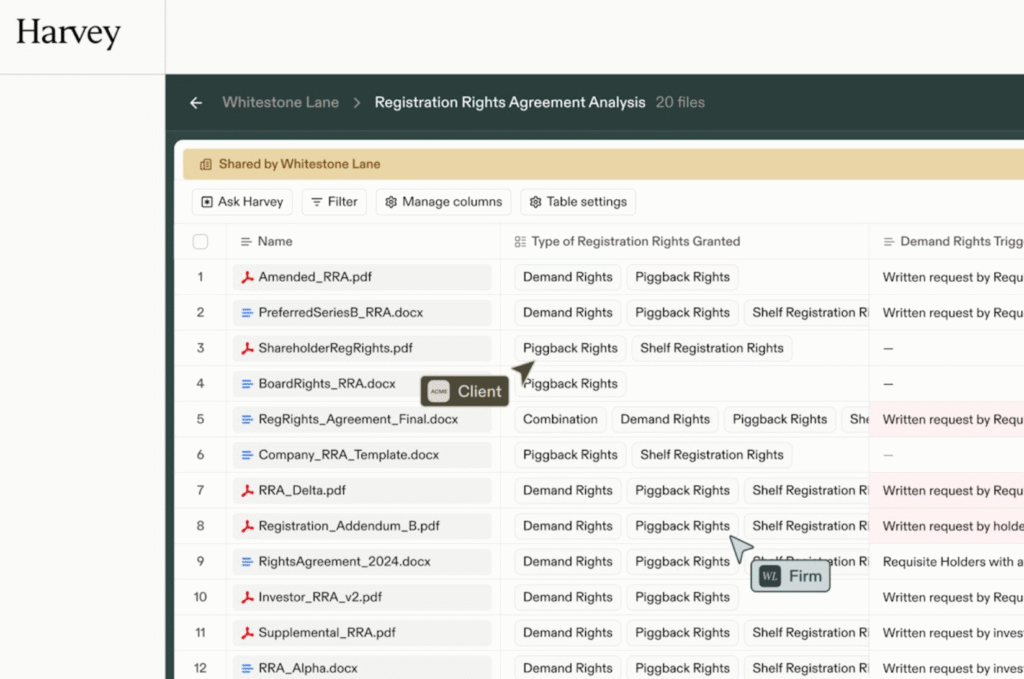
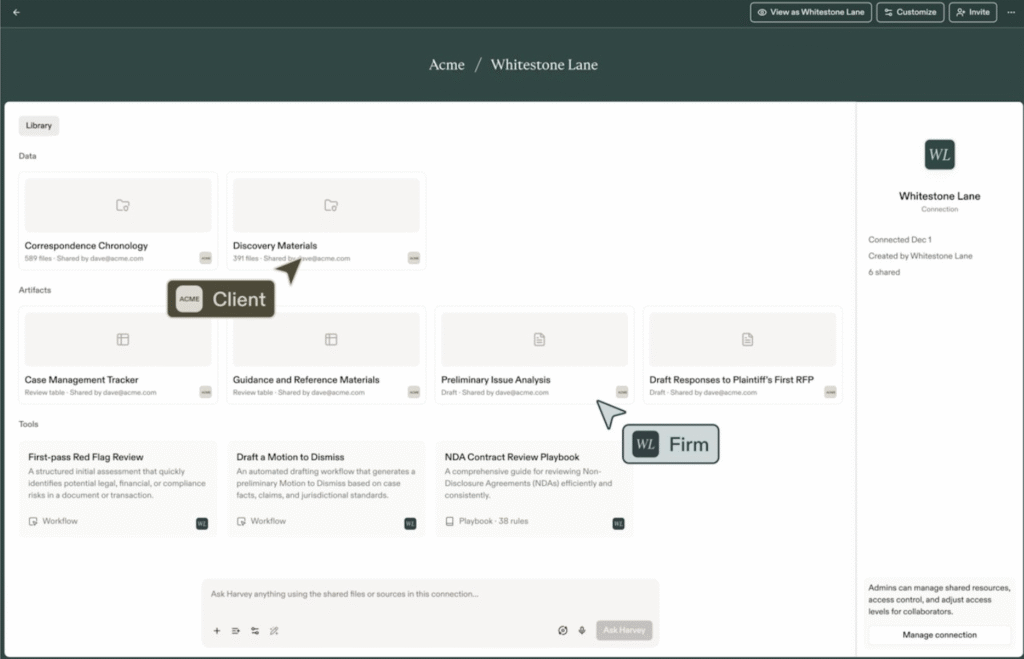
Law firms, which may act as the host, can provide ‘guest accounts’ to their clients ‘so the client does not need to have their own Harvey subscription to participate’. The company also stated that the ‘curated’ and shared space can be branded by ‘either side to fit their brand’.
Plus, ‘users can now securely share actual Harvey work product directly with external parties. This includes Vaults (documents), Review Tables, Threads, Workflows, and Playbooks,’ they explained.
Rival platform Legora has also recently launched their own multi-player collaboration system, Portal, which allows for law firms and clients to work together whilst leveraging the AI tools on their platform.
Harvey added that Shared Spaces will provide the following benefits:
Law Firms:
- ‘Law firms can share customized AI tools (like Workflows and Playbooks) without revealing the proprietary prompts or ‘secret sauce’ used to build them
- Accelerate deal cycles by collaborating with clients and AI directly in Harvey.
In-House:
- Get full visibility of outside counsel’s matter and use of AI
- Monitor progress and ensure outside counsel is following your internal playbooks
- Give business partners controlled access to data for routine questions or workflows.’
And here is a short video of how it works:
—
Plus, here are some screenshots of the interface – note the client info and the firm info.
–
AL Interview
Artificial Lawyer also asked Matt Zerweck, Head of Enterprise Product for Harvey, if he could tell us some more about the new capability.
Why structure things this way? How did you come to choose this way of balancing law firm and client need?
We wanted to ensure our product reflected how modern legal work happens. Firms and their clients work closely together, and the most effective legal work depends on seamless collaboration. Firms have been asking for better ways to share their expertise through playbooks, workflows, and curated databases to deliver a best-in-class experience to their clients. Clients have been asking for faster results on legal matters, greater visibility, earlier alignment, and their firm’s expertise embedded throughout the process.
The goal with shared spaces and our collaboration offerings is to satisfy the needs on both sides of the market by enabling real-time collaboration, allowing firms to productize and scale their expertise, ensuring clients consistently leverage firm best practices, guidance, and knowledge, and giving both parties the transparency and speed they expect. This structure reflects how legal work gets done in practice today and positions everyone to work more strategically and efficiently.
In terms of the tech behind the Shared Space, what is that? And where is that hosting taking place?
Shared Spaces are built on Harvey’s existing tech stack, using the same secure infrastructure that powers the rest of our platform. Each Shared Space is hosted by the team that creates it, and the same goes for the resources shared. The originating workspace will have full ownership and control over the shared resources. Data residency is preserved at all times, which means the underlying resource data never leaves the host workspace’s infrastructure.
Law firms can protect proprietary prompts, why is this so important to the firms?
In many cases, prompts can be considered proprietary intellectual property because they capture expertise, judgment, and firm data. Enabling firms to protect that is essential to maintaining quality and preserving the value they deliver to clients. Our collaboration suite gives firms full control over what they share and what they keep private, so they can deliver great outputs without exposing their internal prompting methods or IP.
On the security side of things, how is that covered when sharing important information?
Across the Harvey platform, we ensure teams have the right security and governance in place, and Shared Spaces are no different. Each connection can have designated admins on each side who manage what gets shared, who can share, and the level of access each participant receives. Each resource shared can be set to view, edit, or full access, depending on how much control a firm wants to retain or grant. This allows firms to share outputs while keeping sensitive methods private, or to collaborate more deeply when appropriate. With granular permissions, approval flows, and clear ownership boundaries, firms can collaborate confidently without compromising security or control. Ultimately, the concept of collaboration is only a worthy path to pursue if controls and security are front and centre, and that’s how we have architected our approach at Harvey.’
Thanks very much.
–
You can find more about Harvey here.
—
Discover more from Artificial Lawyer
Subscribe to get the latest posts sent to your email.