By Ryan Samii, Head of Product Innovation, Harvey.
Terence Tao, the world’s greatest mathematician, recently suggested we’re living through a ‘cognitive Copernican revolution.’ His point: for a long time, we placed a very specific form of intelligence at the center of everything. Human intelligence.
Now, AI is revealing that intelligence comes in very different types, with very different strengths.
It’s a pretty disorienting idea. How do we make sense of it?
Let’s put AI aside for a moment. Instead, let’s consider the traditional balance of work within a knowledge-intensive organization, like a law firm. Multiple ‘layers’ of work co-exist.
There’s one layer of work that’s traditionally systematic in nature. Research, extraction, synthesis, comparison. An associate pulling comparable transactions, mapping risk factors, reviewing hundreds of pages of diligence or discovery, poring over a web of cases.
Then, there’s another layer of work. Spotting the issue the checklist didn’t anticipate. Recognizing patterns across matters and past work. Making the call that no instruction specifically contemplated.
The progression from the first layer (structured execution) to the second layer (complex, multi-variable reasoning) is the arc of pretty much every career in knowledge work. Ask a partner or managing director to describe the characteristics of a ‘star junior associate’ vs. a ‘star mid-level associate’ and you’ll see what I mean.
Most people in professional settings will readily acknowledge that these different layers of work exist. But what if that articulation understates it? What if, instead, we need to begin thinking about this as work that runs on different underlying intelligence?
It’s an unusual way to put it. We’re so accustomed to thinking about intelligence as a monolith. But if you’re willing to make the leap — that the existing ways of working already involve different intelligence inputs, with different strengths, producing different outputs, all in collaboration with one another — then Tao’s Copernican shift starts to feel less abstract and more like a description of something you’ve been living with all along.
And it reframes the AI question entirely.
Because if you recognize the first layer — systematic, structured, repeatable — as the form of intelligence where AI has proven itself to date, then what’s happening now becomes clear: AI is breaking through to the second layer.
What Changed
Until recently, AI agents in legal operated within human-designed systems. Lawyers encoded their expertise into structured workflows — checklists, extraction templates, review logic — and the agent executed reliably within those constraints.
Valuable. But a bit bounded.
The human designed the decision tree. Harvey navigated it. This is the first layer of intelligence, systematized and deployed at scale. Harvey has been running this kind of work at scale: over 700,000 agentic tasks executed daily, more than 50 million terms extracted weekly.
What’s new is that these ‘long horizon agents‘ can now control the loop themselves.
Give the agent a task, the relevant documents, and a set of tools — and instead of following a pre-mapped path, it prompts itself. It selects approaches. It evaluates intermediate results. It iterates until the work meets the bar. The shift is from human-designed execution to AI-navigated reasoning.
Two things made this possible.
First, foundation models can now sustain coherent reasoning across many steps without degrading — a qualitative jump from even months ago. Second, the execution infrastructure matured: sandboxed environments, scoped tool access, durable audit trails. The models became capable enough to do the work and the ‘harness engineering’ made it reliable enough to trust.
In a recent experiment, Harvey gave agents complex legal tasks and through iterative self-improvement, agent performance moved from roughly 41% to 88%.
How This Manifests for Knowledge Work
For repeatable work, lawyers or other professionals encode their expertise once and deploy it at scale. A diligence checklist for a client’s red flags runs identically across hundreds of documents. This form of intelligence has an advantage: it executes at scale with precise direction.
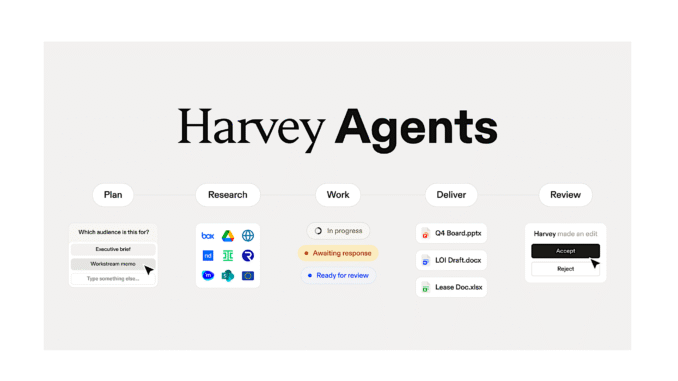
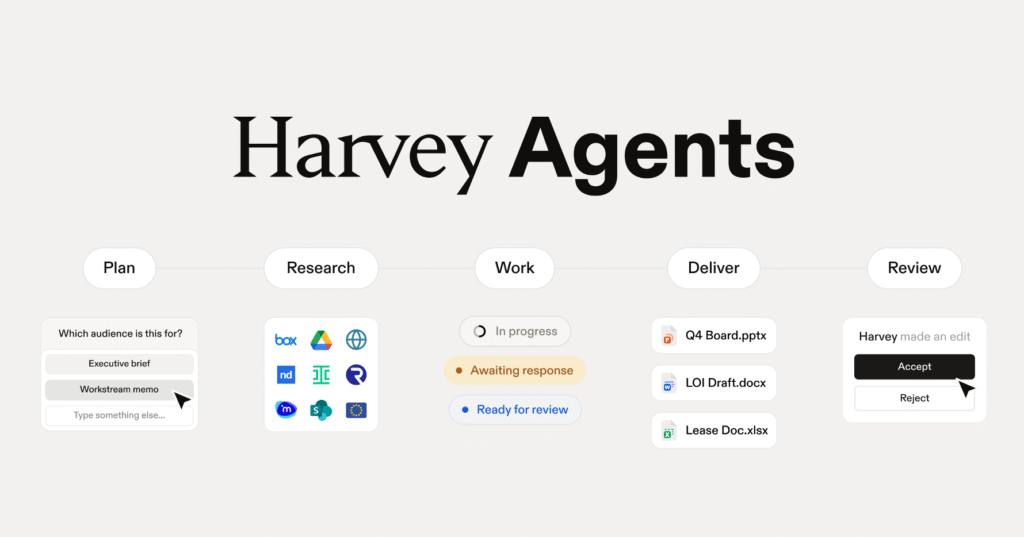
For complex, long-horizon work, the experience is more like directing a colleague than running a prescribed workflow. It’s a new capability. Harvey produces a plan. The lawyer reviews and refines it before execution begins. As Harvey works, routine decisions get logged and are available for review. When the task requires it, Harvey gathers context across documents, selects the appropriate tools, and determines the right sequence
Instead of pre-defining a decision tree, the lawyer will direct Harvey’s goal through our Assistant feature or through the updated version of our Agent Builder. This form of intelligence has a different advantage: it reasons through problems rather than executing against them
Now, if the path taken is one that may be repeated in the future, the lawyer will soon be enabled to save that path as a reusable workflow — converting a one-time reasoning chain into a durable, reusable process.
Just as different forms or ‘units’ of intelligence co-exist within law firms today, Harvey can invoke repeat workflows as part of its broader execution. Not so different from how a seasoned lawyer directing a complex matter will draw upon established institutional processes or colleagues with specific expertise.
The orchestration layer — deciding which form of intelligence to deploy, when, and toward what end — is where the lawyer’s judgment will now live.
The Opportunity
Harvey co-founder Gabe Pereyra recently described where organizations are heading: ‘a surplus of intelligence bottlenecked by judgment.’
For law firms, that bottleneck is the opportunity.
When every form of intelligence was scarce, a firm’s economics were defined by how much of it you could produce. Headcount. Hours. Leverage ratios. In a world where certain forms of intelligence are more abundant, judgment reaches further — across more matters, more clients, and more complex problems than the old staffing model could support.
The firms that win will be defined by the reach of their judgment. A partner’s strategic framework deployed across an entire portfolio, not just the matter she’s personally staffing. Institutional knowledge embedded in agent workflows rather than locked in individual heads. The ability to serve clients and workstreams that the old staffing model struggled to support.
The pyramid is reshaping. As the production base compresses, the structure that emerges will look fundamentally different — with judgment, not output, as the defining layer. The firms that recognize this won’t simply operate more efficiently. They’ll redefine what a law firm can do.
For a closer look at how these capabilities are taking shape in practice, see here: Harvey Agents.
—
[ This is a sponsored thought leadership article by Harvey for Artificial Lawyer. ]
Discover more from Artificial Lawyer
Subscribe to get the latest posts sent to your email.