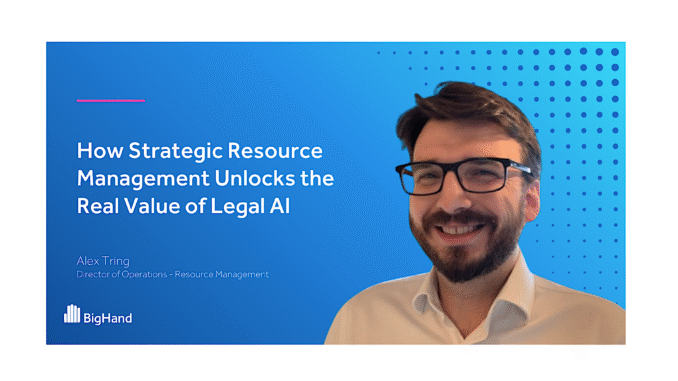
By Alex Tring, BigHand.
For all the noise around AI reshaping legal work, one thing is clear: successful adoption is only possible in firms that truly understand their people and the impact of such a significant change on workforce strategy.
Those who layer AI into how their lawyers operate, with clarity and purpose and without generating career anxiety, have a smoother, more exciting path ahead.
The introduction of legal AI can serve as a catalyst for redesigning lawyer development and elevating roles throughout a firm’s hierarchy. Much of the public conversation has focused on what junior lawyers might lose as AI automates the repetitive tasks that once formed the foundation of legal training. But inside firms, a more constructive reality may emerge. AI can change the composition of junior-level work without eliminating it.
New AI-driven operating models may allow firms to increase value from junior lawyers much earlier. New generations coming into the workforce will be more and more ‘AI literate’. They won’t find working alongside an artificial colleague new or revolutionary, but rather in line with their expectations and experience of how they live, work, and learn. Firms should use that to their advantage. Embrace new opportunities for earlier exposure, richer learning, and more intentional development pathways, driven and facilitated by AI.
Achieving that kind of outcome will be a journey for some. It’s not easy, and it relies on data, insight, and structures that many still lack, or that are still evolving.
How firms manage the allocation of work and the intelligence they apply to that process plays a big role in the optimal adoption of AI. Understanding how you use your people alongside these new tools, and structuring matters with the right balance of lawyers and technology, will determine which firms deliver the strongest results (for them and their clients).
A Changing Work Mix and a New Set of Opportunities
For decades, the apprenticeship model relied on juniors learning by doing. Drafting, reviewing, researching, and gradually building the expertise required for more complex work. AI can now handle much of the manual execution, but it doesn’t remove the need for human oversight, contextual understanding, or legal judgment.
Even as some tasks are accelerated, lawyers now must be able to:
- Review and validate AI-generated output
- Apply contextual judgment
- Draw out insights and meaning
- Manage hybrid workflows between people and technology
For sustainable adoption of AI, the kind that sets a firm up for long-term success, that work needs to be allocated in a more intelligent manner. Junior lawyers need to be deliberately exposed to the right tasks in order to acquire the right skills.

The Role of Strategic Resource Management in the Successful Adoption of Legal AI
BigHand’s 2025 Resource Management Report found that nearly 40% of work allocation is still driven by personal preference rather than merit, skills, career goals, or development needs. Add AI to that model, and it’s going to be difficult to construct teams or make the best use of your lawyers alongside the shiny new tech, let alone develop new talent.
A robust technology and data-led approach to resource management gives firms something they’ve historically lacked. A clear, data-driven view of their people, their workloads, their skills, their interests, and their development needs. That visibility is the foundation for redesigning work allocation to support both performance and growth.
Firms can understand…
- Who is doing what
- How matters are structured and resourced
- How the delivery of a matter is tracking against plan
- Who is developing which skills
- Who is overloaded or underutilised
- Where development needs or lawyer preferences can be considered
- Where there is flexibility to adjust and prioritise across workloads
…and, bring all that data and insight into the allocation and lawyer career management process.
With that kind of structure in place, firms can introduce AI and utilise their intentional and intelligent allocation approach to:
- Ensure the right lawyers are in place to validate and synthesise AI-produced work
- Balance workload and learning opportunities across teams
- Structure matters with the right blend of lawyer and technology
- Surface emerging skills and development needs early
In other words, resource management becomes the orchestration layer that enables firms to integrate AI thoughtfully around their people.
What This Looks Like in Practice
Womble Bond Dickinson offers a compelling example. After integrating BigHand Resource Management into a real estate practice group, the firm saw improvements in utilisation, output, and retention. Administrative tasks were shifted away from fee earners, utilisation rose by 10% over two years, and staff retention increased by 33% in the first year.
But the most important shift was developmental. As Resource Manager Fran Perry put it, data-led allocation gives ‘all the fee earners a chance to get involved in work they might not otherwise see.’
That exposure is exactly what firms need to protect and rebuild in an AI-enabled environment.
AI Doesn’t Replace Development, It Demands Better Development
Whether you believe AI will accelerate learning or risk hollowing out expertise, the conclusion is the same. Leaving development to chance is no longer viable.
Firms that succeed will:
- Redesign their operating models
- Treat work allocation as a strategic capability
- Use data to ensure equitable access to meaningful work
- Build development pathways that reflect how work is actually done
AI is reshaping legal work, but it doesn’t diminish the need for capable lawyers. It simply requires firms to think more carefully and strategically about how it supports them.
Resource management is central to that shift, as the mechanism that ensures capabilities compound across generations. For a deeper look at how leading firms are moving beyond partner-led allocation, read the full Womble Bond Dickinson case study.
—
About the author: Alex Tring is Director of Operations, Resource Management at BigHand.
–
[ This is a sponsored thought leadership article by BigHand for Artificial Lawyer. ]
Discover more from Artificial Lawyer
Subscribe to get the latest posts sent to your email.