Anthropic has created agents that can represent buyers and sellers in a transaction. For now, these are simple barter arrangements, but they point the way to a possible future for transactional legal work.
As they stated: ‘Anthropic [is] interested in how AI models could begin to affect commercial exchange. You might recall Project Vend, where we had Claude run a small business from our office.
‘Recently, economists have begun theorizing about a world in which AI models handle many or most transactions on humans’ behalf. We thought we’d run a new experiment—Project Deal—to learn more about this in practice.
‘Specifically, we wondered: how close are we to marketplaces in which AI ‘agents’ represent both parties? Could they figure out what humans want and make deals they’d be happy with? And what would happen if there were different AI agents negotiating with each other—would stronger models gain the upper hand?’
‘[So] for one week, we created a classified marketplace for employees in our San Francisco office—like Craigslist, but with a twist: all of the deals were conducted by AI models acting on our employees’ behalf.’
It worked really well, and some of the staff who took part said that they would pay for such an agent to negotiate on their behalf – which has huge implications for the wider retail world. However, as readers can imagine, this is just the beginning. A significant prize for the commercial world is not just getting agents to buy your shopping, but also to work on more complex B2B deals, such as where lawyers would be involved.
Anthropic concluded: ‘To be sure, this was a pilot experiment with a self-selected participant pool. But we suspect we’re not far from more agent-to-agent commerce bubbling up in the real world, with real consequences.’
Is this a big deal?
Yes. Even before Artificial Lawyer started in 2016, its founder, Richard Tromans, had written a paper in 2015 on the potential for two AI systems to negotiate a deal, using game theory to reach a conclusion.
After AL got started, one startup, Pactum, started to use early NLP to help with basic procurement transactions for companies such as Walmart. It’s still going and has embraced LLMs now.
And of course, we have seen dozens of companies use genAI to help with contract review work. Although, this has not been moved to an entirely agentic, autonomous level yet between both parties. (At Pactum, the agent is there to ‘assist’, not lead the negotiation.)
What the work here opens up – and as mentioned, AL and others have explored this even a decade ago – is that law firm clients could engage with each other’s agents and get as far down the road on a deal as they can….without the lawyers really getting that involved. These would probably be relatively simple deals to start with. But, even that would be a major step forward.
With the ability of AI systems to now tap playbooks, tons of past legal data, the ability to work in ‘shared spaces’, and operate via defined workflows, the era of truly automated, agentic negotiation may not be that far away.
Naturally, the key issue is accuracy and also getting the result you want. Playbooks, and very clearly defined end points – or at least end goals – for a negotiation between two agents, will help. However, the agents will have to be taught when to stop. Otherwise they may end up in an endless loop.
AL can see a time when the inhouse team of one company activates their deal agent – perhaps having dozens of them for all types of different deals (both small procurements and more complex matters) – and then the other side activates their agents as well that match.
The two agents go to work, the contractual result is provided, and the lawyers of both sides look it over. If things are too complex then it gets sent out to a law firm to sort things out, perhaps using their agents, or just pure human insight.
Or maybe innovative law firms can be quick here and offer their clients their agents first for such deals?
One barrier is that we need both sides to have agents. If just one has them then it won’t work as a truly automated process. But, as AI use spreads, then this will become more possible.
Plus, when a company such as Anthropic gets into this, and where it’s already playing in the legal space, the possibility of this happening in the future is growing.
Richard Tromans, Founder, Artificial Lawyer.
You can read more here. And below is how they did it.
—
Conference Advertisement:
A Legal Tech Conference For All of Europe
Legal Innovators Europe – Paris – June 24 and 25.
Express route to your ticket here.

And,
Express route to your Legal Innovators California June 10th and 11th ticket here.
Legal Innovators California, the landmark West Coast legal tech event, will take place on June 10 and 11, in the heart of the Bay Area, the home to many of the world’s leading AI businesses – and plenty of legal tech pioneers as well! More information and tickets here.
—
The setup
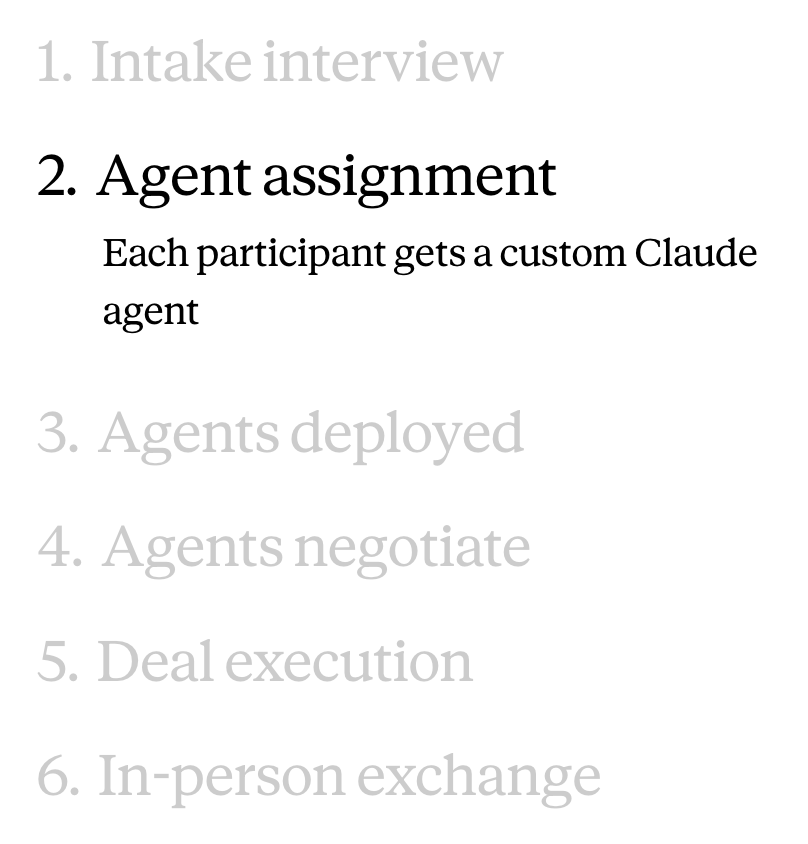
First and foremost: to run this experiment, we needed a set of brave human volunteers who possessed both lots of stuff they wanted to get rid of and a possibly abnormal willingness to let AI play an influential role in their lives. Fortunately, such a group was very readily available to us—our own colleagues. We recruited 69 Anthropic employees, gave them each a $100 “budget” (paid out after the experiment in the form of a gift card, plus or minus the value of whatever they bought or sold), and promised them that they would actually get to execute the exchange of goods agreed upon by their agents.
Volunteers on board, we asked Claude to conduct an interview with each one, in a format much like our Anthropic Interviewer. This elicited a wealth of information: what our volunteers wanted to sell, how much they wanted to sell it for, what they were interested in buying, what they’d pay, and any other instructions they had for the negotiation or interaction style of their agents. These responses informed custom system prompts that we set for each person’s AI representative.
See Anthropic’s Project Deal page for more.
—
Discover more from Artificial Lawyer
Subscribe to get the latest posts sent to your email.