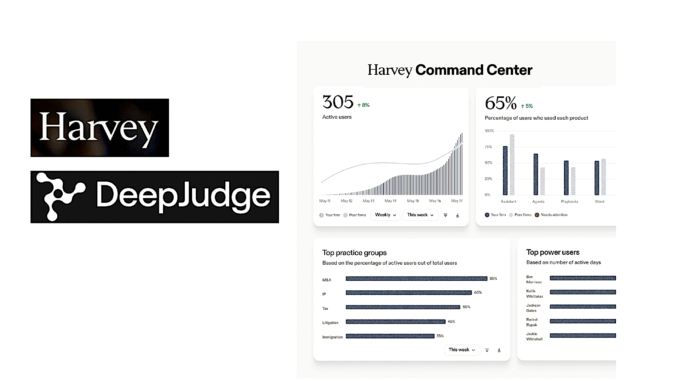
There’s a lot happening at Harvey this week. First, they’ve forged a partnership with genAI KM pioneer DeepJudge (more below), and also have launched Command Center, a peer-based window pane into how customers are using different Harvey features.
The Command Center lets you see plenty of things, but for Artificial Lawyer the most interesting aspect here is that law firms, and inhouse teams, can allow their Harvey usage data to be shared with their peers. This way everyone knows how far they are in step, or behind, everyone else.
It can be broken down into specific features, e.g. the use of Shared Spaces, and also by practice area. The data shared with peers is, as you’d expect, totally anonymous and without any sensitive info attached. Meanwhile, the internal only view can drill down into a more detailed firm-wide picture.
Harvey’s new CPO, Anique Drumright, told Artificial Lawyer: ‘It lets you see if you are evolving at the same pace as the market. And it allows you to see, for example, which practice areas are adopting a feature the slowest or fastest.’
This in turn helps the firm as a whole to know where they are, plus it also supports innovation heads to gauge what impact Harvey is having – at least in usage terms. Drumright added that the reports Command Centre makes can also be turned into AI-produced presentations that can be shared across the business.
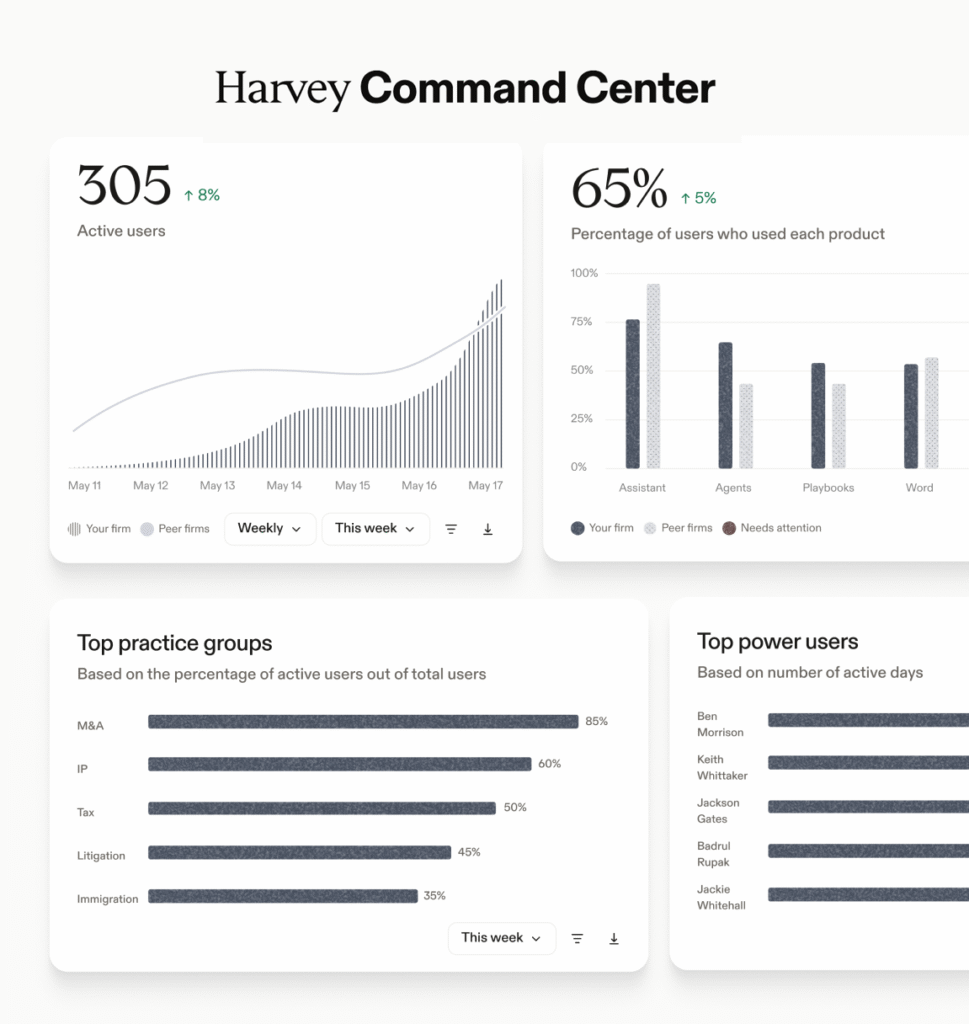
And here’s a summary of some of the key aspects:
– ‘Command Center gives organizations visibility into how Harvey is being used across practice groups, offices, product areas, and user cohorts.
– The platform is intended to help firms identify adoption trends, usage concentration, and areas where rollout efforts may require additional support or training.
– In addition to internal analytics, Command Center introduces peer benchmarking based on anonymized and aggregated usage data from more than 1,500 Harvey deployments globally.
– Command Center includes an agentic layer that allows users to ask questions over deployment and usage data in natural language, so you can ask about:
– how adoption differs across practice groups,
– how partner usage compares to associate usage,
– what behaviors distinguish highly engaged users,
– and which workflows or prompt types are driving adoption.
– The platform also includes an Intelligent Recommendations capability designed to help organizations identify Harvey features and capabilities that peer organizations have already enabled or adopted.’
But, let’s leave that now with a comment from Sean Monahan, Foley Director of Practice Innovation, who is among the organisations Harvey worked with to develop this, which also included Haynes Boone, Clayton Utz, Rajah & Tann, and Dentsu.
Monahan said: ‘Command Center gives administrators visibility into how Harvey is being used across the firm — adoption trends, high-value use cases, underutilized groups, and where training is needed — along with clearer insight into whether the platform is being used consistently with firm policies. Overall, it moves Foley from anecdotal assessments of AI usage to data-driven management of deployment, training, governance, and value creation.’
—
( Legal Innovators California Conference advert )
Tickets For Legal Innovators California Conference – SF – June 10 + 11
To gain your complimentary pass for the two-day landmark legal AI event in San Francisco, please use the Express Registration here – only for those working within law firms or inhouse teams.

—
And now onto DeepJudge. As readers will know, the Swiss legal AI startup, formed by ex-Google people, has quickly managed to win over law firms in terms of its ability to get into their documents to classify and surface key information that their lawyers need in their work.
This is quite a feat, given that law firms are very picky about which tech companies they will let look into their holiest of holies, i.e. their document stack. In fact, over the years, AL has heard many stories about X or Y legal tech company that has offered to fillet a law firm’s DMS to surface information and was politely told: ‘Thanks, but no thanks.’
So, with that context, it’s a big deal that Harvey has formed this relationship, as it will certainly help them to do more with firms.
This is how it will work.
- ‘DeepJudge brings an organization’s past work, decisions, and expertise to Harvey’s workflows, while respecting existing access permissions and ethical walls, enabling legal teams to research, draft, analyze, [and so on].
- This [also] enables AI agents that not only generate and evaluate high-quality outputs, but also align them with what ‘good looks like’ within a specific legal team, grounded in institutional expertise, prior decisions, and the collective judgment built through years of practice.
- And, as work continues across both platforms, the organization’s knowledge compounds over time, becoming stronger, more connected, and more accessible. In legal, a firm’s knowledge is its product, and activating it across matters is what turns AI into a differentiator.’
The partnership also addresses the ‘context tax’, i.e. the pain in the proverbial caused by having to go in and out of multiple, but much-needed, disconnected applications.
Paulina Grnarova, CEO and co-founder of DeepJudge, commented: ‘DeepJudge brings past work, decisions, and institutional expertise directly into that reasoning, so that the resulting work reflects the judgment, standards, and ways of working unique to each firm or legal department. Together, DeepJudge and Harvey enable legal professionals to manage the full arc of legal work seamlessly, while ensuring AI outputs are grounded in how they actually practice.’
And Winston Weinberg, CEO and co-founder of Harvey, concluded: ‘DeepJudge knows your firm through every past matter, memo, and negotiated position. Most firms have decades of expertise embedded across prior work and decisions, but that knowledge is often fragmented and difficult to apply consistently in practice.
‘This partnership closes that gap by bringing a firm’s institutional knowledge directly to Harvey users, enabling legal teams to ground their work in prior expertise and run their practice on a system that reflects how they actually operate.’
–
Overall, two major moves by Harvey, both with practical benefits, but in different areas of legal innovation. And expect more tomorrow.
—
More about Harvey here, and about DeepJudge here.
–
And if you found this interesting and are in Europe, then come along to the Legal Innovators Europe conference in Paris – June 24 (Law Firm Day) and 25 (Inhouse Day).
Express route to your ticket here.

Discover more from Artificial Lawyer
Subscribe to get the latest posts sent to your email.