
Lavern, which is figuratively a ‘law firm’, has formally launched and now offers 67 specialist legal agents that can perform key tasks. Together they form an ‘agentic team’.
Here, its creator Antti Innanen, the well-known legal tech expert, explains how Lavern works and why he’s doing this.
As noted, it’s not a ‘law firm’ in the current sense of the phrase, but it raises the question: what is a law firm? If an organization or entity performs a range of legal work for you, is it a still a law firm if the ‘staff’ are in fact agents? Is the ‘real law firm’ of the future just the judgment bit? Do we eventually get agent-dominated law firms, and then human-dominated judgment layer law firms? I.e. is there a bifurcation driven by irreconcilable business models? Some may say we are already at that point.
Right, onto Lavern in detail, in the words of its creator, below.
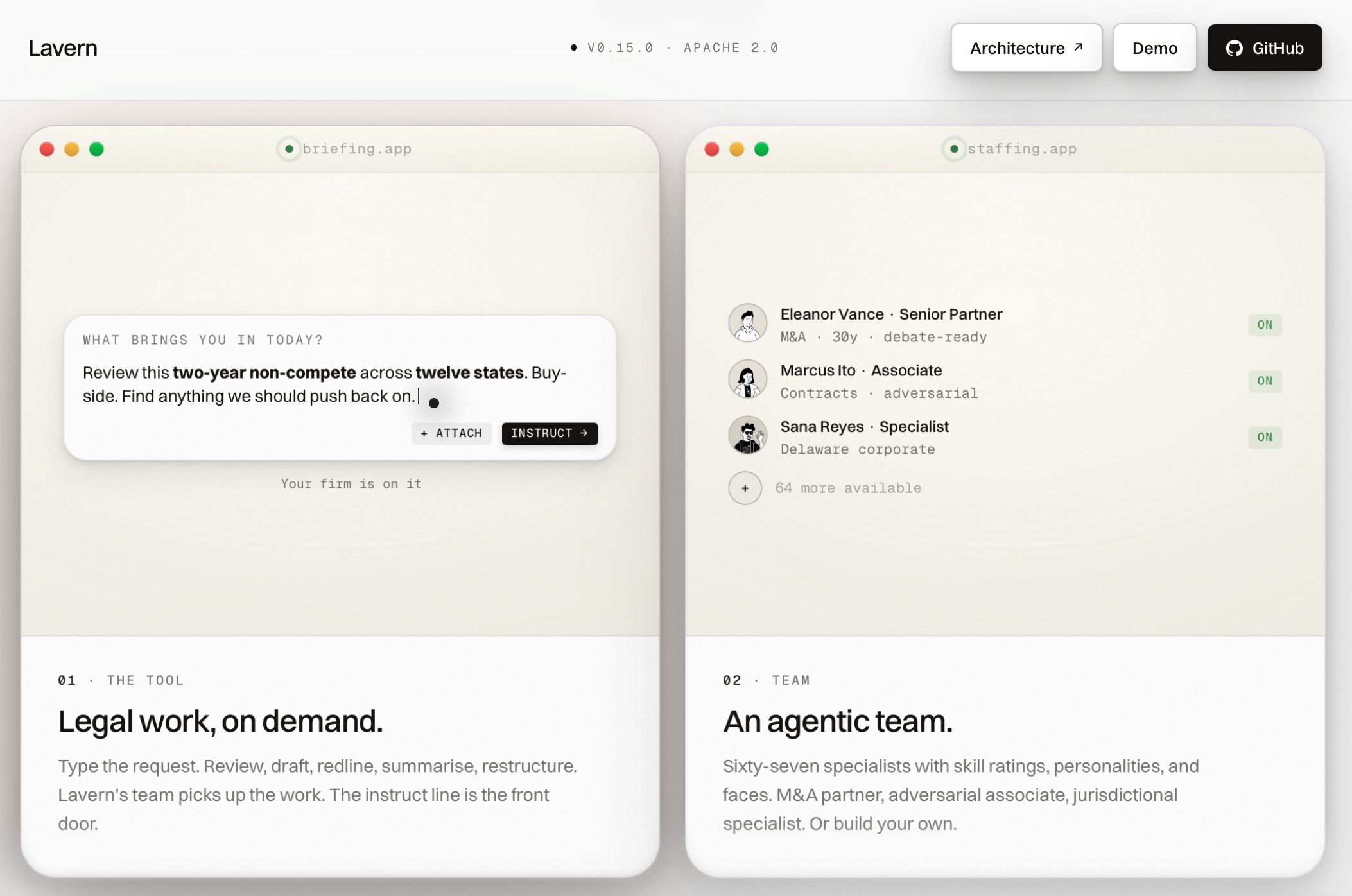
—
Lavern Goes Open Source
By Antti Innanen
Today we are releasing Lavern. For free.
An agentic legal system, six months in the making, 155,000+ lines of code, 67 specialist agents, eight workflows, and at least ten things inside it that you could make as a separate product.
In April I wrote that Lavern had thirty days to find the right home, and that if it did not, the whole thing would go open. The thirty days came and went. A lot of good conversations happened. But in the end, I thought that open source was really the only thing that made sense.
License is Apache 2.0. The repo is public as of this morning. All of it yours.
It is one of the most ambitious open-source legal AI tools published so far. Look at the repo and decide for yourself.
Law is having an open-source moment
Law has always been a closed system. Legalese is exclusionary. Bar rules. Workflows are proprietary. And the legal tech scene is dominated by big players.
But now it is quickly changing. First MikeOSS arrived, claiming feature equivalence with Harvey and Legora. It caused huge waves.
Now in the last weeks, the discussion has been about agentic workflows. Legora announced an ‘agentic operating system’ and Harvey rolled out a public ‘agents’ page across thirty practice areas.
Claude for Legal just dropped. OpenAI is planning ‘Codex for Legal.’
Many of these are building in a direction focused on efficiency and accuracy. And these are good things, and great products.
But what if we built in a different direction? Could we employ the dreaded ‘non-lawyers’ in an agentic setting? Could we build something that resembles a modern law firm, with different professions collaborating on legal problems?
What if the opportunity is making law understandable, accessible, elegant, human-centered?
And if we would like to build differently, where do you start?
What is in the box?
Lavern is best understood as a collection of ideas in one repo. A polished demo of how we could build in the future.
You can criticise it for not working as a product. That misses the mark. It is not meant to be a product. It is a source of inspiration.
It is at least ten things, several of which are, on their own, products somebody could build a company around. They are sitting in the repo. Take whichever ones you want.
A few highlights:
Clawern. Autonomous folder-watcher with multi-agent review, running on a local model. This could ship as a standalone macOS app with some tweaking.
The agent corpus. 67 agent prompts, eight workflows, openly licensed. All different flavors.
The orchestration engine. Debate, gates, hand-offs, synthesis. Domain-agnostic. Strip the legal layer off and it is a multi-agent debate framework that works for medicine, policy analysis, or due diligence on anything.
Hybrid local-plus-frontier processing. Anonymise on-device, send only safe snippets to the frontier model. The privacy architecture every regulated industry says it needs and almost nobody has shipped. Not legal-specific. Take it.
Agent builder. Build your own agents or clone teams. A fun way to think about agentic work. Reminds me of NBA 2K’s team builder. Or Pokémon.
The Challenge. Blind document comparison. Drop a contract in, get a side-by-side against the standard, with reasoning. Mostly useful in-house, mostly underbuilt as a category.
If you ship one of these and never mention me, that is fine too. That is kind of the point.
Don’t read it. Point Claude Code at it.
A 155,000-line repo is intimidating and you should not try to read it. Point your AI tool at it.
Then ask things like:
‘Walk me through how the multi-agent debate works.’
‘Extract just the Claw module into its own repo I can ship.’
‘Show me the agent corpus without the rest.’
‘Rebuild the orchestrator for a non-legal domain.’
‘What would it take to build [your idea] from these pieces?’
Nobody is going to read 155,000 lines. But AI can quickly make sense of it, to explain the ideas to you. And there is a longer piece on the architechture on the site too.
The Law is the Claw
There is a new kind of strategy forming. The Lil B strategy. The Claw strategy.
Peter Steinberger built Clawde, watched it go viral, renamed it a few times, got hired by OpenAI, handed the project to a foundation, and moved on.
Lil B understood the same thing about music a decade earlier. When the cost of producing a track collapsed, the old strategy stopped making sense. The new strategy was to release everything, build in public, let the audience decide what was real.
Drake just dropped three new albums. Fred Again.. released a continuous 108-hour mix.
Why can’t we release for free in legal tech?
Open source has never meant nobody makes money. It has meant nobody makes money from the specific thing that has been opened.
The open-source movement understood this in the 1990s, in a more procedural way. Releasing software for free is not generosity. It is a financial weapon. It removes the ability of anyone (including the person doing the releasing) to make money by gating access to that specific thing, which forces everyone, including the person doing the releasing, to compete on something else.
Linux came from Finland. Lavern is following in the same footsteps. And maybe your project too. We can build and collaborate together. All we ask is that you build in a direction that makes law more accessible, more human, and maybe even…fun?
We are voting with the code. More about Lavern here.
—
Antti Innanen is the founder of Legit, an AI consulting firm, and Dot., a legal design firm. Lavern is a legal tech tool, not an actual law firm, and does not provide legal advice or employ lawyers. Use it at your own risk.
–
And for those of you who would like to dig in, here’s the GitHub page.
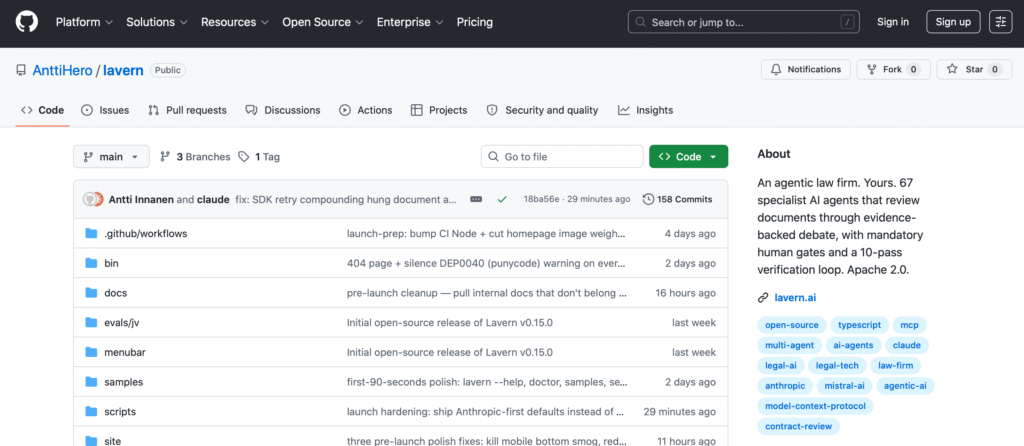
—
Legal Innovators Europe Conference – in Paris – June 24 and 25
And if you found this interesting, then come along to the Legal Innovators Europe conference in Paris – June 24 (Law Firm Day) and 25 (Inhouse Day).
Express route to your ticket here.

Discover more from Artificial Lawyer
Subscribe to get the latest posts sent to your email.