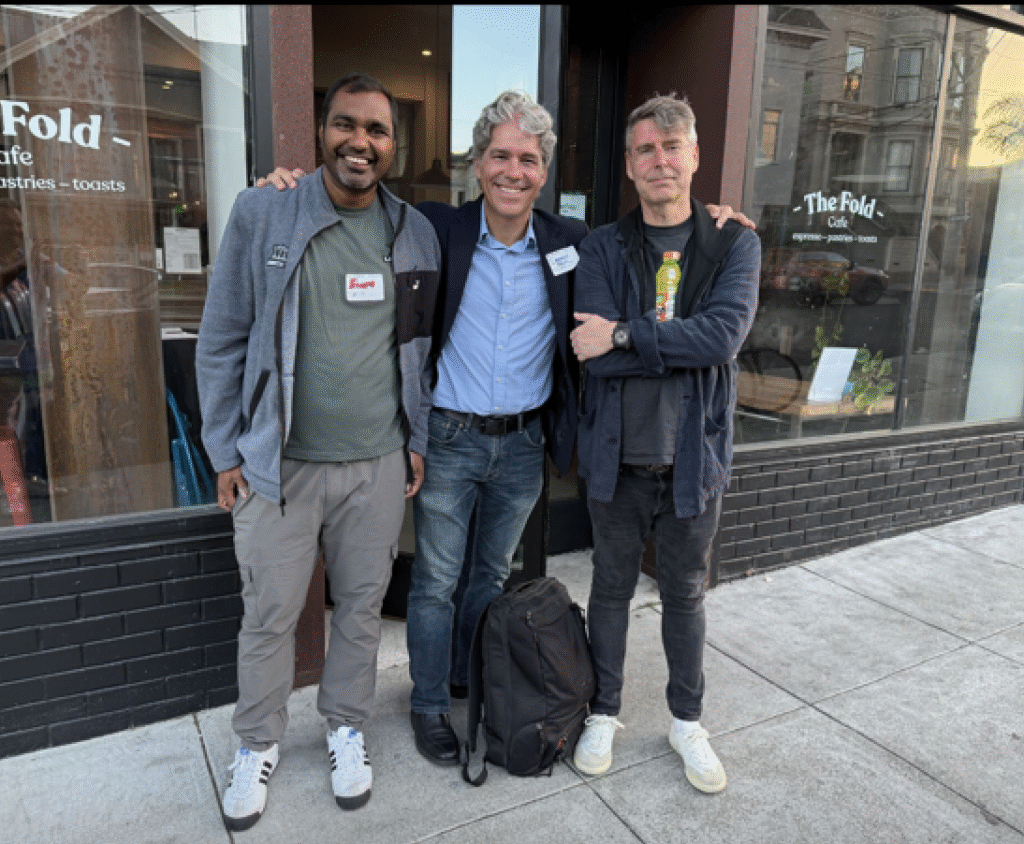
At the pre-conference event in the Mission District, Enam Hoque announced: ‘We are not the status quo, we are the rebellion. We all got here by X-Wing.’ Well, some of us travelled by Waymo at any rate, but it really helped capture the mood of what was to come in the next two days.
In the heart of San Francisco, Legal Innovators California (LIC) took place, bringing together what felt like a masterclass in frontier thinking about legal AI and the business of law. Artificial Lawyer attends a fair amount of conferences – although these days I try to avoid the shopping mall-style events – but LIC always feels special, to me at least. Why? Because the Bay Area is not just the home of the AI industry, it’s also home to the computer industry, the software industry, and before that to many of the Beats of the 1950s and the 1960s counter-culture movement. In short, the status quo really doesn’t do well in San Francisco. And I really like that.
Personally, the Bay Area for me is not just the Western frontier of our civilisation, it’s where so many of the defining technological and sociological moments of our world originated. Sometimes those two things come together, like those wonderful stories about Steve Jobs tripping in a friend’s orchard as he and Woz argued about computer architecture, and which led him to come up with the brand name Apple.
Or, that you can sit in a self-driving car and wander around in a four-wheeled AI along the wildly undulating streets made famous by Steve McQueen in Bullitt and by a dozen other classic movies. Or you can cross the emblematic Golden Gate Bridge – usually passing through an all-encompassing fog – to then suddenly emerge into that bright California sunshine and gently coast down to Sausalito, a gem of a small town with a harbour full of yachts that would not look out of place on the French Riviera.
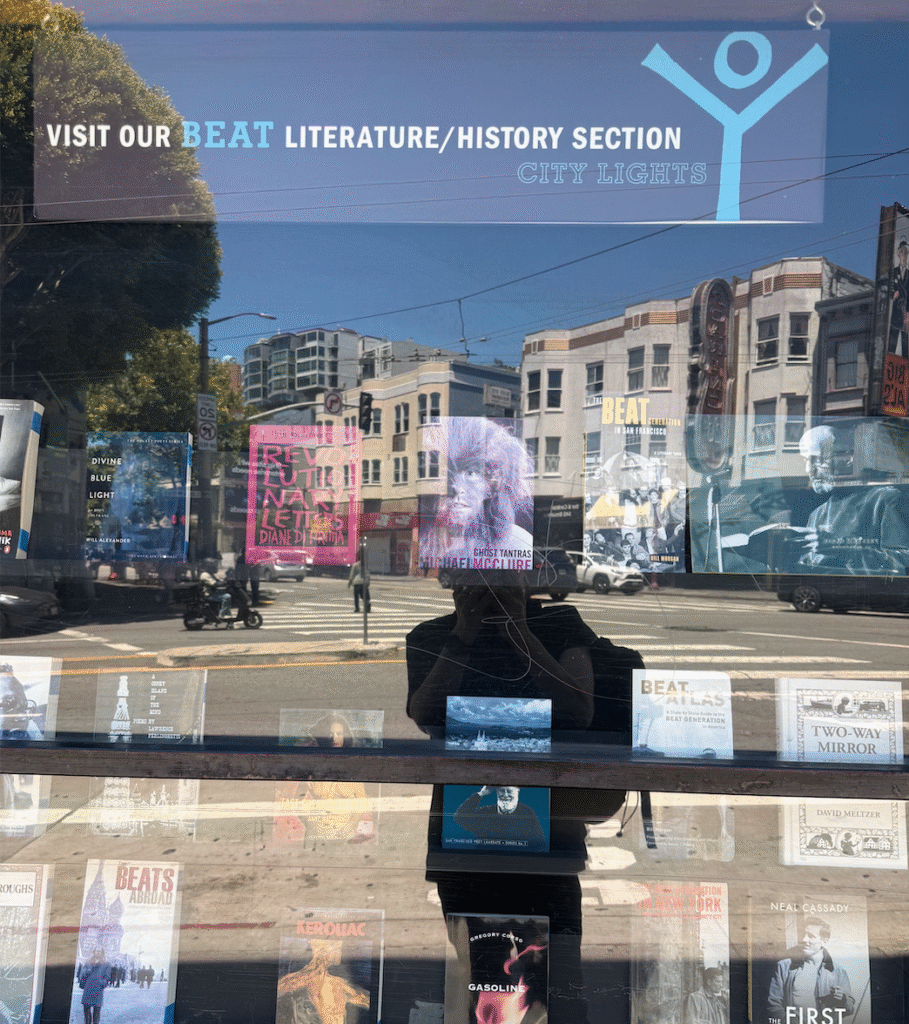
And it’s worth mentioning that small presses such as that of City Lights in North Beach, which published Allen Ginsberg’s generation-shaping epic poem ‘Howl’, was in many ways a forerunner of the blogs of today. I.e. it was all about the idea of taking one’s destiny in one’s own hands and not waiting for the gatekeepers to allow you through, but to just say: ‘I’m doing this my way, I’m saying what I want to say, I’m publishing what I want to, and I’m building what I want to build, and I don’t need the status quo’s permission.’ So, without the Bay Area, would Artificial Lawyer exist? Maybe not. It certainly inspired me.
It’s perhaps no coincidence that radical ideas break both along the cultural and technological axes, and often at the same time. And that’s why, for me at least, Legal Innovators California is a lot more than just a bunch of folks flogging software to people who count their lives in six minute intervals.
And so, onto legal AI – which one could argue is as much about legal culture change as it’s about technological evolution for lawyers.
What’s Remembered After the Close
I have to be honest with you here. I really don’t like writing up conferences, whether my own or elsewhere. Most long-form accounts just don’t really explain what actually matters. Instead, here are some of the things, the impressions, the emblematic snapshots that paint a larger picture, and ultimately what is remembered and continues to pulse in your mind like a song you cannot get out of your head.
So, in absolutely no particular order, and very likely missing out loads of really important things that our incredible group of speakers shared….here are some moments that are still stuck in my mind:
Ryan Walker, co-founder of NewMod firm General Legal, explaining on Day Two to an audience of GCs that while they used plenty of AI, they were also staffed with elite Big Law lawyers, and could provide work at a fraction of the price of traditional firms, and deliver it 10X faster.
And then we saw what I call the Post-Stage Rush Quotient, i.e. the number of people who rush the stage at the end of a talk to engage with one of the speakers – usually the one who said the most powerful things. In this case, Walker got rushed.
P.S. on that point, later on, Sam Presvelos, founder of Lexiden, recited the great Jeff Bezos saying: ‘Your margin is my opportunity!’ And indeed it is.
–
Annie Datesh, head of innovation at Wilson Sonsini, during a fireside chat with Marion Miller at Sheppard Mullin, talking about ‘The Innovator’s Dilemma’, and noting: ‘Ignoring the disruptors tends not to end well!’ She also explored how it can feel like the legal world is not built to move this fast, in relation to how legal AI is changing things now.
The Dilemma – as set out by Clayton Christensen – maps very nicely onto the legal world. For AL, Big Law is an innovation in itself. It didn’t really exist before the 1980s, at least not in the way we see it today. It’s had an amazing run. But, the NewMods are on the move, legal AI is disrupting things, and the culture is changing.
I.e. we tend to see the Big Law world as some kind of permanent state of being, but it’s not. It’s a passing phase in legal history that has only lasted for about 50 years or so. Eventually that world will become the past. Big Law will remain, of course, but it will be different.
–
The Billable Hour Barometer is also a handy bellwether – i.e. the amount of times that people say they can’t stand it during an event. At LIC it was a constant refrain – even among people who work at major law firms. And that’s good to hear.
Of course, it will take time. As Clio’s Damien Riehl noted: ‘The billable hour isn’t dead, but it is ill.’
Whenever I see people fiercely defending the status quo online, it’s good to know that the market really is moving the other way now.
–
Gil Perez, head of innovation at Freshfields underlining that change now, driven by legal AI, is a marathon, not a sprint, but equally you can’t expect to go from doing almost nothing in terms of change to changing everything overnight. He noted that their deal with Anthropic, and before that with Google, took a long time to come together and has been built on months and months of effort analysing how the firm works and what it needs by way of AI and workflow support. In short, legal AI transformation is a marathon that just keeps going, so you have to build up to it, but then be prepared to keep running, and running, and running.
—
Nicole Diaz from OpenAI telling the audience in her keynote that they are looking for ‘builders’ in her legal team, and also people who can become ‘architects’. She underlined that lawyers can truly become builders – and in the context of OpenAI moving into the legal vertical that really resonates.
It also illuminates what ‘the lawyer of the future’ – or perhaps already today – should be like. I.e. someone who is as much about building AI-driven workflows for themselves and their clients, as they are experts in the law. They take the means of production into their hands and they evolve it on their desktops.
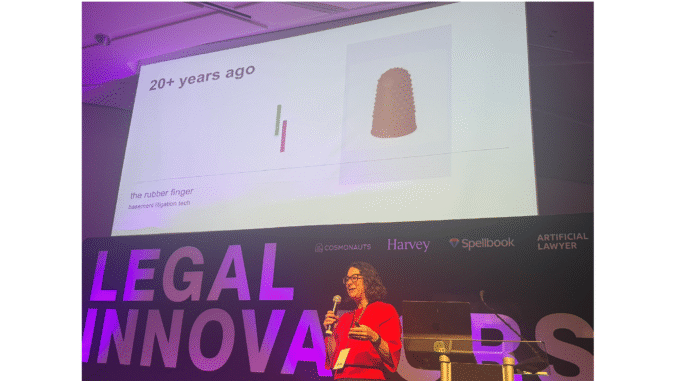
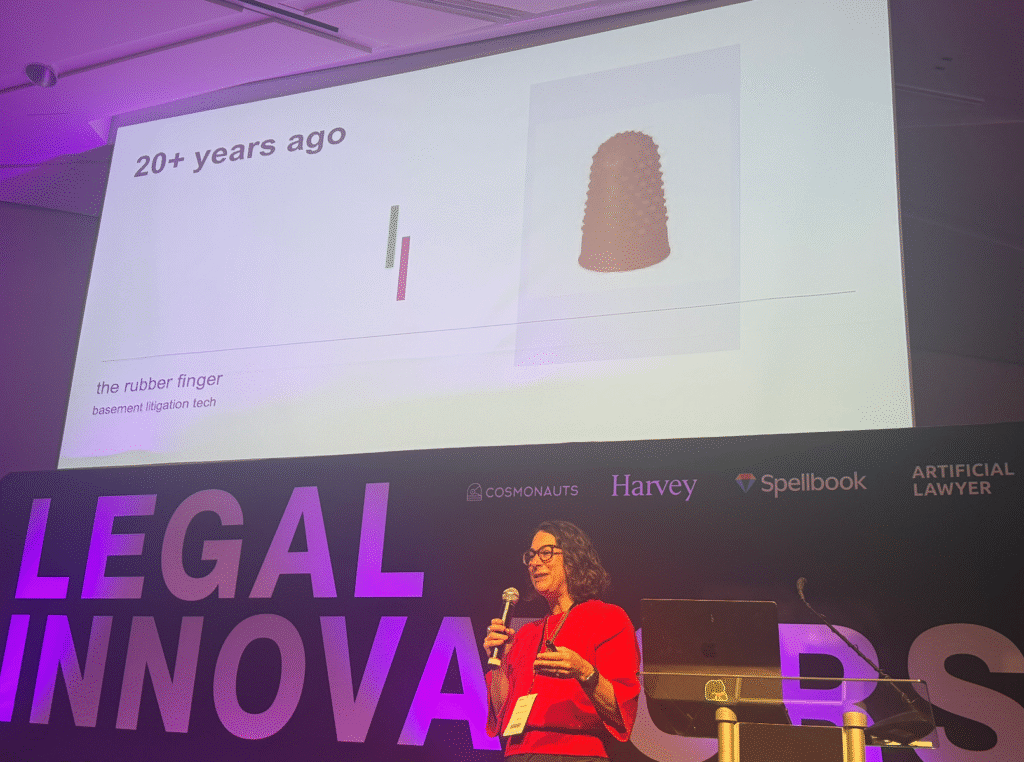
She also noted that when she started as a lawyer at Sullivan & Cromwell 20 years ago, some of the most advanced tech available was a rubber finger to help turn pages. How things have changed!
—
Alon Shwartz at Trellis invoking the idea of ‘progressive AI strategy vs conservative AI strategy’ within the legal world. I.e. many firms will just do what’s necessary so as not to be out of step, but don’t change with a real passion for innovation. But, others will embrace the possibilities that AI brings and those are the progressives.
P.S. during the conference I also gave a keynote about mapping one’s path through the legal AI landscape. My key takeaway was: have a plan. You can float around like a cork in the ocean, getting swayed one way or another, if you want to. But, it’s better to have an idea of where you are trying to get to – and that is, perhaps surprisingly, not an easy thing to develop (especially with so many moving pieces, and so many pros and cons to every strategic legal AI decision).
–
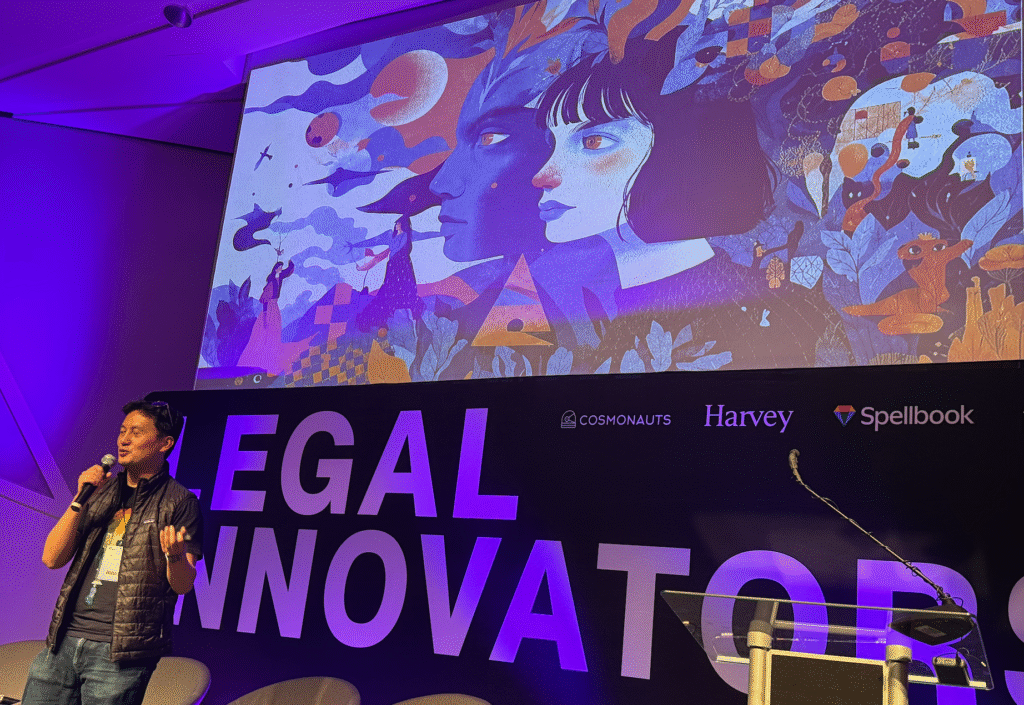
David Wang, head of innovation at Cooley, nicely collapsing the entire debate into a single concept: attention – the attention of AI, the attention of lawyers, the attention of lawyers to what AI is producing. In short, an attention economy.
–
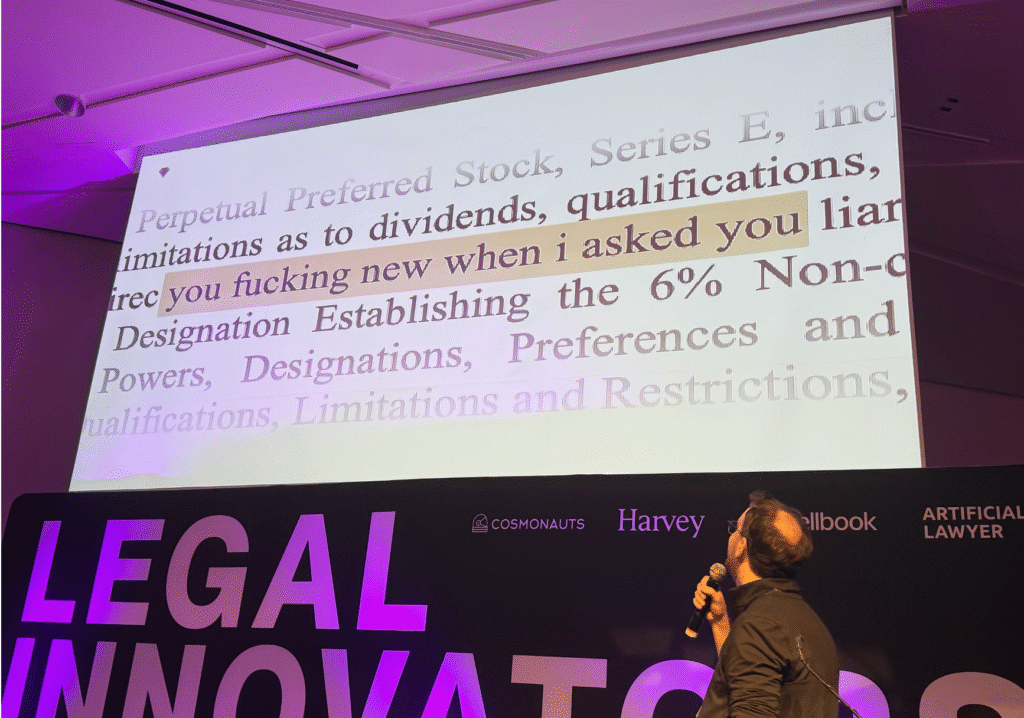
Scott Stevenson, CEO of Spellbook, pointing out – and showing via statistical study of public documents – that lawyers on their own make many, many mistakes. Some of them very funny, some very serious. In short, before you get too judgmental about AI, consider the realities of how human lawyers work today: they ain’t perfect either!
Conclusion
There were many more great things that people said. But, if there is one key takeaway it’s that legal AI is so real now that it’s bursting out of every conversation, every partner meeting, every GC chat with the CFO. It’s in the water now!
From now on, it’s all about the rate of change in relation to deploying legal AI – this technology that owes the Bay Area so much.
And I can’t wait for next year! How far will we have come? Where will AI be by then? It’s a truly exciting prospect.
P.S. the next Legal Innovators conference is in Paris – 24 and 25 June, followed in November by our events in New York and London.
- Legal Innovators UK – our landmark conference, across two days: law firm day and inhouse day. We had the biggest ever event in 2025 and hope to do even better in 2026! See you all there!
- Legal Innovators New York, in Midtown and also in November. We held our super-successful first New York even in 2025 and plan for something even larger in 2026, also across two days, for law firms and inhouse.
We’d be delighted to see you there. We will have much to talk about!
–
Thank you to everyone who came to the main event, to the side events, and who showed myself and the Cosmonauts team who organised the conference, so much great hospitality. Thank you and see you next year!
Richard Tromans, Founder of Artificial Lawyer and Legal Innovators chair.
Discover more from Artificial Lawyer
Subscribe to get the latest posts sent to your email.