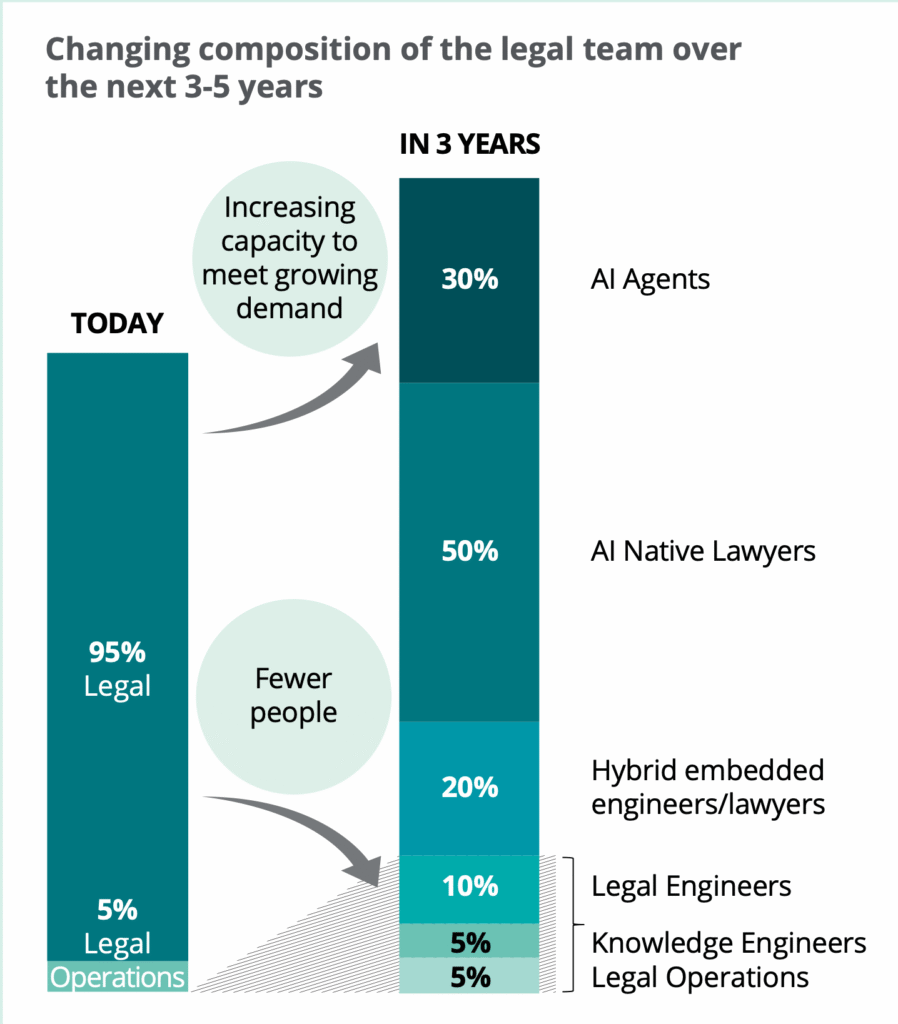
A market analysis by Deloitte Legal suggests that in the next three to five years AI agents could handle 30% of the work within corporate legal teams, and 20% of the inhouse group might be ‘hybrid engineer-lawyers’.
The report, ‘The AI imperative: Reshaping the Legal industry’, and helmed by Deloitte consultant Richard Punt, used feedback from a survey to shape its projection of the future. And depending on your estimate of where we are now, it’s either ‘this is to be expected’, or ‘wow, that’s quite radical…!’ See below.
Another useful insight was that ‘85% of respondents believe AI will change how law firms price work to a moderate, large, or very large extent, with the share of hourly-rate work expected to fall from 72% today to 44% within 2-3 years’.
And it’s worth stressing that if large commercial law firms moved to less than half their income derived from selling time, it would create huge changes within their business model. AL has to say this site does not really expect this to happen so quickly. The AL estimate for the majority of time-based billing to go away is much further out. But, it’s nice to see inhousers supporting this move as AI use grows and grows.
Deloitte also found that ‘[for] General Counsel, external legal spend could reduce by 20–40% over the next 3 years through collaborating with outside counsel to capture AI benefits and insourcing’.
And again, that’s a radical move! AL sees very few law firms wanting to have those types of conversations with clients, even if the above numbers in terms of cost savings are quite possible – if law firms wanted to play ball and the clients applied some real pressure, (which very few will….so, maybe it’s a moot point).
And this is the problem: the survey also found that ‘58% of General Counsel say their external providers rarely or never proactively discuss AI benefits with them, with just 4% having directly experienced benefits from providers’ use of AI’.
Let’s repeat that: just 4% have seen any AI benefit from their law firms….! Although, not that shocking when you stand back and consider the macro-dynamics here. We are not at the tipping point…..yet.
In which case, how much of the above can actually happen? It seems that the law firms are not singing from the same hymn sheet, or are even in the same choir for that matter.
Inhouse teams can indeed bring in more agentic tools – and there is much on offer now in terms of providers to help here. They can also hire lawyers who are ‘builders’ or ‘engineers’ – but, which is harder, as there are not 1,000s of such people wandering around looking for work. But, even so, that doesn’t necessarily change the relationship with law firms….unless they want it to change.
And, let’s be frank: many GCs this site has met or heard from in the last couple of years don’t necessarily want massive change to those relationships…yet…(or perhaps more correctly, not enough yet).
Projections of change are one thing, intervening in a very busy legal team and really shaking things up at a systemic level – and in a way that really changes staffing internally, and also then puts panel law firm noses out of joint because of major cost reduction demands – well, that’s something else.
And, as noted, few law firms are really trying hard to help with this change either. Why would they?
But, at the same time, everyone can feel that change is coming. So how does this happen? AL’s estimate is that it will be led by a handful of legal teams (and an even smaller group of pioneering law firms who help to lead the way), then that is observed, and then eventually these moves are taken as the new normal. Law firms across the market will then have no choice but to be ‘enthusiastic supporters’, even if some partners are dreaming of the old days before AI ever arrived on the scene.
Last bit – the table above also suggests a reduction in the number of inhouse staff. That is something we just don’t really know for sure. More AI, more agents, more builders for sure. But will it trigger a Jevons’ Paradox and lead to so much more work that overall staff numbers stay the same, or even increase? Or will AI, despite good old Jevons, just absorb so much work that total staff can only reduce?
We shall see. Thanks to Deloitte for a stimulating read. You can find the survey here.
—
This and other key topics will be explored at Legal Innovators New York – Nov 17 and 18 and Legal Innovators UK in London, November 5 and 6.


Discover more from Artificial Lawyer
Subscribe to get the latest posts sent to your email.