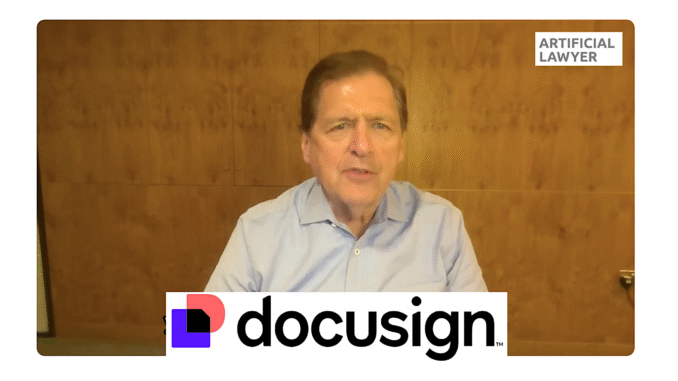
Docusign is a $3.2 billion revenue company and is now focusing more than ever before on its legal tech offering. In this AL interview with CLO, Jim Shaughnessy, we explore its Intelligent Agreement Management and CLM capabilities, how it’s been deploying genAI, and where it’s heading now.
We also look at aspects such as Docusign providing legal customers with a ‘certificate of agentic action’ to help reduce the black box effect of AI, and we also explore the future potential for automated negotiation and a new generation of smart contracts.
To watch the video please press Play. You can also go direct to the AL TV channel here. Below is an AI-generated transcript.
–
More about Docusign here.
–
AI-Generated Transcript with Docusign CLO, Jim Shaughnessy
RT (00:05)
Today we’re doing a special interview with Docusign. With us is the CLO, Jim. Good to have you with us.
Jim Shaughnessy (00:11)
Great to be here. Richard, thanks for having me. I’m here in London today along with you at our UK Momentum Conference where we are celebrating lots of ⁓ new innovations and also a lot of customer successes.
RT (00:22)
Fantastic. We’ll get into those in a moment. So people obviously know Docusign. There’s probably not a single lawyer on the planet who has not heard of Docusign. What they may not know is what Docusign is doing today that connects beyond signature and goes into the broader legal tech area. We can drill into these aspects later, but just initially, could you give people an outline? of where Docusign is with Legal Tech today.
Jim Shaughnessy (00:51)
Sure, happy to do that. As you mentioned, you know, Docusign has been is and has been the leading e signature provider since its ⁓ inception in in two thousand three. that was formed not too long after the US passed its e signature act and ⁓
It spent about 10 years building out e-signature functionality and became sort of a a a key part of the signature and contracting infrastructure for organizations worldwide. you know, in in 2018 we broadened our focus by buying a CLM company.
And we also in 2020 we made an early introduction into AI by buying SEAL software, which is an analytics and and AI company. And then in ⁓ in 2023, coincidentally, you know, shortly after generative AI became a popular topic with the introduction of Chat GPT, we recognized the the significant impact that that AI could have on
contract management and the whole contracting process and started working on a platform called intelligent agreement management, which that’s how how we brand it and which we we actually launched in the spring of 20 twenty four. So we are in addition to being the provider of the the best and most popular signature platform, we are you know pioneers in in the intelligent agreement management space with Docusign intelligent agreement management platform.
RT (02:15)
Fantastic. And where are you trying to get to? So you mentioned CLM earlier. Is the primary goal to build a CLM, well, you have a CLM platform, but to build that out and to focus on CLM, is that the main goal or do you want to build into different parts of
Jim Shaughnessy (02:31)
I think you you we you should think about intelligent agreement management as being broader than than CLM. We you know we have a a leading CLM product that’s used by many large companies to manage a significant corpus of agreement and you know and complex workflows. And Docusign Intelligent Agreement Management is a more modular ⁓ platform, AI native. we in in the two years since we’ve introduced the product, we’ve we’ve had more than four. 40,000 companies subscribe to it and it represents 12% of our annual recurring revenue.
but it but it is it is a way to think about it is a a platform through which organize organizations optimize their contracting outcomes by really kind of ⁓ holistically tying together the the the creation, ⁓ the commitment and negotiation, and then the ultimate management of of agreements. And the particular problem that we were focused on in in 2023 is how to unlock the value represented by the content of agreements which is often locked into static files and not available, not readily available for organizations to you know analyze, manage ⁓ manage and and ⁓ exploit.
RT (03:46)
Gotcha. So in terms of the AI or the LLMs that you’re using, mean, are you sort of an agnostic, as they say, you’re using anything that’s available?
Jim Shaughnessy (03:56)
We’ve actually spent a lot of time thinking about the architecture of our AI. So at the core of the which which we’ve branded as as ⁓ Docusign Iris. And iris has a number of different components. One component are some proprietary models that are trained on agreement-specific data. And and we have ⁓ consented agreement data from our customers and more than a hundred million contracts that we have available for training. We anonymize those and then train on those. ⁓ but we also use LLMs a as necessary and and appropriate. And I mentioned architecture before. We’re very careful about having the right model do the right work at the right time in the right way. And by doing that we can keep the cost of inference low and also keep latency low.
So we can offer, you know, fine, you know, performance. We process a million agreements per day. We do fifty ⁓ extractions on each agreement as our standard extractions. We have given the ability of customers to do their own custom extractions. So it’s really important that our models work efficiently and that they they be tuned, as I said, so the the right model is doing the right work at the right time.
RT (05:06)
moving forward to Perplexity, well-known research company that has announced that it wants to get more and more into legal. They’re working with other companies as well. Could you tell us what you can about that relationship with Perplexity?
Jim Shaughnessy (05:28)
Yeah. So let me start out sort of generally about our our partner relationships. We have more than eleven hundred ⁓ partners ⁓ with whom offer integrations. ⁓ some have been longstanding, like you know, Salesforce is an example of a company with whom we have a long relationship in integrations. ⁓ some are more recent, you know, Perplexity, Harvey, Legora, Anthropic, OpenAI,
You know, our our concept with all these is we want to pr let our customers interact with the platform in the way they want to interact with the platform and using the tools that they’d like to use to interact with the platform. And so for if you think about the the Salesforce integration, a lot of ⁓ salespeople invoke IAM from Salesforce. They initiate a process in Salesforce and get the results back in Salesforce. oftentimes people will be able to interact with with IAM and in Slack. And then similarly with the both the legal traditional legal tech tools and the LLMs, we we want them to be able to have two way two-way integrations back and forth there. And with perplexity, I I think it it is something that will allow customers to use the the strength of the per perplexities research tools at the same time that they’re interacting with with IAM and
And you know, vice versa. So it’s it’s something that we we see a lot of ⁓ a promise to in in the sense of ⁓ it will you know let customers interact with I am kind of with a f from from perplexity or or and ⁓ in in the ways that they’ve they find most efficient, most comfortable.
RT (07:04)
Gotcha. So, I mean, what is the sort of long-term strategy then? mean, you’ve got, mean, Docusign has a huge advantage in that millions upon millions of businesses use it globally for Signature. That gives you a fantastic in to then cross-sell the legal tech, you know, offering as well. I guess the question then is how far do you want to take this? I think initially people probably assumed that this was a small sideline.
Docusign kind of thought, well, this isn’t too difficult. We can just add a little bit of legal bit on the end. But now, of course, particularly with AI being so adaptable and the market growing in general, you could argue there’s a huge opportunity to really build a major legal takeoff And you mentioned already it’s quite a significant part of your revenue.
Jim Shaughnessy (07:51)
Yeah. So
Yeah, we it’s it’s interesting. Our our concept of IAM is a little bit different than legal tech. It’s technology that lawyers use, and lawyers are central to the value proposition for IAM, but they’re not the only users of of IAM. And in fact, some of the IAM features ⁓ actually reduce the work that that lawyers will need to do because it allows it democratizes access to agreements. So sales reps can access agreements, other business people can access agreements and and today we had experience on stage at London Momentum. They were talking about their use case and and a big part of it is to make these agreements available to people ⁓ other than lawyers so the lawyers aren’t aren’t responding to sort of simple administrative requests. Can you find this agreement and share this clause with me? And that this it becomes possible for for the business people to to find those. But we do we do as I you know, mentioned that, you know, lawyers are really central and lawyers central to contracting processes and therefore, you know, a big part of the IM user base. And ⁓ we so we want to you know want to make it work in what they found is their natural workspace. Natural workspace is is often using other AI tools as well. There’s some things that ⁓ IAM does that that
none of these other products will do. And there’s some things that that ⁓ these other products do that we don’t do. So for example, we’re really not interested in offering a legal research product, but we have partnerships with Harvey and Lagora who have you know very significant legal research capabilities and so we can, you know, the you can interact with with that. And you might you might
be using one of those and see that there’s a new regulatory requirement and then want to check the existing corpus of agreements to understand whether existing agreements are consistent or not consistent with this regulatory requirement. And so and you you could potentially do that analysis either in an IM, which is where we we think you probably want to do it, but you could also do it potentially in in Harvey or Legora by by you know uploading the contracts there, doing the analysis and then sending it back to IAM. So it would be set up for either for a a new amendment process or it’d be ready for ⁓ for renewals.
RT (10:09)
Gotcha, gotcha. So just to clarify, IAM, what would you say if you were doing an elevator pitch? you were at a startup, right? What
be the elevator pitch? What differentiates IAM from all the other many tools?
Jim Shaughnessy (10:24)
I think it it is a you know a a flexible modular platform. It lets companies effectively automate the entire agreement process from creating agreements to negotiating agreements to committing to agreements and the managing the agreements and the and their and the obligations and rights that are inherent
in those agreements over over time. ⁓ and it is ⁓ it is really ⁓ the only platform that lets them do that holistically and offers what Docusign has historically offered to people, which is a a trusted secure system where that is a a system of of record and you know so they know what was committed to, when it was committed to, by whom it was committed to, but also becomes a system of record and a system of action for contract contents and for business value from the agreements.
RT (11:15)
Interesting. that’s where we are today. Where do you want to head? Where’s next? Because you said you bought that CLM company some years ago, then you bought Seal, which I guess was much more on my radar, having focused very much on the early AI companies. Now you’ve got links with Perplexity, as you say, many other companies. Where do you want to take this?
Jim Shaughnessy (11:34)
I I think that ⁓ we’re closer to the beginning than we are to the end of of the development of technology and use of AI to ⁓ you know effectively ⁓ you know manage and and and get the the business value out of out of agreements. you know we at Docusign spend last fiscal year we spent over six hundred sixty million dollars US in R and D. the most important area in our R and D is AI. Well we spent some of the $664 million on on other things and as as well, but we’re investing very, very heavily here. So what can you expect to see? I think that ⁓ we’re in still in the early days of obligation management functionality and so you’ll see more work there that helps people really understand ⁓ the the ability to manage their obligations. We we actually demoed a a couple of of really cool features today. one involving an integration with with Coupa that you know showed how ⁓ a pro procurement manager could could use
the combination of Cupid and IM to to isolate savings opportunities on on renewals. we so that that’s an area I think we’re very, very early on in the use of of agents. And there are a couple of areas I think you’ll see us ⁓ spending more time ⁓ there which would be really so so yeah let me just step back for a second say well what have we introduced with with respect to agents? We we have it at IAM
contract assist agent. We have ⁓ some prepackage agents that we introduced in Momentum. And also we introduced a a product called Agent Studio, which lets people write their own agents in using natural language. And and so those are ⁓ you know those are important areas. But I I think we’ll see more coming in and w with
agentic AI. The other thing that that I think we will spend a fair amount of time on it’s related to you know the development of more capability for agents is agentic governance. That ⁓ one of the you know the challenges that that large organizations have is that ⁓ you know they they have to have kind of auditable financial results and and those require
⁓ a system of internal controls around contracting that that ⁓ you know make sure that that people entering into contracts have the authority to enter into them, that they’re consistent with rules, that the contents of the contract are appropriately recognized in the company’s ERP system. And I and ⁓ well I think we’ve we’ve gotten a lot further along in in thinking about agents, the development of agents than we have really around
around the agentic governance. And so one of the things I I think you’ll see us and other people working on is like a certificate of agentic action. And you know, DocuSign has from its inception offered a certificate of completion, which is which is a source of truth about, you know, what has been agreed to and by whom and when and under what circumstances. And I think you will see work ⁓ done ⁓ by us and and potentially by others around offering sort of similar trust collateral around gentic action.
RT (14:37)
Interesting, I’m just going to repeat that so people understand at home.
So this is a certificate of agentic action.
Jim Shaughnessy (14:43)
So when you think about now, so if an agent takes an action, let’s say you had an agent place an order for widgets ⁓ and it was accepted by another agent, how would you and and you know the widgets weren’t delivered or payment wasn’t made, how would you enforce that now? How would you prove that a contract was was made? You could use log files, you could use you know somebody who would describe the way the agent worked, but it but it
It’s kind of messy right right now. And and we have the the ability to kind of make that less messy ⁓ now.
RT (15:23)
what you said there is a subject I’m very interested in, which is the idea of fully automated or nearly fully automated contract negotiation where both parties are automating. And they give you example of buying widgets, know, a low value product, low risk transaction where both parties might be using agents, a docusign on one side, maybe the other party’s got docusign or maybe another system. Somehow they meet in the middle.
Is that something that Docusign is interested in?
Jim Shaughnessy (16:00)
So I I think ⁓ yeah we’re interested in all things contracts and a and agreements and it wouldn’t shock me to to see us ⁓ become kind of more involved in in the handshake there. and I think
Yeah, but people have talked a lot about agent to agent contracting and and I’ve tried to create the sort of simplest, lowest risk transaction. You can imagine there’s already a master purchasing agreement that’s set. There are parameters about price and delivery terms, and you’re you’re just trying to to to to get the specific order ⁓ accepted, o offer an acceptance it’s like.
Contracts 101 problem. What’s what’s the offer and what’s the acceptance? And the terms will be a lot of the other terms be set in this other document. At the other extreme is ⁓ something like you know, you’re not going to see, at least probably in my lifetime and and who knows if ever, like the a FTSE 100 MA agent contracting with another FTSE 100 company to for a merger of the two. But that is probably not.
genetic contracting that we’re going to see. But there’s a big, there’s a a you know a a big space between those two poles. And I think you will see you know gradual movement up in in complexity and risk as people become more comfortable with both the system of controls that you have in place and how they would manage the the risks. And then and you know this is you asked about the future. Another another area of the future that’s really important for us is what
people are calling the the context layers. We already are r really good at providing context in the form of what people have agreed to in the past. And there’s other context that becomes available through the integrations with with Salesforce and with Slacks, but that’s still in its nascency. And and I think that there’s the opportunity to bring in more context.
intelligence ⁓ a through agents and some of some of the contacts will be acted on by human actors and some maybe acted on by other agents as as the AI develops on on that. And you know, things we haven’t even touched are empirical data, well whether you know, the a contract for agricultural commodities is impacted by the amount of precipitation over the last month in a particular location. Right. So you can see things happening like that.
RT (17:53)
Yeah, that’s right. and it’s funny you should mention that because of course, yeah, if I remember correctly, and maybe I’m remembering incorrectly, didn’t you buy a smart contract company?
Jim Shaughnessy (18:16)
yes, we d we did. We we did. Yeah.
RT (18:16)
Yeah, because that was one of the classic examples, wasn’t it? This idea and the smart contract thing never really came off, I think, to some degree, because the technology just wasn’t really there at that point.
Jim Shaughnessy (18:29)
we may see a resurgence of smart contracting, it’ll just look different than they conceived it at the that time.
RT (18:32)
Yeah, Yeah, no, I like that idea a lot. And I mean, and it goes to the context point, which is, I mean, accuracy is not because the accuracy issues are not occurring because the AI is adding two and two and getting five is because it doesn’t understand the context of what it’s doing. And so it makes an error because it didn’t get like, it’s like you’re trying to explain to someone how to cook an omelet and you get scrambled eggs, right?
Jim Shaughnessy (18:59)
Right.
RT (18:59)
It’s just, it’s a very, very small difference between the two things that if you don’t get the context right, the whole thing goes wrong. And I guess that’s to some degree, that’s kind of where we are now.
Jim Shaughnessy (19:08)
Yeah, I think I think that’s right. And I think the you know s solution will be sort of how different
context vectors are kind of layered on each other and and what the weights will be and this is you know way beyond my my technical or mathematical under understanding but but there’ll be there’ll be ways of developing nuance views, automatic nuance views of of context that that we don’t have now.
RT (19:31)
Yeah, yeah.
Yeah, totally. And again, I mean, that’s another advantage or potential advantage for DocuSign in that if you can get agreements from your customers to enable you to have that anonymized contract stack, you can build in so much context if you can organize it, of course.
Jim Shaughnessy (19:47)
That’s that’s right. And and what we’re really doing is, you know, helping c customers use their own data. We we can develop the the intelligence for that, but we you know, the we respect our c the confidentiality of our customers’ data and we’re giving them tools to to make these decisions and we’re not, you know, attempting to to mine or monetize it for our own purposes at all.
RT (20:06)
No, nobody
Well, it sounds very exciting, really, really interesting what you’re doing. And I’m sure that the readers of artificial lawyer will be enthusiastically waiting to hear all the new announcements coming out throughout this year.
Jim Shaughnessy (20:21)
We have a yeah, we we’ve have a ⁓ you know, ⁓ aggressive ⁓ roadmap we’re we’re really interested in and committed to this this space and people are are just, you know, kind of super excited about about the future and and ⁓ things that we can bring to bear for our our customers and we’re you know a very customer focused ⁓ company and ⁓
that’s really our our North Star is is how to how to provide value to them so they can optimize their contracting operations. and that’s why we’ve been able to win the loyalty of one point eight million customers over our twenty year existence, and including forty thousand IAM customers.
RT (20:58)
Wow, that’s a lot. That is a lot. Exactly. And a tremendous foundation to build on. Thank you very much, Jim. Real pleasure speaking to you and hearing about the journey that Docusign is on. Thank you.
Jim Shaughnessy (21:10)
Well thank you for providing the opportunity, Richard. And you know, I as I said I’m a big fan of Artificial Lawyer and and ⁓ look forward to to all the great work that you’re you’re doing.
Discover more from Artificial Lawyer
Subscribe to get the latest posts sent to your email.