Neota Logic, which is now going to market as ‘the AI governance layer for legal teams’, has launched an AI orchestration capability which lets lawyers bring their own choice of large language models into governed AI workflows.
This means that ‘every AI call [to an LLM] is logged, checked against the team’s own rules, and routed for human sign-off’.
This is a big change from what many of you will remember Neota doing in the past, which was one of the first ‘no code’ legal workflow automation companies. Neota, which can trace its roots back to 2010, is now very much focused on generative AI use, and in particular how inhouse teams and compliance groups are using the technology.
They added that the new AI governance offering is ‘the first of several AI capabilities the company is bringing to market, all built to a single standard: legal teams should be able to move at the speed of AI without giving up the ability to defend the work’.
But, back to the governance part. How does it work?
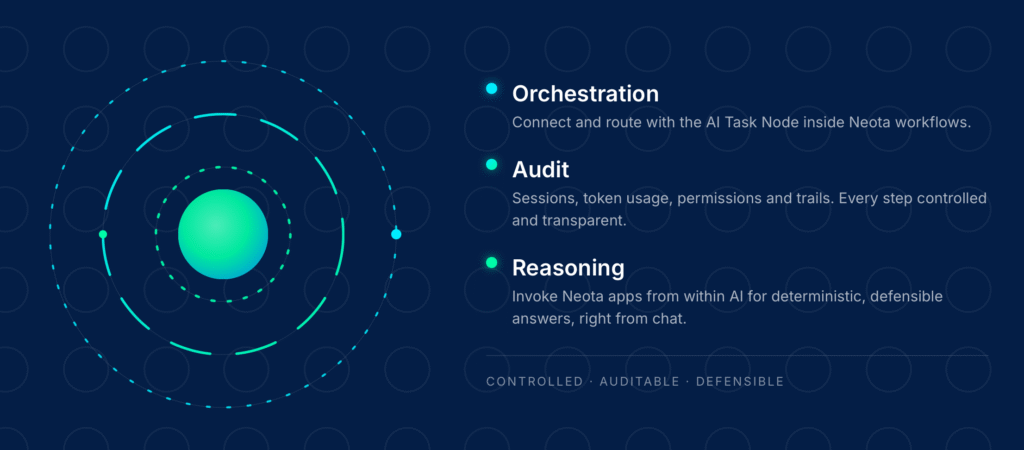
This is how they explain it: ‘Calling a large language model is straightforward, and most tools stop at that: they return an answer and leave the user to catch what is wrong. Neota Logic’s AI orchestration places the model inside a workflow instead. It is called only for the tasks it does well, such as extraction, summarization, and classification, while the rules, the routing, and the human sign-off around it stay under the team’s control.
‘The workflow decides what happens to the model’s output. A contract can be read by the model, assessed against the firm’s own playbook, then routed automatically: low-risk matters cleared, anything material escalated to the right lawyer before it moves. Calls can be chained so one model’s output is checked before the next step runs, and a workflow can escalate to human review the moment confidence drops.
‘Every run produces a full audit trail: what the AI was asked, what it returned, which model ran, and who signed off. Models are approved centrally, no model is ever invoked by default, and legal teams work with the providers they already use, including Anthropic, OpenAI, Azure OpenAI, Google, Open Source and AWS Bedrock, through their own accounts.’
And they reiterated that they are working on the basis that a human will check the final output.
Vinay Varma, Chief Customer Officer at Neota Logic, commented: ‘Our customers are investing more in AI, but they do not want to lose the rules and controls that make their legal and compliance processes work. They want to bring the models they have already chosen into workflows they can trust and stand behind.’
Is this a big deal?
Well, all of the ‘no code’ rules-based workflow automation companies across the world faced a major challenge once LLMs took off. This was because you easily could ask such AI systems to perform complex text-based tasks with just a simple, natural language prompt. Agents and better reasoning within LLMs only accentuated this.
Peer company, BRYTER, for example, pivoted heavily into AI. And even though there is a resurgence of interest in rules-based, deterministic systems in order to sustain accurate AI outputs, the world has very much changed.
Neota is now coming to market by using its workflow experience to support today’s AI use – applying what they’ve learned over 16 years to improve LLM outputs and provide better guardrails and governance.
Or, as the company put it: ‘The ‘[new] capability runs on the rules engine Neota Logic has refined since its inception, one that now handles more than eight million legal sessions a year. The AI is one component inside that engine, called where it helps and constrained everywhere else.’
I.e. they’ve not abandoned their core capabilities, rather they have found that they can now apply what they have built to the new era of legal AI in ways that add value.
Last word goes to John Lord, Chairman and CEO: ‘A model answering on its own, with no rules around it and no record behind it, is a liability, however quick and impressive the answer looks. Our aim is to set the standard for how AI is used in legal and compliance work, not to follow it.’
Good to see Neota still iterating and innovating!
More about Neota Logic here.
—
Two Major Legal Innovators Conferences this November
Come and join us in New York and London this November at Legal Innovators!
Legal Innovators UK – London, Nov 4 and 5
And, then Legal Innovators New York – Nov 17 and 18.
After another fantastic Legal Innovators California, where we had speakers from OpenAI, Y Combinator, Google, Meta, and many more pioneering organisations; and our stellar inaugural event in Paris this June, we are now looking forward to the landmark conferences in London and New York, both in November, and both across two days: Law Firm Day, and Inhouse Day.
Discover more from Artificial Lawyer
Subscribe to get the latest posts sent to your email.