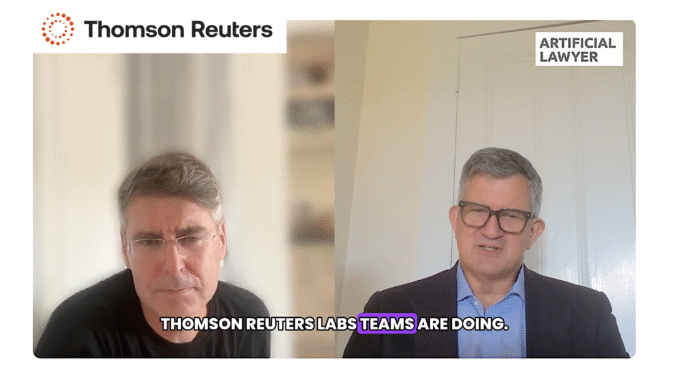
As Artificial Lawyer just shared, Thomson Reuters has launched Thomson 1.0, its own open weights LLM, trained on its own data. Here, AL talks in-depth to TR’s CEO, Steve Hasker, about the move, why it matters so much, and we then explore some key issues related to the wider legal AI sector.
Please press Play to watch inside the page, or you can also go direct to the AL TV Channel here.
— (Advertisement) —
Legal Innovators New York – Nov 17 and 18 – the landmark legal innovation conference in New York this November: Day One: law firms, Day Two: inhouse.

—
AI Transcript
Richard Tromans (00:00.162)
Artificial Lawyer TV is doing a special interview today with Steve Hasker, the CEO of Thomson Reuters. Thanks for being with us, Steve. It’s really appreciated.
Steve Hasker (00:01.916)
Yeah. Great. Hi Richard, yeah, good to be here.
Richard Tromans (00:24.98)
So we’re recording this a few days actually before the big announcement which will accompany this video but let’s get straight into it. So Thomson which Artificial Lawyer you know wrote a big piece about a couple of months ago very very interesting tell us more about it what is Thomson and why is it such a big deal for Thomson Reuters.
Steve Hasker (00:47.676)
Yeah, thanks, Richard. so Thomson, or Thomson One, as we call the first production ready version, is a a large language model that we’ve built in-house here at Thomson Reuters. Essentially, what we did was in August 2024, we came across a startup which was centered in and around Cambridge University in the UK. And it was a group a group of former Google DeepMind scientists who were building a large language model for legal.
And so we got to to speaking with them and and pretty quickly reached the conclusion from both sides that that that Safe Sign ought to become part of TR. And so we bought the company and bought the scientists across. And so for about 20 months, we’ve been investing heavily in the development of the Thomson LLM large language model, with a view that we wanted to to create a vertical specific large language model. So one that was that was built, purpose built for the legal profession. and of course we we have a couple of advantages in doing this. One is access to tremendous amounts of content and editorial expertise through West law and practical law and all all the jurisdictions in which we operate. And the second is tr tremendous subject matter expert expertise across many, many legal practices and many jurisdictions. So
Steve Hasker (02:16.412)
Roll the tape forward 20 months or almost two years, and we put out the first production-ready version last week, and we’ll talk a lot about this next week at Iltacon. But essentially the evaluation suggests, and we’ve done a very robust set of set of comparisons to the leading iterations of the Frontier models from all of the names that you will recognize.
And Thomson One is outperforming most of those models and is performing for general domain tasks. So set aside the legal tasks for a second. For general domain tasks, it’s performing at or above the very, very latest cutting-edge models from the from the from the frontier companies. And then for legal tasks, as you’d expect, given our content and our expertise, it’s it’s right up there as well.
And that’s with only a fraction of our legal content applied. So so we think this is a pretty interesting breakthrough, Richard, for for the industry. It provides us and I think more importantly, our customers with all sorts of options going forward. So we’re very excited about about showing the industry the model and the results of the model and then continuing conversations as to how we might bring it to bear for the benefit of the market and and and of our customers.
Richard Tromans (03:42.233)
Fantastic. So let’s dig into this. So first of all, was based, think Joel Horan was telling me about this a few weeks ago. Effectively, these are open source, open weight models that you have trained, that you have post trained. Can you say which models you were working on?
Steve Hasker (04:03.09)
So we started with a couple. I won’t go into the specifics of which ones because we have evaluated many and incorporated the the the open weights of a number of them. But essentially, you know, well known to you, Richard, is that there are some very, very powerful, very thoughtfully constructed open weight models available for the research community to then build on and post-train on. And so we’re able to start with one or more of those open weight models and then apply all of our expertise and some of our content to create what we think is a really compelling compelling offer.
Richard Tromans (04:40.152)
Gotcha. And when you say it’s improved, you know, the performance is better. This is in terms of just pure accuracy. It’s in terms of relevance. It’s across a bunch of like a basket of different criteria.
Steve Hasker (04:51.684)
It exactly. So if you if you go back to Joel’s Joel and Richard Swartz’s blog post of earlier in August, they basically go through a series of of criteria and it’s its accuracy, its speed of resol resol of of of resolution of different of different issues, it’s i around information retrieval and and and analysis.
And essentially we look at the performance and the output of the Thomson One model relative to, as I said, the cutting edge frontier models. and we love the we love the results, particularly in its first iteration.
Richard Tromans (05:35.064)
Gotcha. So, I mean, in terms of just one last sort of technical question, did you have to bring in your own GPUs? Did you rent your own GPUs? Did you buy your own GPUs? Was that not necessary?
Steve Hasker (05:46.671)
yeah, we I mean given our size and scale, we we have a we think, you know, an advantage in terms of our access to GPUs relative to relative to our customers or relative to many of our competitors. And so we’re able to to to rent and in in a sense ring fence our own GPUs to create to to create the model. So we’ve done that within the the clo the cloud environment.
Richard Tromans (06:12.974)
Okay, it makes sense. So looking forward, let’s look towards benefits. okay, so hopefully incrementally better accuracy, better relevancy and so forth. And of course, you know, if you’re doing legal research and of course, this is one of the key pillars of Tomson Reuters and the other major legal research companies, obviously, accuracy is paramount. So that’s clear win as well. Does this then follow through into your other sort of productivity tools? So like these days, Thomson Reuters has gone way beyond, you know, litigation research, you’re into transactional work, into a whole bunch of different things. Will Thomson One spread into these areas as well?
Steve Hasker (06:55.964)
Yeah, so we think it’s an essential sort of addition to our AI stack. So if you think about at the front end co-council, which is our legal AI assistant, supported by Westlaw Advantage, supported by a practical law in its AI form, this essentially is all the way back to that source model. And we think it’s going to give us a couple of of different options. And this is these are the conversations we’re having with our customers.
So the first is starting next week, we will port across our tabular analysis, so our bulk document analysis function onto the Thomson model. And we see that as having a couple of clear advantages. The first is speed, so the latency is significantly reduced relative to accessing you know, one of the one of the third-party frontier models. The second is accuracy, given that the Thomson model was created for this specialist.
you know, for this profession and specialized set of tasks. and the third is a cost advantage. You know, and we’ve all read about token maxing and tokenomics and Yeah. Yeah. Yeah. So so essentially because because it’s trained on our own content and and the Reuters news file and and a and a whole series of other relevant content sets, it is it is much more, you know, to to sort of put put it in layman’s terms.
Richard Tromans (08:00.578)
Yeah, I was going to ask you about that, but go for it. Tell tell us about the token side.
Steve Hasker (08:20.058)
It is much more efficiently constructed than it than a a large language model that’s sort of scouring the rev the web and going through Wikipedia or Reddit and all sorts of other sources. This one is much more tailored and specific. So it ends up being more efficient. And so if we can get the capacity utilization of our GPUs up to to any anywhere near a hundred percent, we think relative to accessing a leading frontier model, we’re gonna have a significant cost advantage, which of course we’ll be able to pass on to our
our customers. So the first sort of iteration of this, Richard, will be to run tabular analysis within CoCouncil on the Thomson model. And if that’s successful, we’ll then move more and more of the functions of Co-Council across. And we could even eventually move you know Westlaw advantage and some of the functionality, including that which we’re building, which is Brief Builder, which is a I think a very, very exciting innovation in the pipeline at at TR. We could move those things across to the Thomson model. So that’s sort of the first, I I suppose, avenue we’re pursuing and and and discussing with our customers. The second one is, you know, you’ve all you you’ve you’ve written about and and and are well aware of this idea of sovereign AI and in in a big subject and ensuring that that law firms and general counsels protect their IP and or their alpha as as as some people call it. and essentially the the the conversations we’re having with some of our most sophisticated customers is the opportunity to put the Thomson model in behind their firewall and have them commingle it with their information, their IP.
Richard Tromans (09:37.504)
Yeah, yeah, big subjects.
Steve Hasker (10:05.948)
potentially run an instance of co-council on the top of that and really create sovereign a sovereign AI solution with and for them that they control and that that that they are a hundred percent assured that they’re not sharing their IP with a frontier model and they’re not sharing their IP with a startup which is a re a reskinned frontier model. And to say the least, that is a topic that is becoming near and dear
Richard Tromans (10:26.242)
with any others.
Steve Hasker (10:36.166)
to the hearts of sort of firm chairs and managing partners and CTOs. So it’s a ver that’s a a sort of a second, separate, but very interesting I think, potential opportunity for us.
Richard Tromans (10:47.766)
Yeah, mean, that opens many, many, many doors, doesn’t it? So you’d have to allocate space for that law firm effectively to migrate some of their own data, to sort of co-mingle, as it were, with your data to, I mean, how would that work?
Steve Hasker (11:05.872)
Yeah. Well we can so so let’s let’s let’s assume that that as you know w within the within the public cloud environment, we can create they can create an environment where we can put an instance of the Thomson model into that environment that they run and control. We constantly update that model. So it’s a sort of a one-way feed of information to ensure the model stays current. They then add their IP, so whether that’s access to their document management system and any other
any other information repositories that they have and they can run applications on that in in that instance that’s created and managed reserved specifically for that firm. And again, you know the the the sort of attraction of that is is is elimination of the risk of of leakage of their IP and that there’s a frontier model or a startup, heaven forbid, a competitor or a competitor to a client.
Who’s benefiting from that IP because it’s leaking out in some way, shape or form. So that’s the that’s the attraction to the firms which as I said
Richard Tromans (12:12.718)
And also, so much simpler. mean, a certain very famous law firm, which we both know the name of, is going down a sort of more DIY route. And I imagine that this would be way more economical to work with TR on this and try to build the whole thing yourself in your backyard.
Steve Hasker (12:29.084)
Yeah, I mean there are there are there are very few firms that have the that have the sort of size and scale financial inclination or or or the the sort of at the at you know the partnership group level the inclination to to go down a DY DIY path. But there is the interest in sovereign AI, as I said. So i I think I think you’ve hit the nail on the head.
Richard Tromans (12:39.309)
Hmm.
Richard Tromans (12:48.226)
Yeah.
Steve Hasker (12:54.64)
This is one way in which they can meet both of those needs. So they’re not creating a completely bespoke DIY instance that they may or may not be able to maintain in the fullness of time, but they’re accessing if they’re keeping access. Yeah.
Richard Tromans (13:05.314)
Well, that’s, that’s totally yeah. mean, that’s actually, put your finger on really good point there, which is maintenance. mean, okay. So there’s a great biggest Travaganza, firework display. Everyone’s excited. You know, we rolled it out. Great. Now you’ve got to run it for the next 20 years.
Steve Hasker (13:22.758)
Yeah. We’ve seen this we’ve seen this, Richard, on the tax and accounting side of our business. So so as some people may may be aware, we’re one of the largest providers of tax calculation engines in the world. And and so every once in a while, one of the big four, and this has been the case over decades, will come to us and say, Okay, we’d like we’d like some content or we’d like some some some software IP, but we’re gonna build our own solution and and so where we can we’ll support that. But but
Almost invariably what happens is a year or two or three later, that same firm comes back and says, Hey, would you like to buy this from us? We’ve developed this application. you know, it’s it’s working to varying degrees. would you like to buy it? And and when we when we ask why, they always say, Well, turns out the building is one thing, it’s the maintenance that which is another. you know, and and it the the the the practice of law and the and the and and the idea of running a law firm is at its essence in in my view.
assembling great people to meet or exceed the needs of clients around particular matters. In our view the technology needs to serve that rather than rather than usurp that or replace it. And so if you keep that in mind as the chair of a firm or the group of managing partners
then you’re laser focused on your people, you’re laser focused on having the technology serve your people, and you’re not laser focused on building out sort of bespoke instances of of software and technology that you may or may not in a year or or two’s time be able to to maintain. And I think it’s particularly the case at the moment, given how fast things are moving. You know, there’s a landscape that you and I understand today, or at least we hope we do, in terms of the the the frontier models, the
the harness the agentic harnesses, the application layer and so on so forth. But that’s going to change and it’s going to change rapidly. You know, six months it’ll be different. Six months after that it’ll be different. And so if you’re managing a law firm and you and you’re trying to meet or exceed the needs of your clients, worrying about how fast the technology’s moving is a whole separate problem that you may or may not have the wherewithal to get across.
Richard Tromans (15:36.268)
Yeah, yeah, yeah, yeah, indeed, indeed. And also, I mean, this brings up another point which, you know, continually writing about, which is data. And, you know, looking at this in particular in the context of the February stock market shock where, you know, Anthropic released a whole bunch of Claude skills and a whole bunch of other people went, my God, my God, you this is the end of the tech world. And of course, it wasn’t.
And I argued in an article that, you know, a lot of the responses were illogical because surely companies that have a lot of data are actually the ones, if anyone is going to get through this, people who have lots of data are in a good position. I just wondered how you saw things playing out.
[Note: video changed tracks at this point, timings may differ.]
Steve Hasker (20:48.722)
Yeah, I mean I I you know, I think the the sort of the wild swings we’ve seen in terms of the perceptions around the the value of legal content, i in in one sense I would say we’ve seen it before, you know, in that Google Scholar, you know, but back in history was going to commoditize all the legal content that was out there and then and then we’ve had over time various new entrants, some of which have been very, very well funded, sort of try but but largely fail to make a real
a real impression in terms of depth and breadth of primary and secondary law content. And I think this is no different. But and what I would add is that, you know, this term of that we coined fiduciary grade AI, which which you know we we use to describe AI that is providing contents and solutions to professions that cannot afford to be wrong, like Lawyer, like tax preparers or auditors.
And essentially, those professions require deterministic answers or as close to deterministic as being as possible. The frontier models themselves provide probabilistic answers. And so that the the risk of hallucination for the practice of law, set aside the business of law. It may well be that these horizontal tools can be very effective in supporting lawyers in terms of running their business. But when it comes to the practice of law, high-stakes litigation, high-stakes transactions,
the the the output needs to be very accurate, firstly, and secondly, it needs to be verifiable, validatable, if that’s a word. And essentially, you know, it cannot be a black box. The agent needs to describe step by step what it’s doing and and equally importantly the citations, the sources of information that it’s accessing.
in order to reach a particular conclusion before going on to the next step. And so that’s what we do for a living. With our content, our expertise, our data privacy and our customer support mechanisms, we provide fiduciary grade AI, which is different than that which a a frontier model can provide.
Richard Tromans (22:52.365)
Yeah, I’ve had so many conversations with people about this and that, you know, there is one school of thought that, you know, he’s pretty, you know, vociferous still, but he’s no, no, you know, mythos and everybody else, they’re gonna, you know, they’re gonna win the game. They’re gonna take everything with them. And I’m just like, yeah, but even if they’re fantastic models, you know, anthropic and open AI and not going to spend years buying and then curating all of this legal data, they’ve got other things to focus on. You know, it’s not that they perhaps couldn’t do, mean, perhaps, perhaps, perhaps that that’s not us.
a strategic objective of those companies, even if they could.
Steve Hasker (23:24.818)
Well it’s not a yeah, it’s not a strategic objective, but but also y you know, as I said, hi history have proven that that this is very difficult to do and that the content and expertise is proprietary. It’s proprietary to Thomson Reuters, it’s proprietary to to to our to our legal research competitors. and so it’s not the information is not freely available. So our frontier model would need to employ hundreds, if not thousands, of deep practice experts.
to add that editorial layer over a long period of time. And the tools may make that process faster, but it’s still decades to to emulate what what we’ve done in the UK over two hundred and fifty years and the US as an example over a hundred and forty. So I I think I think, you know, candidly the the the argument is it can be a little naively waged on on one side. But, you know, essentially time I suppose time will tell. Time has has told
In the past and it’ll tell again.
Richard Tromans (24:26.039)
Yeah, yeah. Well, I mean, talking about relationships between your company and other tech companies, mean, how does how does going back to Thomson briefly, how does Thomson one connect perhaps to many of your different alliances over the years? And I’ve written about many of them as well. You’ve built many, different relationships, you know, positively with other companies. I mean, how does Thomson fit into that? If it does.
Steve Hasker (24:51.195)
Yeah, it’s a great question. I mean, giv given that the Thomson model is is literally, you know, new news. I mean, we’ve just put the first production ready model in place and and run all the eBails. I think the the answer to your question is to be determined. But we’ll we’ll approach the Thomson model in the same way we have with with other with other partnerships and alliances, which is put our customers first.
And what is in the best interest of our customers in terms of in terms of the availability of that model and and how our customers p can benefit from that. So if there are ways in which we can utilize the Thomson model to work with some of our partnerships and alliances, we’ll we’ll do that. And we see that as a pretty exciting potential path.
Richard Tromans (25:35.279)
And also you could go the other way or do both at the same time, which is you could expand on your, you might say the productivity layer type tools, which you’ve already started to do because you find, now that we’ve got Thomson one, we’ve got a pretty good engineering team of our own. We can spin up X, Y, and Z. We don’t need to outsource it to somebody else.
Steve Hasker (25:57.371)
Yeah. No, I I I agree with Richard. And I think I I think the other the other place that I’m confident is that is that, you know, we we’ve applied less than ten percent of our legal content to the Thomson model to date. And yet is it it is performing extraordinarily well. And as I said, up with the with the the the accuracy and speed and applicability of the very latest frontier models.
And so I’m very confident that as we open the spigot and apply more of our content and more of our expertise, the model output will improve, the the the veracity of the model will improve, and that we will more than keep up with the with the very latest frontier models. And I think that’s going to support the set of options that you described.
Richard Tromans (26:40.395)
Interesting. Actually, just one thing I don’t know you’re allowed to say, but if you can, have to ask how much did it cost to build Thomson 1?
Steve Hasker (26:48.299)
so we’ve spent about forty million dollars building it out. So in addition to the cost of acquiring SafeSign, we spent about forty million dollars on on the compute and and so forth. Now bear in mind we own the data. and so we’re we’re we’re only using we’re only using information that we have full access to and that we have ownership and and copyright to. and that provides us with a big advantage, a big cost advantage in terms of
in terms of building that model out over time and and we think that that that advantage will will increase, as I said, particularly as we start to move to close to 100% utilization of the GPUs that that the model’s running on.
Richard Tromans (27:31.393)
Interesting, interesting. And obviously this is, I mean, shouldn’t get too far ahead of us, but you know, this is Thomson one that implicitly suggests there’ll be a Thomson two. Will there be a Thomson two?
Steve Hasker (27:41.778)
Yes, yes. Yeah. I mean I think I I think we’re very excited about the the research work that that the that the SafeSign and the Thomson Reuters labs teams are doing. And so more than excited about investing behind them and
and seeing a a Thomson two or Thomson three. And it and it may be that those models are are increments or refinements on the source model. It may be that they’re different variants to meet different customer needs. But I think we have the flexibility to pursue both of those paths.
Richard Tromans (28:12.143)
Yeah, I suppose in some ways it’s like the big, you know, LLM makers. Once you’ve run through the creation of an LLM once or twice, you get a hang of it, you know what you’re doing, you start to be able to make efficiencies in certain areas and so forth. And then, you know, the second and the third and fourth iteration almost become faster.
Steve Hasker (28:28.753)
That’s right. And and and I think if you if you study carefully what the frontier modelers have done, and I think we will emulate this in some way, shape or form, that when they create a new model, essentially the the the new model is is the the in almost has a multiplicative effect of various other prior models. And so they’re constantly building on the on the past progress. And I think we’ll we’ll be looking to do that as well.
Richard Tromans (28:55.607)
Interesting, interesting. So let’s just widen the picture briefly, if we may. And that’s just to talk about the market as a whole. mean, the legal tech market has probably never been busier. There’s probably never been so much investment. There’s probably never been so many people using legal tech. I think AI has been a shot in the arm for the entire industry. Huge growth. I’ve certainly seen it in artificial law. It’s just been like a ramping effect. How do you see things? It’s very hard to look.
Steve Hasker (29:18.193)
Yeah.
Richard Tromans (29:25.347)
too far in the future, but just generally, how do you see things panning out?
Steve Hasker (29:29.138)
Yeah. I think, you know, what was a what a couple of years ago was a relatively s s sleepy neck of the woods has become, I think, one of the most the the the most closely followed and exciting sort of places for innovation, investment and development. And and we couldn’t be more excited about that. And we’re we’re benefiting from that. You know, our our legal professionals business is growing at a rate that it’s the beyond that which has ever grown before.
So I think the starting point is is is a a really sort of fun and innovative space. The underpinnings of this is if you look at the amount of percent of revenue as one sort of rough statistic that a law firm spends on, the average law firm to the extent there is one, spends on technology in its various forms relative to the
percent of revenue that a consulting firm or a financial services firm spends on technology. Law firms have unsurprisingly been extraordinarily low. So as a percent of of revenues. And so I think one of the things that we’re going to see through this this AI adoption era is that percentage creep up.
And so at Thomson Reuters, we’re very focused on ensuring that we meet and exceed the needs of our customers and that we take our fair share of that increased growth and we play a larger and larger role in the success of our customers, whether that is a law firm or a general counsel’s office. And so that’s the sort of, if you like, tailwind that’s that’s driving this, firstly.
Secondly, my own view for what it’s worth is that AI will lead to an increase in demand for legal services. So whether it’s business formation, whether it’s restructurings or bankruptcies, IP d IP and other disputes, copyright disputes, whether it’s MA, I think all of these areas are set
Steve Hasker (31:29.82)
to to increase and the and the flow-on effect to to the demand for legal services will be significant. And that I think will be a a process that will that will give over the next sort of three to five or even ten years. The question is how much of that increased demand is met using machines versus using highly trained Lawyer, or or my bet is a combination of both.
You know, we don’t think a machine can assume the the rights and responsibilities of a practicing attorney. But we do think that attorneys can be significantly more productive and the and the quality of their output can be significantly higher when they use the right tools in the right ways. And I think that journey, Richard, has just started. You know, if you talk to the managing partners of firms and you say, okay, what are you what are you doing and what sort of ROI are you getting?
The the answer to what are you doing tends to be we we’re trying f you know two or three or four tools. so we’re still in a very a version of experimental phase. And then the ROI is not yet clear. You know, our young Lawyer like particular tools and they’re getting benefit from them. Certainly from us, Westlaw Advantage has been a huge step forward in terms of AI applied to and deep research applied to.
To legal research. But the idea that, well, there’s a very clear ROI from these AI legal assistants, I think that is yet to happen. It will come, and I don’t think we’ll see a backing away in terms of demand and adoption, but it does suggest to me that it’s still early days in that broader sort of tech adoption across the industry. And I think we’ve got many, many more chapters of this story to be written.
Richard Tromans (33:13.933)
Yeah, no, totally. I mean, for me, I mean, it’s an oldie, but it’s a goodie, and that’s accuracy, which is, you know, the more you can trust the output of an AI, and, you know, I don’t mean just being like a simple prompt, but, you know, like a chain of instructions, which, you know, perhaps become increasingly complex and, you know, important that they are accurate, all connected together, the more that you can trust those outputs.
Steve Hasker (33:15.879)
What
Richard Tromans (33:39.117)
the more it starts to become truly systemically changing to the market.
Steve Hasker (33:42.792)
Yeah. Well, yeah. No, I think that’s I think that’s well said. The other thing is you put put put yourselves in the seat, as I know you often do, of a of a practicing attorney. So the idea of applying an AI tool to do a better job of capturing your hours or your billing or syncing up your to-do list with your calendar and your email. So you know, the idea of using a an AI tool from a frontier model to do all those things.
Makes a lot of sense. And it comes back to your earlier question. When it comes to doing legal research or or building a brief, you know, creating a motion to compel or a motion to dismiss, creating a first version of an SPA or any other form of contract, the the downside from getting it wrong and hallucinating is tremendous.
And the upside from getting it right and doing a better job than than your opposing counsel is very significant. And so y you know, that that focus on accuracy that you talk about is critical for Lawyer. And and n to a much greater degree than it is for many other professions. And I think that’s
That’s been lost in the early conversation, certainly not lost amongst the Lawyer, but I think lost amongst the sort of broader investor community as to how important accuracy is and the sort of asymmetry in terms of the the upside and and and downside consequences from hallucinating and getting it wrong and using the wrong tool or or not having the right sort of AI governance around it, around the usage of tools.
Richard Tromans (35:24.847)
Actually, it’s, it gave me an interesting thought, is we need something that is the opposite of hallucinations, you know, in this, you know, in this discourse, which is to say, I used AI, and it made me better. We don’t, we don’t hear enough of positive stuff. You know, we hear lots of people sort of like, you know, pulling their hair out around efficiency gains, and how do we calculate ROI and so forth. And then of course, you’ve got hallucination debates, trundling along in the background. But we don’t hear enough about
I used Xtool and it produced a better overall piece of work for my client and the client I’m guessing is happier than they would have been normally. I mean that’s an interesting area to explore.
Steve Hasker (36:04.935)
Yeah. So I’ve got a couple of examples of that. I think one is a very, very well known litigator based in New York City who described how throughout their career that hi his career had been forged sitting in conference rooms with his colleagues and and and and partners, going back and forth and refining his arguments. So that was sort of the technique that he used to get ready for trial. And and since he’s had access to Westlaw Advantage.
He said, I’m doing less of that. And I’m doing more of of really going back and forth with the tool and putting in different scenarios and and and and different fact patterns and getting and and getting sort of critiques of those and input from from Westlaw Advantage. And so that I think was an example of someone saying, you know.
the the the AI is is making me better and getting me to to a a a high level answer faster. The other one is you know we’ve started to test our brief builder application within CoCouncil and this is this is you know a a tool that can produce a highly sophisticated brief over a two to three hour period and and the comparison from our test customers has been
It would have taken twenty or thirty hours to do that and the quality would not have been as high. So I I I talk about those two examples because I think we’re getting very close, Richard, to the point where not only can a lawyer say, Yes, it saved me a bit of time, or it it took away some of the grunt work that I’ve never really enjoyed in terms of producing a first draft or checking a fact pattern or doing some basic research. And and I think we’re close to being at the point where it said, No, no, this is
This is allowing me and my teams, my colleagues, to do work with a speed and a and a level of accuracy and precision that I wasn’t able to to perform before. I think we’re very close to that and I’m confident that that the the roadmap of TR products in and around Co Council and Westlaw Advantage are gonna deliver that in the next few months.
Richard Tromans (38:11.683)
Fantastic. Very last thing, &A, acquisitions and so forth. Everybody seems to be buying everybody else at the moment. A lot of smaller companies are getting kind of hoovered up by cash rich VC backed companies. You’ve bought some companies in the last couple of years, so some of your rivals. What are your thoughts about &A at the moment? Are we entering a sort of golden age for opportunity or is it or have we actually have we passed out of that already and it’s just like we’re just going to build it ourselves guys?
We don’t need to buy any of all of it.
Steve Hasker (38:42.213)
Yeah, I think I mean it’s a it’s a fascinating question, isn’t it? I think when you have a disruptive technology like generative and now agentic AI, the the that that creates a wave of VC investment, a wave of new business formation. and so for companies like ours, we’re constantly doing that build versus buy and in some cases partner scenario planning. And so we’re looking at, okay, there’s a
particular customer need that we want to meet and we can build something you know on on top of our traditional product set or we can go and buy one of these startups because it’s reached a point where we think the product is stable enough and the and the c the product market fit is coming into view. We actively, Richard, evaluate between between those three things. So we’ve you know in the last in the last couple of years we have made a couple of acquisitions but we’ve also
made very significant organic investments. and and in some cases like the Thomson model it’s it’s a combination of those two things. So you know you you you you buy a foundational capability and then you invest heavily behind that and then push it through your distribution. So for us very much a mix mix of those things. And I and I’ll be comfortable with a a a balanced approach. I think if we ever become
you know, sort of a not invented here type environment where we we have to build it ourselves, otherwise we don’t trust it or we don’t like it. Or we’re just constantly buying things and sort of churning through them. I think I think either ends of that spectrum can can be unhealthy sitting right in the middle.
Richard Tromans (40:23.119)
Hmm.
Steve Hasker (40:23.119)
and having that sort of aggressive evaluation on an ongoing basis. I mean, it’s almost a daily task now, given how fast things are moving. I’m comfortable that so far we’ve gotten the balance right, but but there’s a lot of work ahead of us to ensure that we stay that way.
Richard Tromans (40:37.773)
Yeah, yeah, totally. And I mean, one additional point there is that it’s the people as well, isn’t it? I mean, I guess the safe sign team, you know, it wasn’t just the IP. You needed those people as well.
Steve Hasker (40:43.355)
Yes. Yeah. Experts who’ve been at Thomson Reuters for in in some cases decades, with with new minds, and and and and new ideas is I think a particularly attractive
combination. And so to your point, we we should never lose sight of how important the talent is and and to ensure that that we’re creating the best environment to attract, retain, develop people from from startups, from scientific backgrounds, but also ensure that the folks who’ve added value to TR over over in some cases, I said, decades, that they’re continuing to to be excited about showing up for work and contributing as they always have.
Richard Tromans (41:38.573)
Yeah, fantastic points to leave it on. And I mean, I’ve been working in this sector for a while, as you have, and this is definitely the most exciting it’s been. It’s extraordinary, extraordinary.
Steve Hasker (41:46.641)
Yeah, yeah. I think I I couldn’t agree more, Richard. I think that that, you know, a couple of things though will continue to be true, at least in my view. One is as I mentioned, this idea that the practice of law is about assembling highly talented people to to to address particular client matters. And so the people will stay at the center.
And machines will play a larger and larger role, but the people will stay at the center. I think that’s one. I think the other one is is the need for any output that has been produced by machines to ensure that it’s that it’s verifiable, that it’s not a black box, that a practicing attorney can go back, you know,
seven, ten years from from now and say how did we reach that particular conclusion? What what were the steps that were undertaken? And what were the citations, source documentations, the logic, the the the legal precedent that was relied upon to reach a particular conclusion. I I
Don’t think we’ll we should lose as a profession we should lose sight of of either of those things. I think those things will continue to be incredibly important going forward. And that’s certainly the mindset that we’re adopting in in building these tools and and and putting them into the marketplace.
Richard Tromans (43:05.967)
Fantastic, and to be continued because there’s gonna be so much more coming from Thomson Reuters in the next few months. But that’s all we have time for. Thank you, Steve. Looking forward to seeing more about Thomson 1. And there will be some links around the video. join us next time. Thank you.
Steve Hasker (43:24.943)
Thanks, Richard.
—
Discover more from Artificial Lawyer
Subscribe to get the latest posts sent to your email.