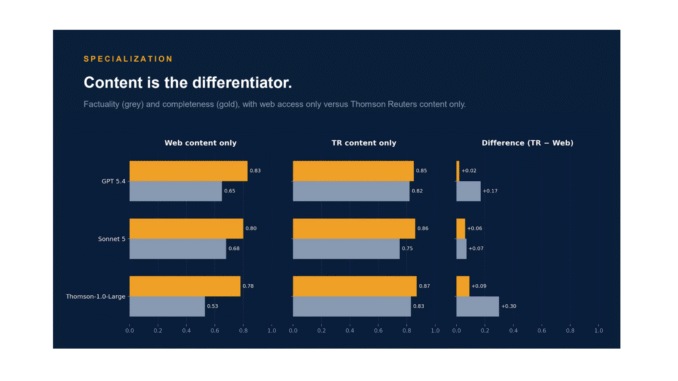
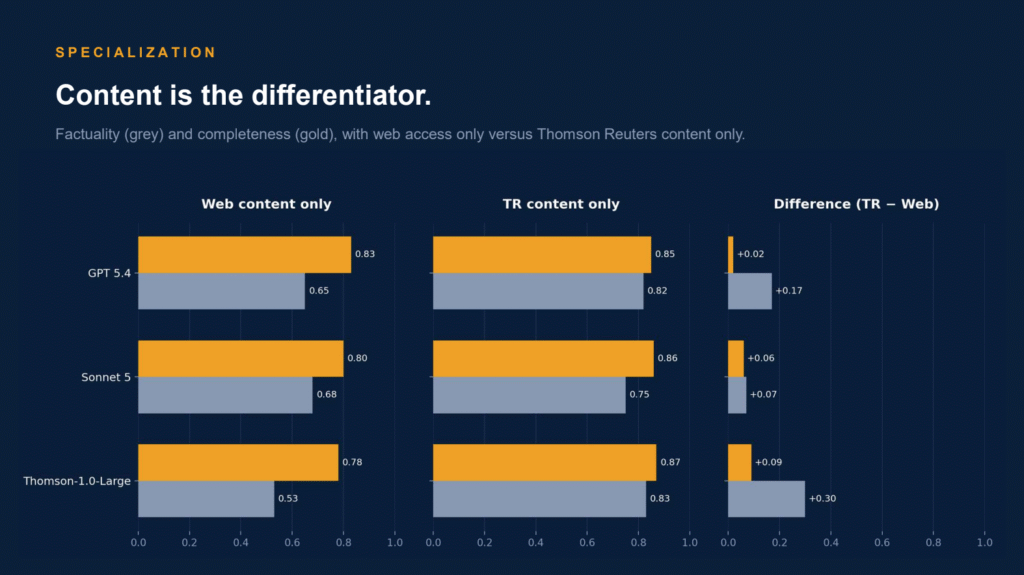
After months of work, TR has launched Thomson 1.0, its own LLM, trained on its own data – and it shows a performance that is higher than some general models. Artificial Lawyer interviewed TR CEO, Steve Hasker, in-depth, about the move, its significance, and the company’s wider legal AI strategy – see below and in next article with transcript.
The move is the result of its work with the team from Safe Sign, the small Cambridge AI company that they acquired.
Amazingly, the cost of Thomson 1.0 was only $40 million and is trained on less than 10% of TR’s legal data.
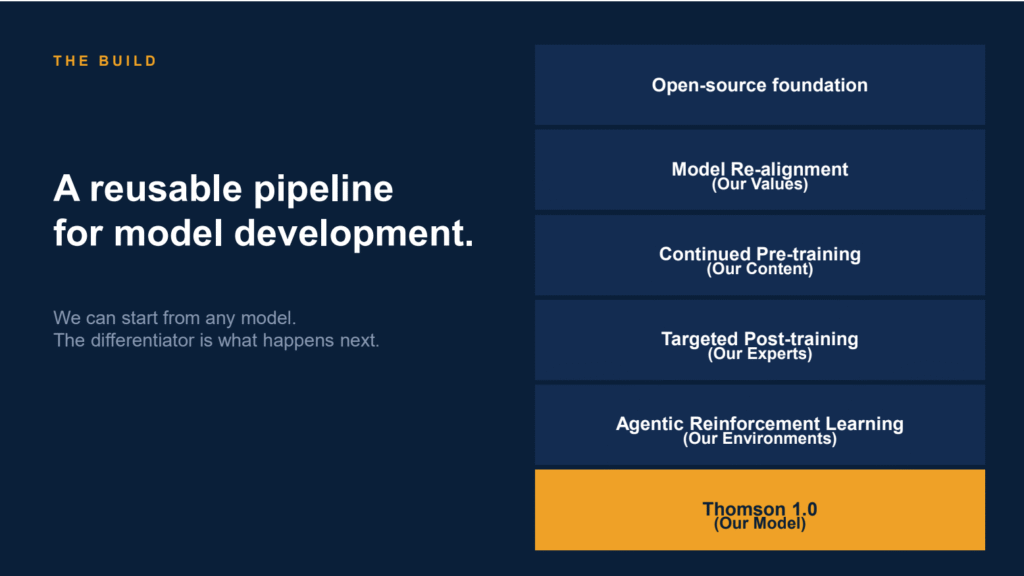
Thomson’s first deployment is inside Tabular Analysis in CoCounsel Legal. Thomson will be available in Tabular Analysis for law firms and corporate legal departments in the upcoming release. There are also plans to extend Thomson models across the legal and tax portfolio with more sovereign AI options to follow, they added.
Joel Hron, Chief Technology Officer, Thomson Reuters, said: ‘For years, the AI industry has treated scale as the answer: bigger models, more compute, more money. Thomson shows there is another path. Start with a strong foundation, specialize it deeply for the work that matters, and you can build intelligence that is highly capable, far more efficient and entirely under your control. We think that changes the economics of professional AI.’
Steve Hasker, CEO of Thomson Reuters, commented: ‘Thomson proves what’s possible when you build AI on decades of proprietary content and editorial expertise. That’s an advantage only Thomson Reuters has, and it shows in the results: our early evaluations put Thomson on par with the latest frontier models across a range of tasks. We’re putting it to work in CoCounsel Legal, with more capabilities and sovereign AI options to come. This is the bar we intend to keep raising.’
See in-depth AL interview with Steve Hasker below where we really explore the meaning of this.
One key aspect we look at is AI sovereignty, and on that subject TR said:
‘Professionals are paying closer attention to questions of AI sovereignty: how a model is trained, what behaviours and biases live inside it, where it runs, and how the privacy of their information is protected. Thomson marks a shift for Thomson Reuters into a world where those questions are answered directly, not left to third parties alone.
‘Thomson shows a meaningful uplift from its base model in instruction following, the ability to execute complex, multi-part professional instructions precisely. It demonstrates an even greater uplift in navigating dense, domain-specific content, the kind of nuanced reasoning the hardest professional tasks require. It is also able to be trained alongside Thomson Reuters proprietary tools like Westlaw and Practical Law, which makes it more sophisticated and nuanced in its work.
‘The domain-specific gain challenges a common assumption, that the most capable general-purpose models only need access to the right content to perform at an expert level. Thomson Reuters’ early results suggest otherwise. Proprietary training and human subject matter expertise, applied to a strong foundation, produces gains that content access alone does not.’
Is this a big deal?
You bet it’s a big deal. TR has shown with Thomson 1.0 that you can get meaningful improvements in LLM performance from using your own data.
That matters because the legal world is full of data – although for some that data is a mess and for others it’s highly curated.
It also shows that law firms can get results from open weights approaches – and after Kirkland and also Harvey’s moves we will see more and more of this. And it will be interesting to see how TR can work with law firms as well with an open weights approach.
As noted, for more, watch the AL video here – or in the next article which includes the transcript.
—
Two Major Legal Innovators Conferences this November
Come and join us in New York and London this November at Legal Innovators!
Legal Innovators UK – London, Nov 4 and 5

And, then Legal Innovators New York – Nov 17 and 18.

After another fantastic Legal Innovators California, where we had speakers from OpenAI, Y Combinator, Google, Meta, and many more pioneering organisations; and our stellar inaugural event in Paris this June, we are now looking forward to the landmark conferences in London and New York, both in November, and both across two days: Law Firm Day, and Inhouse Day.
Discover more from Artificial Lawyer
Subscribe to get the latest posts sent to your email.