
After plenty of waiting, OpenAI has launched Astra for Law, a ‘new offering powered by GPT-6 Astra with tools, settings, and context to support the expertise and judgment of lawyers and legal technology firms’. Law firms such as Latham & Watkins, Ropes & Gray, Cooley and Sullivan & Cromwell are already early adopters (see more below).
The company explained:
‘Astra for Law pairs GPT-6 Astra with instructions for legal analysis and writing, settings for thorough work, and a new Legal Search Index.
The index searches U.S. case law, statutes, regulations, court rules, and administrative decisions across more than 230 million URLs – with sources added daily. That helps lawyers move from the facts of a matter to relevant authorities and supporting passages they can examine themselves.
We’re also launching 26 partner-built plugins and 47 community plugins for legal work in ChatGPT. Partners including Thomson Reuters, Harvey, Legora, and iManage connect specialist tools and knowledge. Community plugins built by lawyers and legal engineers give firms skills they can adapt and extend.
Astra for Law will initially be offered to selected firms through Trusted Access in ChatGPT and Codex, with API access coming soon. We’ll maintain the legal configuration so builders can focus on their own products and workflows.
We’ll build the next chapter of Astra for Law alongside the lawyers and legal technology partners who put it into practice.’
And here’s a video about Astra for Law.
–
Initially it’s understood that OpenAI had been looking at rolling out its legal vertical capability as part of Codex, but it seems that between the start of this year and now it’s taken a branding shift, as so often happens.
Regardless of what it’s called, it good to see it finally arrive.
Here’s an overview from OpenAI of what it will do, then what some law firms are already doing with it.
Legal research: from facts to a supported answer
‘Our new legal search index is one of the tools Astra for Law can use. Legal research often begins with finding the exact right authority, locating the relevant passages, and understanding how relevant and binding they are to the situation at hand. The index helps Astra for Law do that work, and complements the licensed content and specialist products firms rely on from providers such as Thomson Reuters.
By using the legal search index, Astra for Law can search U.S. case law, statutes, regulations, court rules, and administrative decisions across a corpus of more than 230 million URLs, with sources added daily. Our work with Free Law Project, the nonprofit behind CourtListener, brings its case-law collection covering more than 99.9% of published U.S. precedential case law(opens in a new window) into this research experience.
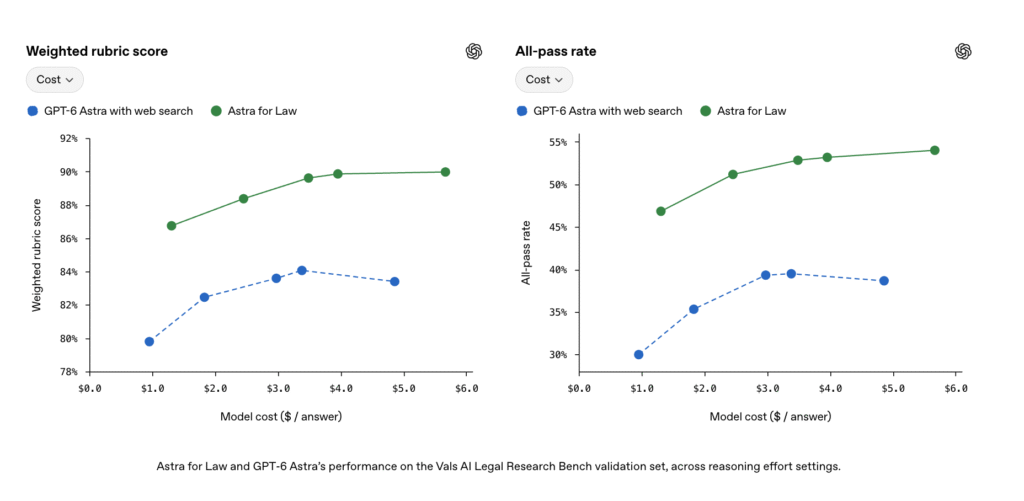
To measure how this configuration improves legal research, we tested Astra for Law’s complete setup on 200 U.S. legal research questions from the private validation set of Vals AI’s Legal Research Bench(opens in a new window). This benchmark measures how well the model can find relevant sources and passages, and how well its research answers meet the evaluation criteria.
At the highest reasoning effort for both systems, Astra for Law passed the evaluation’s overall correctness check on 54.0% of questions, compared with 38.7% for GPT‑6 Astra using web search alone – a 40% relative improvement. Astra for Law also produces more comprehensive answers.
On case-law-focused questions, Astra for Law found 24% more reference cases than GPT‑6 Astra using web search alone at the highest reasoning effort. On the audited set of target passages, it retrieved up to 54% more relevant passages from the correct court opinions, when comparing the systems at the same reasoning effort.
The result is a stronger research foundation for advising on a deal, assessing a dispute, or developing a legal strategy, with reliable authorities the lawyer can examine for herself.
–
Improving performance on end-to-end legal workflows
Legal research is only the first step. Custom instructions for legal analysis and writing guide Astra for Law in applying that research to the client’s facts, developing arguments or deal terms, and identifying weaknesses and uncertainty. That can mean distinguishing a court’s holding from its other observations, addressing cases that weaken an argument, or explaining how a contract exception shifts risk between the parties.
For example, when prompted to identify good law with similar fact patterns, Astra for Law could both pinpoint relevant precedent and match fact patterns better than other frontier models.
Legal-grade trust and controls
Law firms need to protect client confidences and control how AI is used in their practice. We’ve created a special Trusted Access Program for eligible law firms to give lawyers and people working under their supervision access to Astra for Law for professional legal work. For eligible firms, the offering includes Zero Data Retention (ZDR) on our API, and usage of ChatGPT Enterprise is excluded from human review by default.
We are also working with Latham & Watkins, a leader in AI governance, to design for information permissions, ethical walls, client instructions, and firm oversight.
‘As AI becomes more capable, so too does the ability to deploy it in environments that demand rigorous governance, oversight, and accountability. This collaboration builds on Latham’s broader investments in AI development, governance, and infrastructure across the firm, which underpin our enterprise-wide strategy for responsible AI,’ said Michael Rubin, Chair of Latham’s AI Strategy Committee
And some of what the law firms are doing:
- Sullivan & Cromwell built an agreement analyzer that brings the firm’s negotiating playbooks and selected precedents into the review of a new deal. It helps lawyers spot risks that emerge when provisions are read together, then turns those findings into proposed redlines and draft client advice they can challenge and refine.
- Ropes & Gray built a deal diligence system around how its lawyers work through a data room and decide what matters to the deal. It helps them trace findings back to the source and pinpoint questions that could affect an acquisition, such as whether key customer contracts require notice or consent.
- Cooley built GO Public to bring its capital markets expertise into how companies prepare to go public, from drafting the IPO filing to identifying the risks that deserve management’s attention. When the deal changes, it carries that change across the filing so lawyers can review the implications together.
In terms of additional commentary:
“We were grateful to preview early versions of Astra for Law, which were built with legal use-cases in mind. Across both litigation and transactional matters, the models demonstrated impressive research depth and sensitivity to authority. Even at this early stage, they felt like a significant step toward legal-focused AI that is carefully grounded in research that is both current and comprehensive, ‘ said John Savva, Partner, Sullivan & Cromwell
‘In our early testing, Astra for Law showed strength across key aspects of legal research: grounding answers in on-point authorities, citing with precision, and offering practical, advisory guidance,’ said Niko Grupen, Head of Applied Research at Harvey
‘Our collaboration with OpenAI has allowed us to rethink how this work gets done – moving lawyers and management teams more quickly through intensive preparation and into questions that require judgment, market experience and strategic thinking,’ said Dave Peinsipp, partner and co-chair of Cooley’s global capital markets group.
‘As AI becomes more open and interoperable, the value is not in connectivity alone. Legal professionals need more than access to information. They need trusted intelligence, relevant enterprise and matter context, purpose built legal capabilities, and the governance required for high stakes work. That is what Thomson Reuters delivers through HighQ and CoCounsel Legal. CoCounsel remains the trusted professional AI system designed to help complete that work. Our work with OpenAI helps make these capabilities available in the environments customers choose, while preserving the accuracy, confidentiality, and accountability they depend on,’ added Joel Hron, Chief Technology Officer, Thomson Reuters.’
–
Is this a big deal? You bet. Although, it will now join with many others major LLM makers operating directly within the legal realm.
More thoughts soon.
–
Legal Innovators Conferences London and New York this November
Come and join us in London this November 4th + 5th at Legal Innovators. The conference at the intersection of legal AI and the business of law. Day One: law firms, Day Two: inhouse.
Legal Innovators UK – London, Nov 4 and 5

And,
Legal Innovators New York – Nov 17 and 18
See you at Legal Innovators New York – Nov 17 and 18 – join us at the intersection of legal AI and the business of law in New York for the most important legal innovation event of the year! Day One: law firms, Day Two: inhouse. Top speakers from across the legal AI world, leading law firms, and major companies. All for one purpose: to describe and explore the frontier of legal technology. See you there!

UK and New York event links are here:
Discover more from Artificial Lawyer
Subscribe to get the latest posts sent to your email.