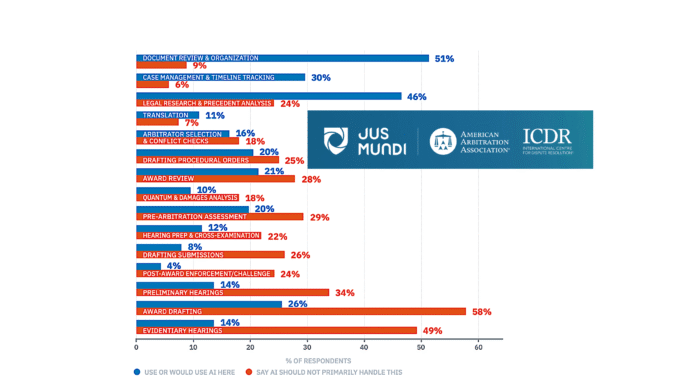
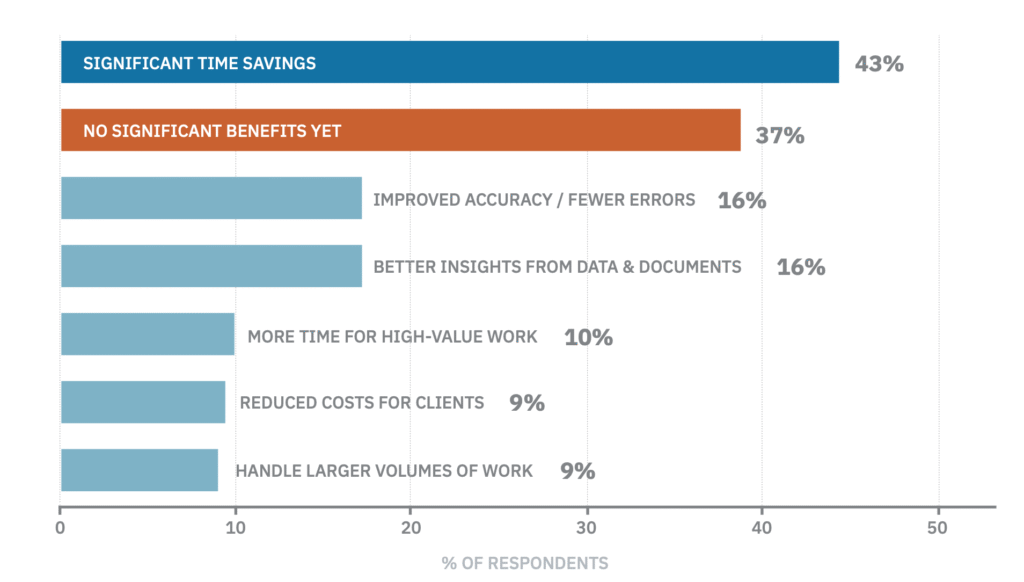
A survey of 557 arbitration professionals in the US has found strongly conflicting data about legal AI. While some use cases for AI seem popular, many others are shunned. Likewise, while 43% report significant time savings, 37% see no major benefits to AI use.
First, let’s look at the AAA and Jus Mundi survey data for what arbitrators are using AI for, and what they prefer not to.
As you can see in the table below, what gets a relatively high level of use, or potential use, is document review and organisation, followed by legal research, and then case management and timeline tracking. Although, none of those three leading examples are higher than 51%.
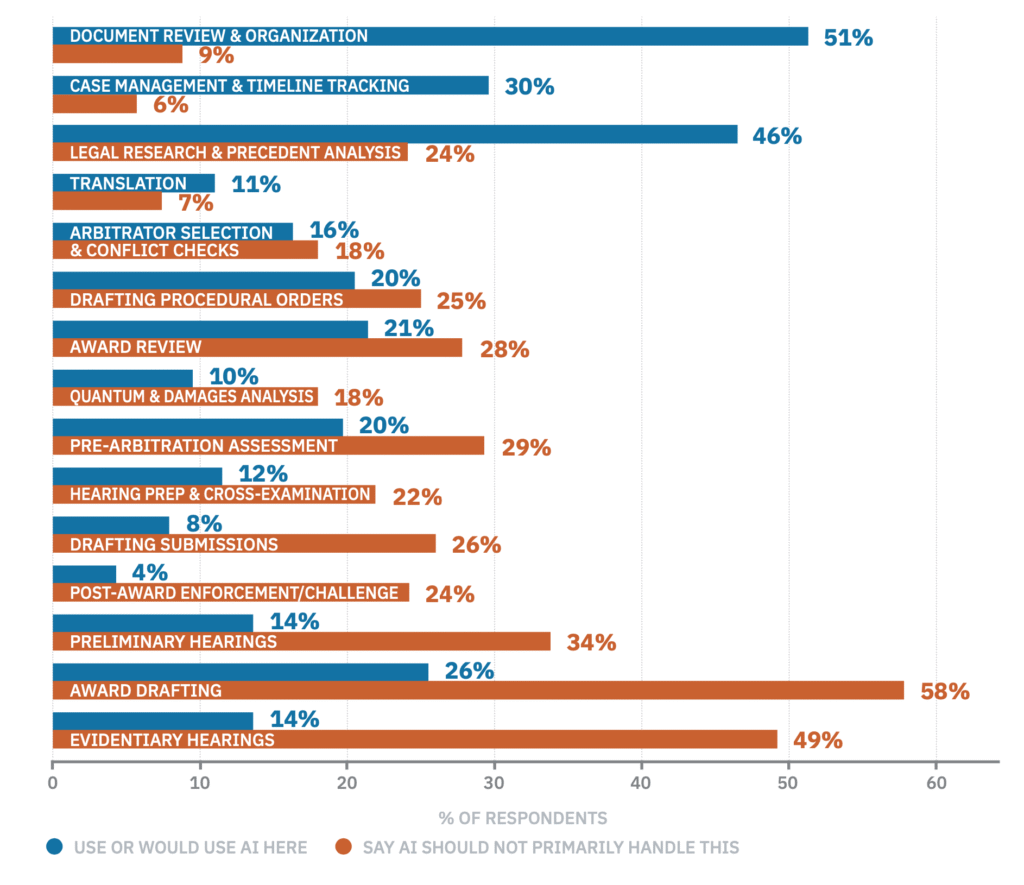
Meanwhile, 58% explicitly said they would not primarily use AI to help with award drafting, i.e. the final ‘judgment’ in an arbitration, and 49% would also not primarily use AI in an evidentiary hearing.
Surprisingly, only 11% said they’d use AI for translation – despite the fact that there are now companies focused just on that use case for lawyers, along with several others focused on good quality translation in general. Perhaps this is because in such an environment arbitrators feel it’s just too risky to use AI when every word could matter?
The overall finding is that arbitrators are fairly conservative in their use of AI, at least based on this survey, trusting the technology primarily where the work is in the early stages, e.g. review and research.
— Advertisement —

—
When it came to the most critical matters, e.g. the drafting of awards, then enthusiasm for AI is very limited, with only 14% out of the sample saying they’d use primarily AI. While doubts about accuracy are likely to be part of this, it’s worth underlining that the final award document is meant to represent the personal judgment of the professional arbitrators. I.e. they actively want that document to be their ‘own thoughts’, and not a rewrite via AI of the key arguments of the dispute.
And now the time-savings and other benefits data. As you can see, it’s almost equally split between those who see benefits and those who don’t.
The answer to this may be on several levels:
- If you don’t really trust AI outputs, e.g. you perhaps had an experience with AI some time ago and didn’t like the results, then you won’t use AI much today, so there are no time-savings, or any other positives that will follow.
- Or, you do use AI, and trust at least what you ask of it, but still use it sparingly. Although there are some gains, those benefits are lost in the much broader and deeper personal work you do without AI, and so on balance you don’t see any real gains.
- A third option is that some arbitrators perhaps fear being replaced by AI, and thus wish to send a message that ‘it ain’t helping much!’ We don’t know. But, based on AL’s experience, this reaction is certainly possible.
Overall, AL would say that arbitration – of all legal work streams – is very much one based on human judgment. After all, it’s literally a case of asking respected experts their personal view in order to come to a solution to an often complex and previously intractable issue.
Yet, there is also plenty of ‘paperwork’ and ‘donkey work’ regardless, especially at the early stages. So, that perhaps explains the split character of these results.
—
P.S. Commenting on the whole report – which can be found here – Linda Beyea, AAA group vice president, said: ‘The more legal professionals work with AI tools, the better they understand their capabilities, where they can deliver value, and what is needed to use them effectively and responsibly. These findings reinforce what we have seen in our AI governance research: organizations that use AI extensively grow more confident in their ability to use the technology responsibly.’
And Annie Lespérance, Head of Americas, Jus Mundi, added: ‘This research gives the arbitration field something it hasn’t had before: an empirical starting point. The data doesn’t tell a simple story of adoption or resistance; it reveals a community thinking carefully about where AI belongs in practice and asking for the guidance and tools to move forward responsibly.’
Thanks to both for the data.
—
Legal Innovators UK – Nov 4 and 5 / Legal Innovators New York – Nov 17 and 18
Cosmonauts have now opened Express Registration for Legal Innovators UK and New York. This means that if you are at a law firm or at an inhouse legal team you can now zoom directly to your tickets – which are complimentary as long as you qualify.
For London – Nov 4 and 5, at the Minster Building, see here:

And, for New York – Nov 17 and 18 – Midtown, please see here:
Discover more from Artificial Lawyer
Subscribe to get the latest posts sent to your email.