By Megan Bradley, Senior Legal Counsel, Docusign.
In-house legal teams share some common pressure points: more contracts, more stakeholders, more urgency, all without additional headcount.
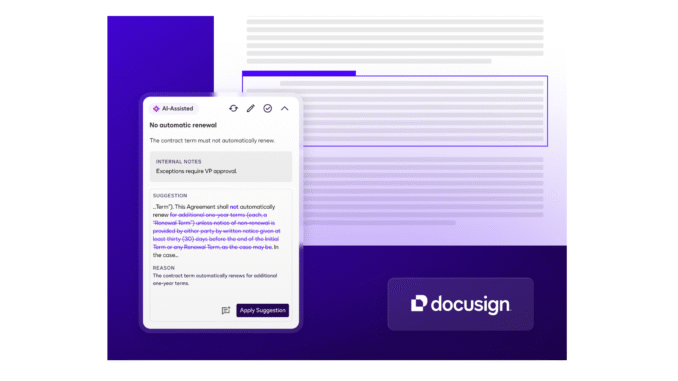
That’s why AI is getting real attention in the contract process. It can speed up first-pass review, catch deviations from standard terms, summarize drafts, and handle the repetitive work that slows teams down.
And as teams incorporate these new tools, legal’s most valuable contribution to AI adoption is building the systems that govern the work and defining how oversight looks from the start.
Legal is redesigning scalable control
Historically, legal control has meant direct review. A contract came in, a lawyer looked at it, made a judgment call, and moved on to the next one.
That model remains important for high-risk work, but it doesn’t scale well when AI handles more routine steps in the workflow.
As more contracting tasks become automated, legal’s highest-value contribution shifts upstream. The work becomes less about touching every clause personally and more about designing the rules, approvals, and checkpoints that govern how work gets done. Once that logic is built into the workflow, the lawyer’s judgment does not disappear. Rather, it gets reused.
‘Escalate anything unusual’ is not a rule yet
A common instruction for an AI agent sounds something like this: handle the routine requests and escalate anything unusual.
Reasonable? Yes. Specific enough to run a workflow? Definitely not.
‘Anything unusual’ is often shorthand for a judgment call an experienced lawyer can make almost instantly. They’ve seen enough patterns to know when something feels off. But for a system to act reliably, that instinct has to be translated into something more concrete.
What counts as unusual? Is it a liability cap above a certain threshold? A change to governing law? A data use term combined with cross-border transfer language?
The rule is usually already there, but it lives in a lawyer’s head.
Governance shouldn’t be a back-end exercise
When governance is built in, teams get the efficiency AI promises, and legal keeps the control it needs. Both outcomes come from the same architecture.
That means deciding early:
- What the system should log
- How decisions should be explained
- Which actions require approval
- Where the audit trail lives
- When a human must stay in the loop
- How rollback, overrides, and exceptions should work
Teams are more comfortable with AI when they can see what happened, why it happened, and where a human can step in. That’s why explainability, auditability, and escalation logic matter so much.
Judgment is getting more valuable
Drafting routine NDAs, first-pass redlines, and contract summaries were always the most likely steps to be automated. Many teams already see the value there because it shortens turnaround time and frees lawyers from work they never wanted to spend most of their time doing.
The gray-area calls are where legal’s value sits: The unusual fallback; the commercial tradeoff; the clause that is technically acceptable but strategically wrong; the issue that is low risk in one product line and high risk in another; the exception that should be approved for this deal, but not normalized across the business.
AI can help surface these issues faster. It can apply a playbook, explain why something appears out of policy, and flag what changed from the last version.
But a person still has to decide what matters, what is acceptable, and when to escalate. Legal is the team best positioned to do that work because they already make those calls.
For lawyers to have the most impact, they need to be able to both make the call on a hard contract issue and explain the logic well enough that a system can apply it consistently.
This is a fundamentally different muscle from the one traditional legal training usually emphasizes, but it’s learnable, and many teams are already building it. Here are a few principles to help you do the same:
- Start with curiosity. When a process works, ask why. Why does this clause always get routed to senior counsel? Why is this position acceptable in one business unit but not another? Why do reviewers treat these two risks differently? Those questions uncover the reasoning that needs to be made explicit.
- Look for unwritten rules. Many legal teams already have strong standards, but they aren’t always documented in a way that a system can use. If the answer to a process question is “it depends,” keep going. Very often, what looks like intuition is actually a pattern with real inputs behind it.
- Tighten the playbook, not just the output. A good playbook is a map of what matters, what can flex, what can’t, and what should escalate.
- Expect iteration. The objective is to create a governed feedback loop that improves over time, not one that is perfect before you even begin. Define a threshold, see an edge case, and revise it. You’ll realize two scenarios that looked similar actually need different treatment.
- Learn from builders around you. Legal does not have to do this alone. Seek out colleagues, in legal or outside it, who think like builders, and pay attention to how they break problems down.
What this unlocks for legal teams
When legal judgment is built into the system, a few important things happen:
- Routine work moves faster because the system can do more, since the rules, checkpoints, and audit trail are already in place.
- Legal gets consistency at scale because similar issues are treated similarly. Exceptions are easier to spot, and review doesn’t start from scratch every time.
- Business stakeholders get a better experience. They get faster answers, clearer escalation paths, and fewer status black holes.
- Legal keeps control in a more durable way. Because they’ve defined how the process works, where humans stay involved, and how decisions can be explained later, they no longer have to hover over the agent as it works.
Right now, companies are making a pivotal choice. Some are rushing AI into workflows and asking legal to bless it later. Others are bringing legal in early to define the playbook, the controls, and the evidence trail before the process goes live.
The second path takes more discipline, but it puts legal teams where they belong: in the room where the rules are being written. That’s real leverage. And it is one of the most practical ways to scale. The work ahead is not to surrender judgment. It is to make that judgment visible, repeatable, and governable.
If you’re thinking about how to put that into practice, explore how Docusign is using AI in our own legal department.
This article is offered for general information purposes only. It does not constitute, and is not a substitute for, legal advice.
—
[ This is a sponsored thought leadership article for Artificial Lawyer by Docusign. ]
Discover more from Artificial Lawyer
Subscribe to get the latest posts sent to your email.