
If the AI natives want to compete at scale with Big Law they can’t just focus on speed and price. While the time/value challenge remains, this way of organising a legal business has many strengths. Artificial Lawyer looks at some of Big Law’s greatest gifts.
Training
Let’s not put on rose-tinted spectacles and ignore the stories about associates left to flounder their way through their junior years, or partners who are as responsive as a brick wall when it comes to giving constructive feedback. Those phenomena do exist.
But, that is not the whole story. In fact, many lawyers receive excellent input from the senior lawyers and training teams at their firms. Sometimes that is more by general osmosis than specifically designed and customised for each and every associate’s needs. Nevertheless, much is learned from experts at the cutting edge of legal work and those handling the most complex and challenging matters of the day.
Aside from the technical aspects of training, there is simply the experience of being part of major deals, or litigation – seeing all the moving parts; the back and forth, the crisis moments, and then – hopefully – the day of completion, or when the case finally settles in the client’s favour.
Where else as a junior lawyer can you experience what it’s like to be part of putting together a multi-billion Dollar deal? Or helping a publicly-listed corporation fight a hostile takeover? Although there are some niche firms out there that handle top-tier work, most of it runs through Big Law. That’s where the big ticket action is, to put it simply – and with such work comes much complexity and novel solutions to gnarly problems. What better place to learn one’s art?
In many ways Big Law is a giant university, with lots of young lawyers staying on their tracks, and equally many from each cohort going out into the world to take on a range of interesting jobs. After all, look at any list of legal tech companies and not all, but many, of those founders worked in this segment of the market: most as associates, sometimes as partners.
Then look at all the legal technologists, and also the consultants out there, and other adjacent roles – so many have come from Big Law. And of course, the vast majority of inhouse lawyers also were shaped first in major law firms. It’s an entire universe of talent – all orbiting what in total, globally is no more than a few hundred law firms, far fewer if you only count the truly huge ones.
If the new model law firms want to really take the fight to Big Law, then over the long-term they will also have to develop training systems that can sustain their talent. Otherwise, they risk becoming refuges for those leaving Big Law, rather than a real ‘university’ that builds talent itself. And training is key to sustaining any segment of the economy.
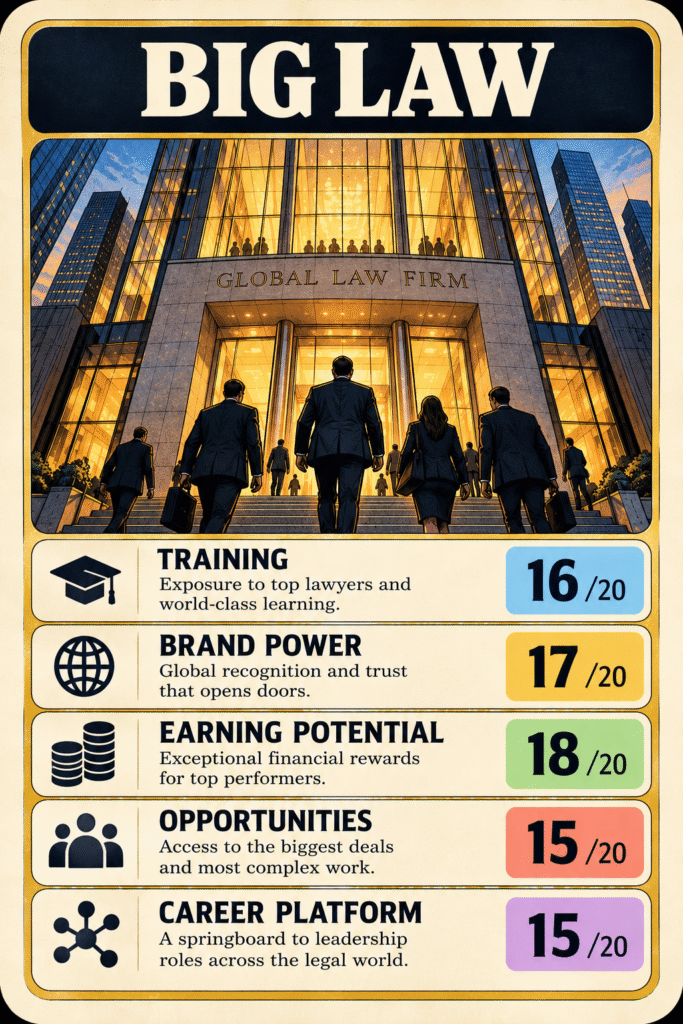
The Brand and the Marketing Platform
Big Law firms are incredible brands. Imagine that Joe Smith of Random Law Firm LLP calls the GC of a major company to gently fish for some work they’ve heard is soon to be needed. Now imagine that the person calling is a senior equity partner from Latham & Watkins, or Freshfields, or any other globally-known legal brand name.
Unless Mr Smith really has something amazing and original to share, there’s no competition – at least for more complex and high-risk work. The brand name alone wins the day, let alone the personal brand of the partner who has been working in their market niche for several decades.
And that is no small thing. Brand really matters. It can carry the day. It can sustain confidence all on its own. It can win an argument just by its mention. It can last for years and years. It can also help a new business establish itself amid much larger incumbents.
Artificial Lawyer, as a site that is focused on legal and legal tech market analysis, deals in brands every day. It’s something that some startups can sometimes fail to fully understand. For example, if X, Y and X contract review systems have a lot in common, aside from offering great service, what will carry the day? Their brand is the answer. And by ‘brand’ this doesn’t mean a cool name and a nice website, but what values permeate that ‘signifier’.
And as noted, there is also the opportunity within Big Law to really carve out a following for yourself. A really excellent deal lawyer – who is also really good at people skills – can build through hard work and skilful engagement with the clients an incredible personal brand, which uses the firm’s platform as a launch pad.
If you are very entrepreneurial – even today in what are far more corporate-cultured firms than in the past – an individual lawyer with the right skill-set and some luck and lots of perseverance can become a rainmaker with a loyal client following. And that’s a wonderful thing.
This site has always massively admired anyone who can build a business. Whether it’s the local bike repair shop, a startup that sells software, or a partner at a law firm who has clients lining up for their help – they have all built something with their own hands, via grit, ingenuity, and determination.
Big Law helps this to happen for several reasons: they are equity partnerships that reward those who can bring in business and ‘build a practice’; they have incredible support services and systems in place that turbo-charge those lawyers at the firm who are great at selling; and as noted, they have a brand that makes getting ‘into the room’ so much easier and faster.
The new model, AI-native law firms have an MSO structure, which has many benefits, such as easily allowing external investment. But, there is great strength in Big Law’s way of rewarding those who bring in business.
You do well with clients then you advance, you start to bring in your own clients and you advance even more, you build your own lasting book of business then you become an equity partner, and then the sky’s the limit. That offering attracts a lot of very talented and driven people – and any business, of any kind, wants people like that. As the saying goes: if you can’t sell, there is no business.
Now, that doesn’t mean that AI-natives cannot create incentive systems to attract and keep such people too. They can. But, there is a beautiful simplicity to the way Big Law rewards those who bring in business, (if they can navigate the occasional fisticuffs over origination credits…!)
— Legal Innovators UK Conference, November 4 and 5, London —

—
Demand is Reality
Big Law makes money the way movies show scenes of counting machines in casinos (and other types of ventures…) going ‘Brrrrrrrrrrrr….!’ as they zip through the Benjies.
This is not magic. It’s not the result of some conspiratorial scenario. It’s simply good, old-fashioned demand.
Commercial legal services are a market, the same as there is a market for apples, and for chiropodists, or AI software, or furniture, and so on.
It’s just a market. There are buyers, there are sellers. That’s the core of it at the end of the day. Yes, legal needs are different to apples; yes, the law is a pillar of our society; but the provision of commercial legal services is something that people do voluntarily and do it because it pays.
It’s estimated that the total global value of the planet’s economic activity is $126 Trillion. Part of the organisations that help to generate that $126 Trillion need expert legal help – continually. Hence Big Law. Hence demand. Hence fat stacks – if you will allow the term.
If a Big Law firm stops providing ‘the goods’ then the buyers will go elsewhere. After all, no-one is stopping you or anyone else creating a new law firm that can capture that slice of work….if what you offer is as good as the incumbents. And to do that you’ll need to attract the top experts in that field and have the systems and support in place to offer those services in as good, or better, fashion as the incumbents.
For the new model AI natives this concentration of demand is both a challenge and an opportunity. AL now likes to quote Jeff Bezos’s comment: ‘Your margin is my opportunity.’ And that is true. But, Big Law could reply: ‘Yes, but our expertise, our brand, our resources, our knowledge, our people, and much more….is our opportunity to keep on going.’
Conclusion
Artificial Lawyer would love to see the Big Law world use AI to its maximum extent. The main barrier, as far as this site can see, is an economic one: the time = value metric that has made Big Law’s giant pyramids super-successful, but has now also become a challenge as new technology changes the means of legal production.
In the ideal world, at least for AL, the new mods will become more like Big Law firms in all the ways noted above, e.g. great brands that create huge trust across the market; while Big Law firms will become more like new mods, e.g. they find a way through the time barrier and keep all the other good things about their own model and culture.
And perhaps one day they will meet in the middle and become one new whole again. That’s the dream.
In short, don’t view the time challenge as removing all the other really positive things that Big Law offers. There is much to learn from Big Law’s success….even if this site hopes that one day they overcome the hour!
Richard Tromans, Founder, Artificial Lawyer and Chair of the Legal Innovators conferences.
–
Legal Innovators UK, on November 4 and 5 in London at the Minster Building, is right around the corner and Express Registration is now open so you can zoom straight to your tickets.
Day One will focus on law firms, and Day Two is for the inhouse world. Both days will also very much be about our great speakers exploring the cutting edge of legal technology; where we have got to with AI; and how all of this changes how you run your firm, practice group, or inhouse legal team.
To pick up your tickets, please follow the link below. Complimentary passes are for those working inside law firms and within corporate legal teams.
And there are many reasons to attend, from networking with literally hundreds of your peers, to hearing from those at the cutting edge of legal innovation – both at major law firms and corporates – to of course seeing all the latest capabilities that the leading legal tech companies have developed. See you there!
Discover more from Artificial Lawyer
Subscribe to get the latest posts sent to your email.