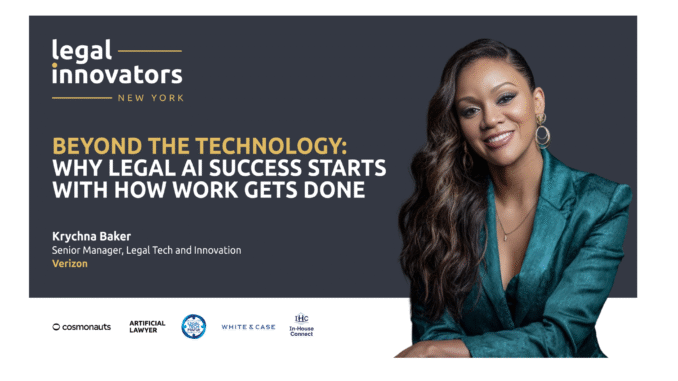
Ahead of the Legal Innovators New York conference on November 17 and 18, the team spoke to Krychna Baker, Senior Manager of Legal Innovation & Technology at Verizon, who will be one of our many excellent speakers on stage at the two-day event.
—
A new legal intake platform can make submitting requests easier. But if no one knows who should review them, where to route them, or when an attorney needs to step in, has anything really improved?
For Krychna Baker, Senior Manager of Legal Innovation & Technology at Verizon, this is where legal innovation often gets complicated. Technology can be implemented successfully while the same delays, unclear processes, and unnecessary work remain.
Having led transformation initiatives at Verizon, Amazon, and WeWork, Krychna brings experience in connecting technology with the people and processes it is designed to support.
Ahead of Legal Innovators New York 2026, where she joins “The Agentic Legal Function”, we spoke with Krychna about overcoming implementation challenges, managing AI risks, and whether AI could fundamentally reshape how legal departments operate.
Enjoy the interview!
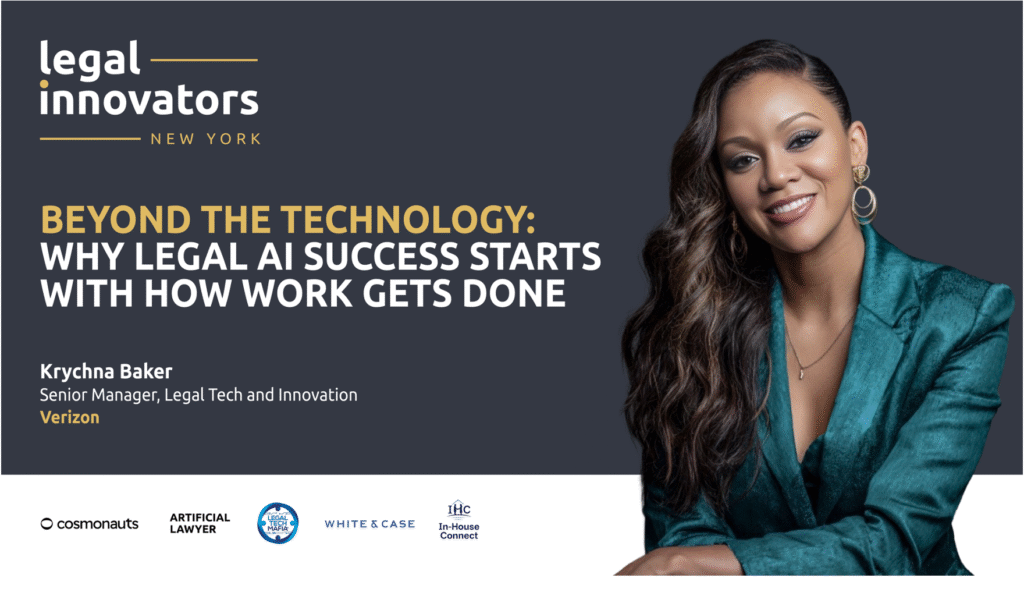
What distinguishes successful legal innovation from simply introducing a new technology into a legal team? What needs to happen beyond purchasing and implementing a tool?
Krychna Baker: For me, the distinction is whether we have meaningfully improved how the work gets done. A tool can be implemented successfully from a technical standpoint and still leave people dealing with the same confusion, delays, or extra steps. My experience connecting Legal’s needs with IT delivery has taught me to start by understanding the work itself. What is someone trying to accomplish? Where are they getting stuck? Is the issue missing information, an unclear process, or something technology can help resolve? Those questions shape what we should build and sometimes reveal that a process decision needs to come first. Take legal intake. A portal can make it easier to submit a request, but someone still has to decide what information is required, who reviews it, how it is routed, and when an attorney needs to become involved. The technology supports those decisions; it cannot settle them for us. Beyond implementation, we need clear ownership, practical training, ongoing support, and a willingness to adjust based on feedback. We also need to measure whether the experience improved. Are requests reaching the right people? Is there less rework? Can people find what they need? That is how I would judge success: whether the change makes a meaningful difference in everyday work.
What role should lawyers themselves play in identifying opportunities for innovation? Should innovation be driven primarily by dedicated legal innovation teams, or should every lawyer be expected to identify opportunities to improve the way they work?
Krychna Baker: I believe every lawyer should have a voice in identifying opportunities, while dedicated innovation teams should provide the structure and support to move those opportunities forward. Lawyers understand the substance of the work and the consequences of getting it wrong. They also see the recurring frustrations: the same question arriving repeatedly, information scattered across systems, or a process that requires unnecessary follow-up. We need that insight to understand what is worth improving. At the same time, it is unrealistic to expect every lawyer to become a technology specialist or manage an innovation project alongside an already demanding workload. Their contribution might begin with a simple observation: “This keeps slowing us down.” The innovation team can help investigate the cause, assess options, and coordinate with IT and other partners. Lawyers should remain involved as solutions are designed and tested. Their role is especially important in explaining exceptions and identifying where professional judgment must remain part of the process. For me, shared responsibility also means closing the loop. If someone brings an idea forward, they should know what happened to it and why. People are more likely to participate when they see that their input is taken seriously and can influence the outcome.
— Legal Innovators New York Conference – Nov 17 + 18 —
—
What are the biggest challenges involved in moving from an idea for legal innovation to an implemented solution?
Krychna Baker: The biggest challenges I have encountered are turning a broad idea into a clear, achievable scope, resolving dependencies across teams, and making sure the solution fits how people actually work. An idea like “make our contracts easier to search” sounds straightforward. Once you begin working through it, you have to answer much more specific questions: Which contracts? Where do they live? Which version is authoritative? Who is entitled to see them? What should the system do when the information is incomplete? Those answers affect both the experience and what can realistically be delivered. There is also the coordination involved in a large organization. Legal, IT, security, data owners, and vendors each bring expertise and requirements. A significant part of my role is helping those groups understand the same problem and making the decisions, owners, and dependencies clear. Otherwise, an unresolved question can sit between teams and quietly delay the whole effort. I have also learned that agreeing on a first release matters. We need something useful and achievable, with a clear understanding of what comes later. Finally, implementation includes adoption. Testing, communication, training, and support need real time and ownership. A solution has to work for the people depending on it, including when their work does not follow the ideal scenario.
How should legal departments approach the risks associated with using AI, particularly around accuracy, confidentiality, and privilege?
Krychna Baker: I think legal departments should approach these risks through the specific use case, with Legal and the appropriate technical and risk partners involved from the beginning. The first questions are: What are we asking AI to do, what information will it use, and what would be the consequence of an incorrect answer or an inappropriate disclosure? For accuracy, I would want testing against realistic legal tasks, including incomplete information, conflicting documents, and questions the system should not answer. Users need to be able to examine the supporting sources and understand when further review is necessary. A confident-sounding response should never be treated as sufficient evidence that it is correct. For confidentiality, we need to understand how information is accessed, retained, and used, including the provider’s terms and the system’s permissions. Making information easier to find should preserve the boundaries around who is allowed to see it. Privilege requires its own legal assessment. I would not assume that a secure environment, by itself, settles that question. The nature of the information, the arrangement with the provider, and the intended use all need consideration by the appropriate legal experts. From my perspective, responsible implementation means making those expectations practical: clear permitted uses, defined review responsibilities, training, and a way to escalate concerns. People need to understand what they can rely on and what they still need to verify.
How do you see the relationship between lawyers and AI evolving? Do you expect AI primarily to become a productivity tool for lawyers, or could it fundamentally change the structure and operating model of legal departments?
Krychna Baker: I expect AI to do both, although I am more confident about the immediate productivity benefits than the exact shape of the longer-term operating model. Helping lawyers find information, organize documents, and prepare preliminary work can create value today. Over time, I think those capabilities could also change how requests enter Legal, how routine guidance is delivered, and where attorneys spend their attention. For example, an employee with a recurring question might be able to access approved guidance directly, with a clear route to an attorney when the situation involves an exception or requires interpretation. That could change the volume and type of work reaching the legal team. It would also require deliberate decisions about who maintains the guidance, how exceptions are recognized, and who remains accountable. I do not think greater productivity automatically produces a better operating model. Departments will have to decide how to use the capacity they gain. There is also an important question about professional development: if AI performs more preliminary work, how will newer lawyers build the experience needed for sound judgment? My hope is that AI helps Legal engage earlier and more thoughtfully with the business. The broader opportunity is to give lawyers more room to understand the context, anticipate issues, and contribute where their judgment and relationships matter most.
Krychna’s perspective highlights a critical challenge: automating legal work doesn’t automatically fix the processes behind it. Whether improving contract search, routing legal requests, or introducing AI-powered self-service, teams still need to decide who owns the process, how exceptions are handled, and where human judgment is required.
At Legal Innovators New York 2026, Krychna will bring these insights to “The Agentic Legal Function”, examining how AI agents could reshape legal workflows, enable self-service, and change how in-house teams operate, while addressing the limits and governance challenges.
– Legal Innovators New York, November 17–18 at Quorum by Convene, New York
—
Credits: Editor: Emma Nguyen, Marketing Executive at Cosmonauts, Graphics: Charles Kabunga, Design Lead at Cosmonauts.
Discover more from Artificial Lawyer
Subscribe to get the latest posts sent to your email.