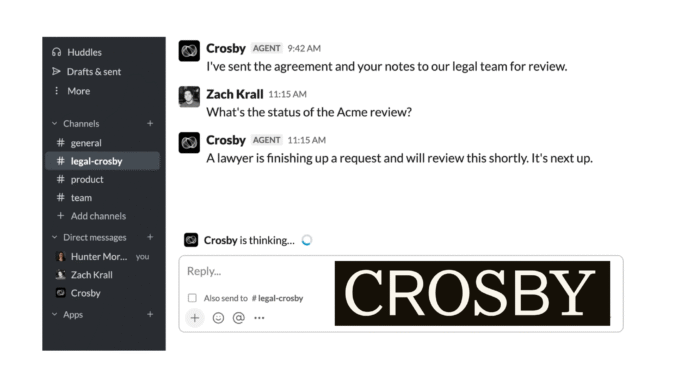
New model, AI native law firm, Crosby has rolled out two key initiatives: paralegal agents that keep working on client matters; and a groundbreaking new insurance policy for their work. Here, Artificial Lawyer asks some key questions about this more autonomous approach to performing legal tasks for clients and the pioneering step to take out special legal insurance for agents – provided by Testudo and underwritten by Lloyd’s of London.
How does it work?
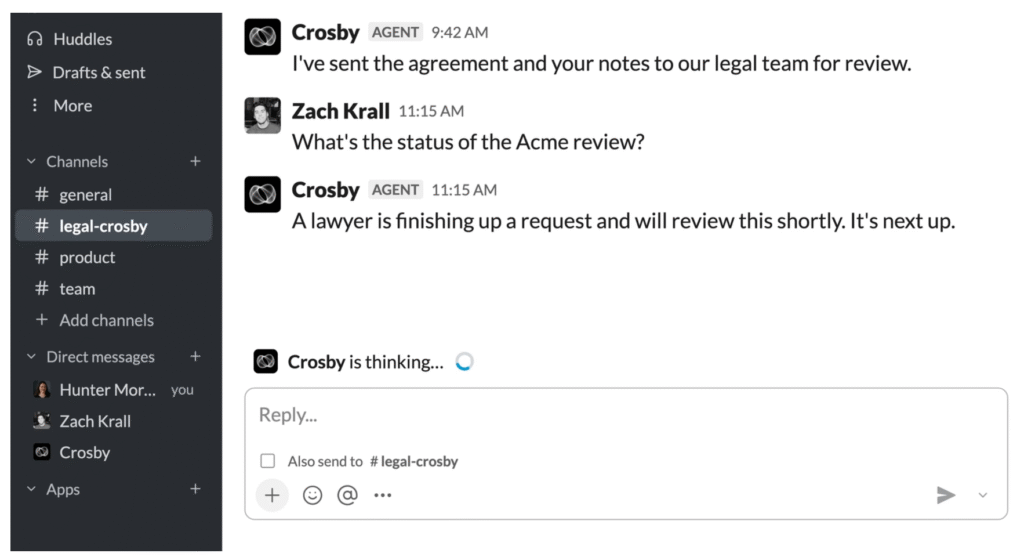
Crosby’s paralegal agents act as a powerful agentic front door for client requests before they reach our human lawyers. Every new message is processed through an agent. The agent can do end-to-end work within a capability set using up-to-date context that Crosby stores on each client. For tasks outside this set, the agent is able to pass documents and context to our human lawyers and communicate updates back to our clients in real time.
— Legal Innovators New York Conference – Nov 17 + 18 is next week!
—
How accurate are the agents?
We measure every new capability we launch on different datasets. Before our initial launch, we reached 94% accuracy on escalation (measured by whether the agent correctly completed the task itself or correctly escalated it to a lawyer). For every new feature, we measure its individual performance on that specific task by building datasets and judges over agent trajectories.
Beyond accuracy, we have also instilled many security guardrails for our agents. The agent works in a sandboxed environment, where it can read and write documents and only has access to the relevant client’s business data. There is total data isolation between clients.
How is this covered by your new insurance?
Crosby has secured a $5m insurance policy covering the work of its paralegal agents. We believe this is the first time a law firm has obtained liability insurance for the outputs of its AI agents.
The policy is with Testudo and underwritten by Lloyd’s of London. Testudo conducted a technical analysis of Crosby systems, including the technology and models underlying it, governance controls and logs of human review steps, with an aim of determining how our agents work, data our systems access, and how our models are trained. They also reviewed internal company contracts and policies, and collected other data to determine our AI liability.
The policy took effect at the start of November. It covers agents handling legal tasks under the supervision of an attorney, and agents doing paralegal work on their own.
How much time is saved by using the agents?
After launching client agents, human review time has already fallen to 0 for 20% of our preexisting legal tasks; this includes work like summaries of negotiations, pulling prior business context, and routing to relevant parties for approval. Typical human review time is ~180 hours per day, which means we are saving 36 hours every day for our lawyers.
Beyond the tasks lawyers were already doing, there are also tasks that our clients will soon be able to ask of our agents that they would never ask of a lawyer. Our lawyers are amazing at making high-stakes decisions, but when our clients need the last time they agreed to a 3x liability cap, our agents have way better memory and will respond in sub-5 seconds, which humans could never do.
–
Many thanks to CEO, Ryan Daniels, and team at Crosby.
–
Is this a big deal?
Well, if the new model approach to legal work is really going to take off, then agent delegation is going to become more and more important.
The goal is to give as much as sensible – within the limits of the state of the art for genAI – to the agents. That in turn means giving them more autonomy. But, you then need to be secure in the knowledge that they will perform correctly – the same as a law firm partner needs to trust their associates.
Improving tech will help here, so will improved ‘harnesses’ by Crosby and others who take this approach. But, the insurance part takes this to a different ‘existential’ level, one might say. I.e. we are now seeing new model firms treating agents literally the same way as an associate, or in this case a paralegal.
And there has been a big debate about delegating responsibility to AI. In this case, that is exactly what is happening – albeit the final outputs do have lawyer oversight. That said, much is being handed over to the agents – hence the insurance.
It’s now November 2026 and just four years since ChatGPT arrived. If anyone believes that in another four years this approach won’t be mainstream by 2030 for many firms and new mods, and inhouse teams, then….well, you’re betting against the market’s clear direction of travel.
—
Legal Innovators New York Conference – Nov 17 + 18 is next week!
The two-day legal innovation conference, in association with global law firm White & Case, and held at the very cool Quorum venue by Convene in Midtown, New York, will have Day One focused on law firms, and Day Two all about the inhouse world.
We’ll be exploring how legal AI is changing our sector, where we have got to, what we have learned so far, and how to handle what comes next – and hearing from those who are right at the cutting edge of this evolution.
It’s going to be both highly useful to everyone who attends, with plenty of takeaways that can be applied to your law firm or legal team – and a lot of fun, with lots of opportunities to network and also see all the latest new product developments from the world’s leading legal tech companies.
Join us this November for a legal innovation conference that will make a difference!
Here’s the Express Registration link for your free ticket if you work at a law firm or within an inhouse legal team.
Legal Innovators New York Conference – Nov 17 + 18
Discover more from Artificial Lawyer
Subscribe to get the latest posts sent to your email.