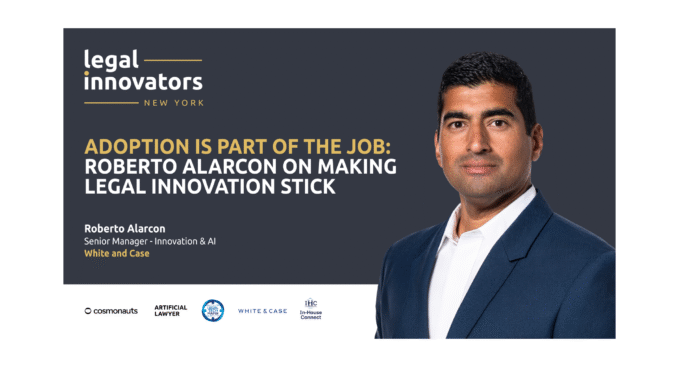
Ahead of Legal Innovators New York, which is next week on Nov 17 and 18, at Quorum by Convene in Midtown, the events team spoke to Roberto Alarcon, Senior Manager, Innovation & AI at White & Case. They explored what he sees as his most meaningful work.
Next Tuesday, Roberto will deliver a keynote on Law Firm Day. For an audience that has heard plenty about what AI could do, his practical, people-first perspective promises to be a highlight. Ahead of his keynote, we asked him about pilots, skills, and why adoption deserves more attention.
—
How would you define ‘legal innovation’ today, and how has your understanding of innovation in the legal sector evolved over the course of your career?
To me, legal innovation means finding practical ways to improve how legal work gets done. That can involve technology, but it can also involve a clearer process, better collaboration, or making information easier to find and use.
Over the course of my career, I’ve come to place more emphasis on what happens after a tool is introduced. Understanding the problem, involving the people doing the work, and helping them build confidence are all essential. The question I keep coming back to is: does this change make a useful difference in someone’s day-to-day work?
Which areas of legal practice do you believe have the greatest innovation potential, and why? Are there particular types of legal work where innovation can have a more immediate impact?
I tend to think about opportunities at the task level rather than ranking practice areas. Activities that involve organizing information, comparing documents, or coordinating repeatable steps can be useful places to explore improvements.
A good starting point is a clearly defined task where the people doing the work can explain what takes time, where difficulties arise, and what a better outcome would look like. That makes it easier to assess whether a proposed change is helpful. Any use of technology should remain appropriate to the task, with professional judgment and review built into the process.
How important is experimentation and piloting when introducing new technology or processes? What does a successful pilot look like for you?
A pilot is valuable because it creates an opportunity to test assumptions and learn from the people who would actually use a tool or process.
For me, a useful pilot starts with a specific problem, a manageable scope, appropriate safeguards, and a clear idea of what success would look like. Feedback should cover both the quality of the work and the experience of doing it: was the process easier to follow, was the output useful, and what support was needed?
A successful pilot produces enough evidence to make an informed decision, including when the right decision is to refine the approach or stop.
From your perspective, what new skills do lawyers need to develop as legal services become increasingly technology-enabled?
Alongside their legal expertise, lawyers benefit from being able to frame a problem clearly, understand a tool’s capabilities and limitations, and critically evaluate its output. Knowing when to use technology, and when to seek guidance, is an important part of that.
Collaboration also matters. Lawyers bring an understanding of the work that technology and innovation teams need. Being able to explain a workflow, ask questions, and give practical feedback helps those teams develop more useful solutions. Curiosity and a willingness to learn are valuable starting points.
What do you hope the audience will take away from your session at Legal Innovators New York 2026?
I hope the audience leaves with a practical appreciation of the work that turns a technology investment into everyday use. That means understanding the organization’s priorities, listening to the people doing the work, and providing support that fits their needs.
One idea at the heart of my session is to meet lawyers where they are. People have different responsibilities, levels of familiarity, and demands on their time. Taking those differences seriously helps make change more practical and sustainable.
My central message is simple: adoption is an ongoing part of the job, deserving deliberate attention throughout the life of an initiative.
—
In every answer, Roberto returns to the people doing the work. He measures innovation by the difference it makes in someone’s day, starts with clearly defined tasks, and treats a pilot as a path to an honest decision, even if that means stopping. He also believes lawyers’ most valuable new skills are the ones that sharpen their judgment. Above all, he sees adoption not as a finish line but as an ongoing part of the job.
It is a perspective worth taking seriously. Legal innovation is often told as a story about technology, but Roberto makes a compelling case that the lasting story is about people.
We are looking forward to hearing him build on these ideas in New York. If your team is navigating the same questions, join us at Legal Innovators New York on November 17-18 at Quorum by Convene, where tickets are complimentary for qualifying law firms and in-house professionals.
—
To get your express tickets, which are complimentary if you work inside a law firm or inhouse team, please follow the link below. See you on Nov 17 and 18 in New York!

—
[ Interview and graphics by Cosmonauts. ]
Discover more from Artificial Lawyer
Subscribe to get the latest posts sent to your email.