
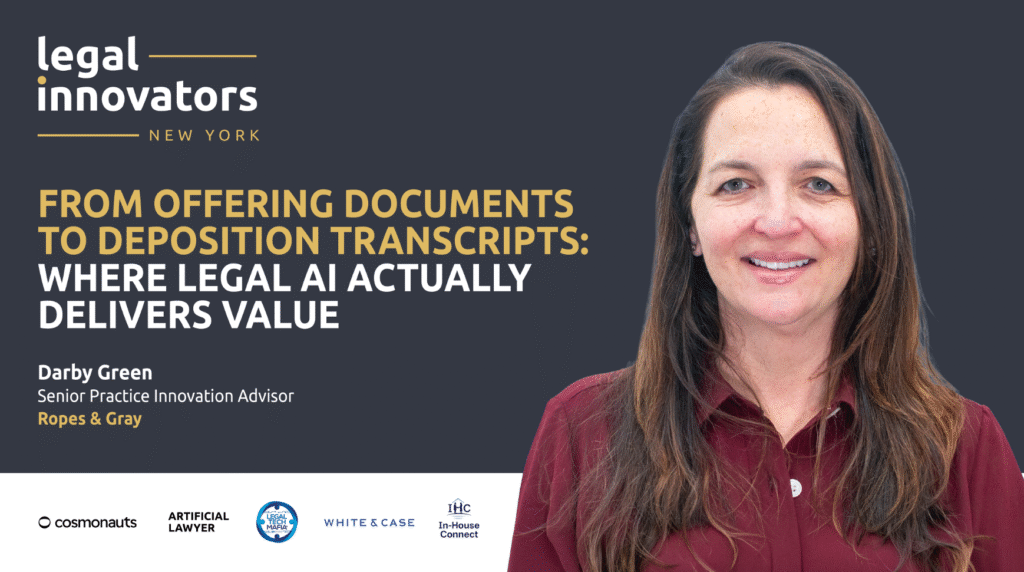
Ahead of Legal Innovators New York on Nov 17 and 18 next week at Quorum by Convene in Midtown, the events team spoke to Darby Green, Senior Practice Innovation Advisor at Ropes & Gray, about meaningful legal innovation.
She will be will be one of our many expert speakers during the two-day conference: Tuesday 17th – Law Firms; and Wednesday 18th – Inhouse.
To get your complimentary tickets, please see the Express Registration link below. Passes are free for one, or both days, if you work at a law firm or within an inhouse legal team.
Legal innovation can mean different things to different people, from introducing AI tools to redesigning existing processes. In your view, what does genuine innovation in legal practice look like?
Darby Green: The word ‘innovation’ has been in my title since 2018, and in that time its meaning has shifted more than once. It’s a moving target, just like ‘AI.’ Not long ago, AI meant machine learning and natural language processing. Today it means generative and agentic AI, and in a few years it will mean something else again. Innovation moves right along with the technology.
What stays constant for me is the definition underneath: being creative with technology to move both the practice and business of law forward while maintaining the high level of quality and verification that legal work demands. That second half is the part that makes it legal innovation. A faster answer that can’t be trusted isn’t progress.
So sometimes legal innovation looks like a new tool. Other times it’s redesigning a process, standardizing a template, or getting information into a structure that can finally be analyzed. The real test is whether the work gets better and the people doing it would fight to keep it.
From your perspective, which applications of AI have the greatest potential to improve legal practice, and which do you think are receiving more attention than they deserve?
Darby Green: The biggest near-term value is in work that’s high-volume, pattern-based, and currently done by very smart people under time pressure. Think of pulling structured information out of large sets of materials, first-pass review, and comparing documents against each other or against a playbook. Examples include checking whether an offering document has drifted from the road show deck, reviewing deposition transcripts for confidentiality designations under a protective order, or seeing how a set of side letter provisions compares with what’s market. I’ve also always been interested in analytics, and with AI we can turn a firm’s experience and the public record into structured data that informs strategy.
A hot topic that is getting more attention than it deserves is the fully autonomous AI lawyer. Agents are genuinely promising, and I spend a lot of time with them. But today the value comes from well-scoped, supervised workflows rather than from handing a matter to a machine. The lawyer stays in the loop, and that verification is what turns an agent’s output into something a client can trust.
Different people learn and adapt in different ways. In your view, how should law firms approach training to ensure that new tools become part of everyday practice rather than something employees use only occasionally?
Darby Green: My years in product management taught me a core principle: a tool only gets adopted if it solves a problem. So I always start with the problem, not the solution. When I work with attorneys, the first step is helping them identify and diagnose what is actually slowing them down. Only then do I bring in the technology that could help solve it.
Right now, many lawyers are feeling pressure to ‘use AI’ without knowing how or why. That’s the wrong framework. It’s a solution in search of a problem, and it’s exactly how tools end up being used once and forgotten. The same principle applies to training. It sticks when it starts from the problems a practice group actually has, uses their real matters and documents, and is delivered in a manner that works for them, whether that’s a one-on-one to address a specific issue, a brief cameo at a team meeting, or a live demo. These tools are changing rapidly, so a launch-day session is only the starting point.
What advice would you give to someone who wants to build a career in legal innovation? Which skills and experiences do you think are most important for success in this field, particularly for someone who needs to understand both the practical realities of legal work and the opportunities offered by technology?
Darby Green: I would take to heart the old chestnut we all heard in law school, ‘You can do anything with a law degree.’ I’ve reframed it a little. You don’t have to practice law to use what made you a good lawyer. The diligence and attention to detail that made you a successful attorney are exactly what these new technologies need. Someone has to know when an output is wrong, and why.
If you’re coming from the technology side, the reverse applies. Spend time with lawyers until you understand their language and their work. Either way, the skills that matter most are about translation. You need to listen well enough to find the real problem, explain technology in plain language, and approach every new tool with healthy skepticism and a willingness to test it.
And jump into the industry now! I’ve been in legal tech for more than 15 years, and I’ve never seen a more exciting time. We’re in the middle of an industrial revolution, and I think we’ll look back on the arrival of GenAI as a true inflection point. There’s never been a better moment to build a career here.
What insights do you hope the audience will take away after your session at Legal Innovators New York?
Darby Green: I hope people leave thinking about AI as relationship infrastructure, not just productivity tooling. The first wave of legal AI was mostly about doing our own work faster. Now we’re seeing firms and clients starting to work on AI together instead of treating it as something each side does on its own. Collaboration in this context means agreeing on which problems are worth solving, what quality looks like, and how the results will be used.
I’d also like the audience to come away with concrete ideas for building these partnerships with their own clients and to understand what this takes. It requires trust, clear governance around data, and a willingness on both sides to rethink how work is scoped and priced.
—
Darby’s perspective highlights a clear distinction: AI’s value comes from solving specific legal problems, with the verification and human judgment needed to make its outputs reliable. From document comparison and first-pass review to supervised AI agents, the most promising applications are those that improve real workflows.
At Legal Innovators New York 2026, Darby will build on these ideas, exploring how law firms and clients can move beyond individual productivity gains to develop shared AI-driven workflows, stronger governance, and more lasting digital partnerships.
Join Darby and many other leading experts at Legal Innovators New York, November 17–18, 2026, at Quorum by Convene, New York – Express Tickets can be obtained below:
—
[ Interview and images by Cosmonauts. ]
Discover more from Artificial Lawyer
Subscribe to get the latest posts sent to your email.