By Peter Duffy, CEO, TITANS.
For years, legal tech adoption was measured in licences and logins. GenAI added prompts and tokens. This data shows who is using AI. Now we can also measure how well they use it.
GenAI is changing how legal work gets done, bringing major efficiency gains, higher-quality work and new ways to serve clients. Yet two lawyers with the same tool, in the same team, can get drastically different results from it. For AI enablement teams, this is a significant challenge.
Traditional legal tech products came largely preconfigured, and the use cases were well known, so results varied little from one user to the next. With GenAI, the variety of applications is much broader, and the results depend heavily on the user: how they prompt, iterate and verify the outputs. The technology is amazing, but imperfect. Because it can hallucinate and reflect bias, there is more room for user error. There are many examples of these errors resulting in sanctions and substantial reputational damage. With such variation in fluency, enablement teams need new ways to measure how well the tools are being used.
Familiar usage measures still have their place. Active users by team and user surveys all help teams track adoption. But self-reporting and volume alone can mislead. In our research with Harvey’s law firm and in-house customers, we found that as lawyers’ prompts improve, their query counts can fall, because they get what they need in fewer attempts.
Institutional capability is the bigger prize when thinking about AI adoption. Moving away from individual productivity and encouraging the build, sharing and use of AI assets across an organisation opens up much more opportunities. Knowing whether your people are ready for that shift begins with knowing how well they use AI today.
What Makes This Possible Now
Three developments now make it far easier to measure how well people use AI.
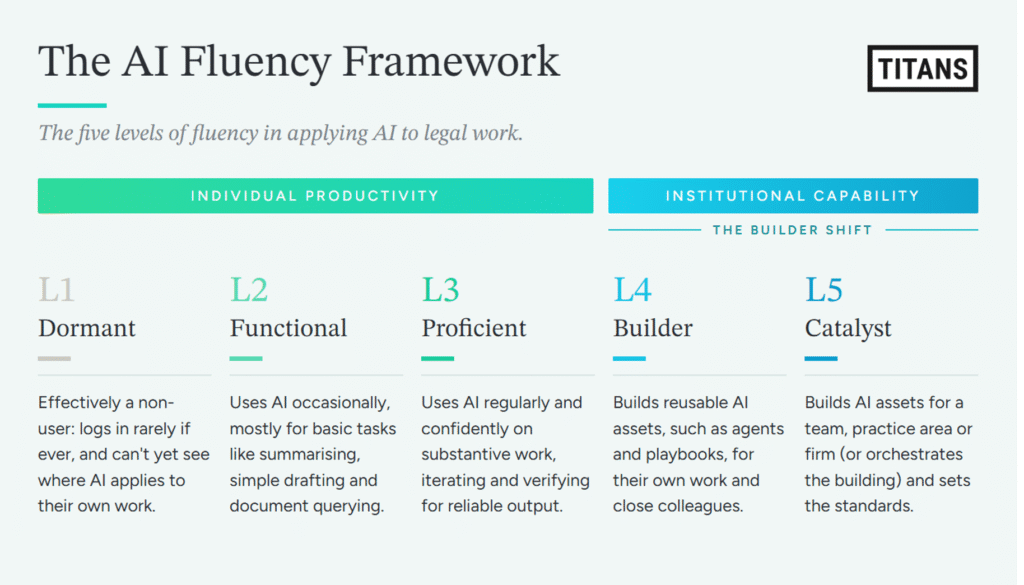
1. A clear framework. Earlier this year, TITANS published The AI Fluency Framework, independent research commissioned by Harvey. Drawing on interviews with enablement leaders at law firms and in-house teams, and set out to answer questions including what fluent use looks like, how to measure it, and how to build it.
The framework lays out five levels, with signals for each in product data, and beyond it, in how lawyers talk and work. The first three describe individual productivity. Dormant users barely log in. Functional users prompt for basic tasks and often accept the first answer. Proficient users work with AI on substantive legal work most days, treating it as a thought partner, refining the output and verifying what comes back. Levels 4 and 5 are where that productivity becomes institutional capability. Builders create reusable assets, such as agents and playbooks, for themselves and close colleagues. Catalysts build for a team, practice area or firm, and set the standards others follow.
2. Richer product data. Feature-level counts used to be as detailed as analytics got, if you were lucky enough to get them! Some products now surface far more: whether a prompt is grounded in sources, whether follow-up questions build on the first answer, and which prompting techniques people use. They also show which AI assets, such as agents and playbooks, each person has built, who else uses them and how often. They can even reveal tool-task misfits, such as bulk documents pushed through a chat interface when a document review feature would do the job better. That moves measurement from how much people use AI to how well they use it.
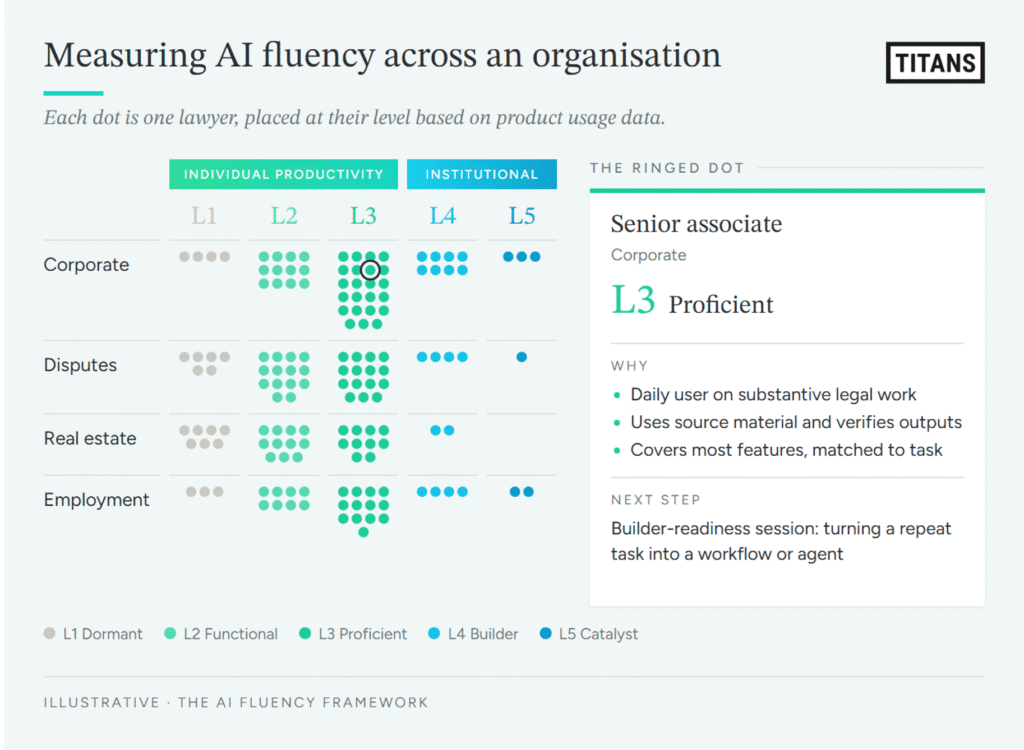
3. AI to run the analysis. Even with good data, decent analysis takes effort. In rollouts we’ve supported at leading law firms, it often meant exporting data, combining and cleansing files, then building formulas to distil it. AI, with supporting tools, is now remarkably good at this kind of work. Run it over product data against the framework’s rubric, and it readily classifies every user by level, with justifications provided.
Some platforms, such as Harvey’s Command Center, let you run this AI analysis inside the admin panel, with no exports needed. With other tools, you may need to export the data first. But it’s still much more efficient than it used to be!
Putting the Results to Work
A reliable organisation-wide picture of AI fluency helps enablement teams support users more precisely. They can:
- Target training at the right level, with one-on-ones for Dormant users and hands-on sessions grounded in real use cases for those in the middle.
- Spot who is ready to build. Proficient is the goal for most lawyers, but a smaller group will go further. Give them the permissions and support to create assets others rely on, with Catalysts as champions and validators.
- See where people need more guidance, such as on verification or choosing the right feature for the task.
- Compare AI fluency across teams and practice areas, and track how it changes over time.
The framework also includes signals beyond the data, such as how lawyers talk about AI, whether they share wins with colleagues and whether others come to them for advice. Naturally, surveys, conversations and observations can enhance the perspective further.
From day one, we set out to make the framework immediately usable, and it’s been great to see organisations already applying it to understand and elevate their users’ AI fluency.
If you’ve been judging adoption by logins, prompts, and token counts, the framework is an easy way to see what sits behind those numbers. We have created this as an independent approach that works across whichever AI tools you use, so you can start applying it today.
Get The AI Fluency Framework here.
–
About the author: Peter Duffy is founder and CEO of TITANS, the AI acceleration partner for legal leaders. TITANS has worked with a fifth of the UK’s top 50 law firms, several AmLaw 50 firms, the Big Four and private equity-backed ALSPs. Its work includes some of the largest AI platform rollouts globally and award-winning AI fluency programmes that have trained thousands of lawyers.
—
[ This is a sponsored thought leadership article by TITANS, on behalf of Harvey, for Artificial Lawyer. ]
Discover more from Artificial Lawyer
Subscribe to get the latest posts sent to your email.