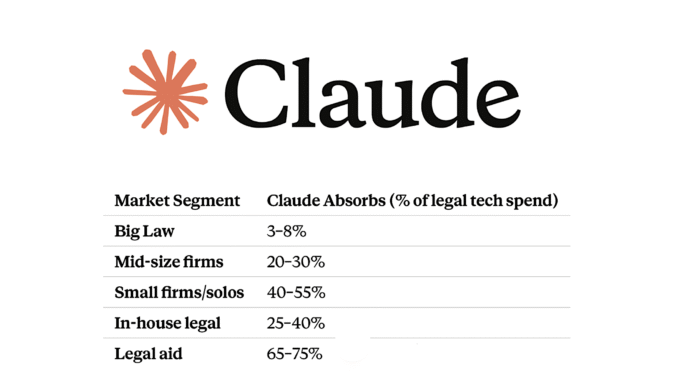
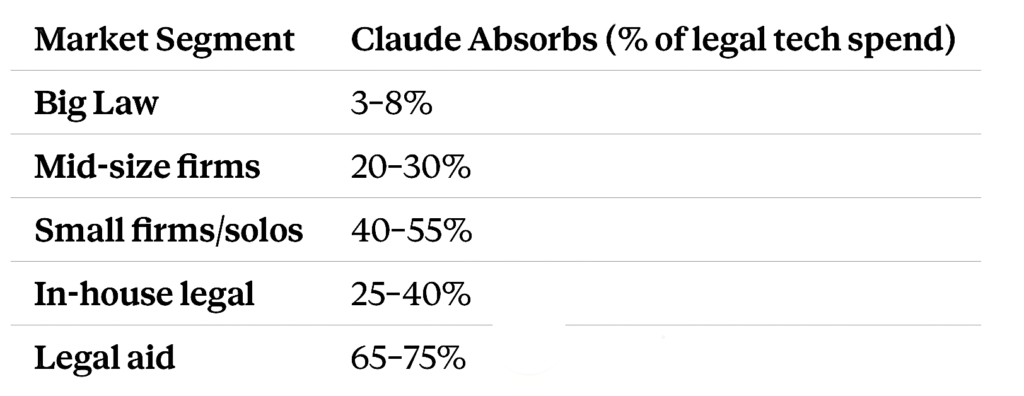
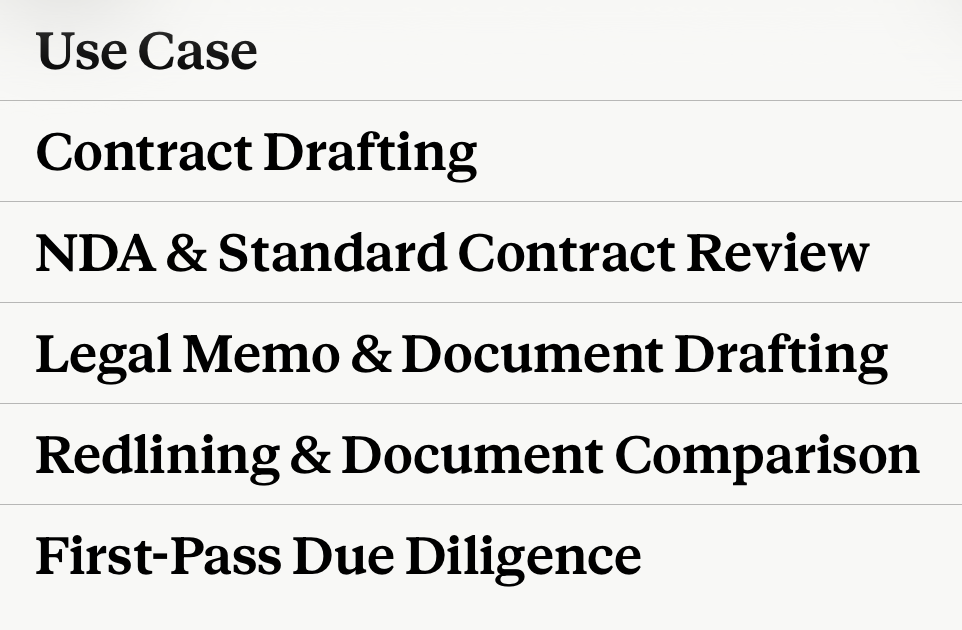
Claude could absorb between 25% and 40% of inhouse legal tech spend over the next three to five years, says Claude, if one takes into account the Word add-in, and other tooling such as customised plug-ins. Most exposed are contract review and drafting tools, or companies with those features.
However, among Big Law / large law firms, and despite the fact that many legal tech company features are heavily exposed to what Claude can now do (see below), especially with the Word add-in, the AI model estimates that only between 3% and 8% of that segment’s legal tech spending will be absorbed by Claude in the next three to five years.
In other segments there is also a notable impact, and especially among mid-size to smaller law firms. See table below.
—
Why The Big Difference: Big Law vs Inhouse?
First, let’s underline that these estimates come from Claude itself; the product that’s in question here. Also, it should be noted that the prompt AL asked, stated that the impact should take into account the Word add-in and all the other available tooling provided by Claude / Anthropic.
AL also asked ChatGPT, and it gave more conservative answers for inhouse, although refined the answers into small, medium and large, with small teams the ones which would most likely move over to Claude, at 16% to 28%
It also stated that around 5% to 10% of Big Law / large law firm legal tech budgets could shift over to Claude, which as you can see, is very similar to the figure that Claude provided as well.
One last point, this doesn’t ask: how much budget will shift over to all general models, e.g. Gemini and others? The focus for today is on Claude, in part inspired by the fact that Anthropic – given the Word plug-in and the explicitly legal tech-focused marketing now – is the main LLM contender to take market share away from today’s vendors. (And ironically, of course, they are all using Claude as well….)
So, why the difference? Well, you don’t need an LLM to figure that out. Here are some reasons:
- Big Law and legal tech are symbiotic – they literally grew up together over many decades. Many of the founders are from Big Law, and the legal innovation heads work hand in glove with legal tech companies. It’s a very tight community, a global village of relationships where many people know each other and what their products can do. That is hard to change.
- Big Law is understandably super-careful with regard to data risks. They like to have brands they can trust. In fact, they just like to buy products with ‘legal’ in front of them – it provides reassurance. And in the legal world that cannot be underestimated.
- Big Law also has 1000s of ongoing contracts with a huge number of legal tech vendors. It would be very hard to unpick that.
- That said, some firms will allocate some of their budget to Claude projects and perhaps even firm-wide use, and some contracts with legal tech vendors will be allowed to terminate.
For the inhouse world it’s different.
- Legal tech and inhouse, at least on the legal AI side, is a more recent relationship. Early CLM tools were not always a great experience for many inhouse teams and many other legal tech vendors struggled to get deep engagement. So, the very long term, symbiotic environment is not there, as it is with large law firms.
- A lot of inhouse work revolves around contract review, with plenty of similar, often lower risk contracts, that fill up the legal team’s time. The inhouse team is not always focused on ‘bet the company’ work. In which case, and given the above point, moving over to Claude – once data security issues are satisfied – seems a lot more logical, hence the high %.
- The smaller the legal team, the smaller the legal tech budget. Plus, the rest of the business may also be using Claude already. Therefore, moving to Claude, with Word, and with perhaps a bit of extra legal tooling, makes sense.
Which Vendors Are Most Exposed?
As AL underlined when the ClaudeCrash happened a few weeks ago, the companies with tons of legal data, such as Clio, LexisNexis and Thomson Reuters, are the most protected of all. Some of that data can be dug up by LLMs, but the data giants have curated it and put in place systems to prevent hallucinations.
Therefore they are really not so exposed on that side, although demand inhouse for their more transactional tools could take a hit.
Check out the tables below:
Most exposed
Least Exposed
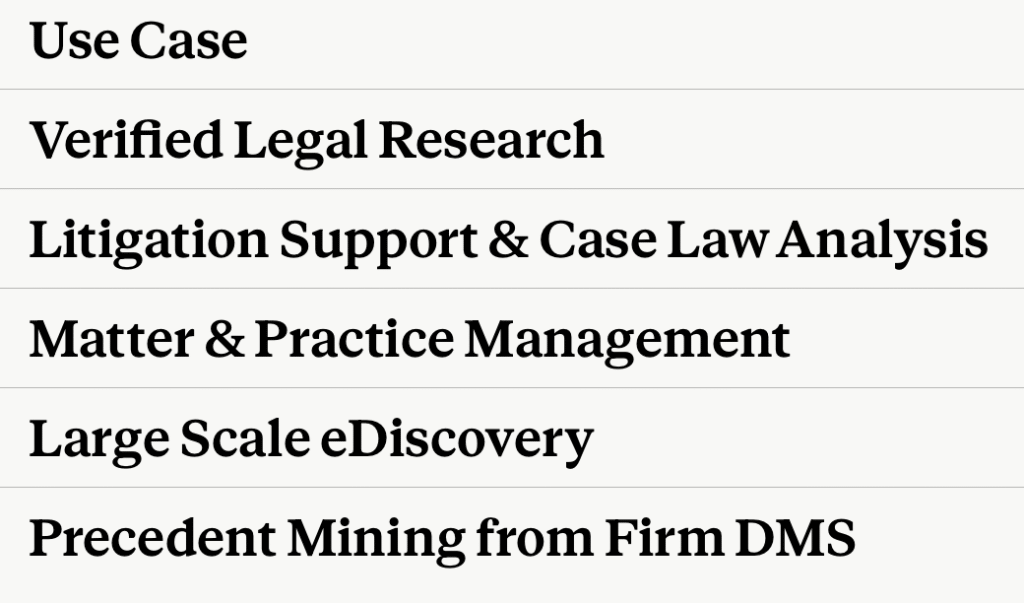
As mentioned, those companies most focused on doc review will have to innovate the most to stay above the Claude tide. Those who offer curated data, or capabilities that have little to do with language understanding will have the most powerful moat. Or where – as in the case with eDiscovery – there is a combination of large-scale data management and very special workflows that Claude alone cannot easily be used for – not to mention possible sensitivities over data security.
Conclusion
After 20,000 people – likely mostly lawyers – attended a webinar about how to use Claude for legal work, and following the quite deliberate targeting of legal by Anthropic in its marketing of Claude for Word, we have to accept that Big AI is entering legal – not just as a supplier of LLMs to legal tech companies – but as an alternative provider.
As noted, there are several key use cases that are most exposed and certain areas such as smaller firms and inhouse are most likely to be easy wins for Claude. Big Law will move more slowly, but innovation teams will likely use Claude to build special workflows, and a few may even go all-in, as Freshfields has gone all-in with Google and Gemini.
The net result is that legal tech remains, but some companies will take a hit. Selling into inhouse will get harder – that is for sure. Some parts of the law firm market will also become difficult for the legal AI platforms, and that will reduce their TAM. Not massively, but it will be noticed.
Overall, we are entering a new era for legal tech, where finally the really major tech companies are part of the mix when it comes to legal AI tools. That impact will only grow in the years to come, and thus legal tech companies will have to ramp up innovation of their own to stay ahead of the encroaching impact of the big LLM players.
Richard Tromans, Founder, Artificial Lawyer, April 23, 2026.
—
Conference Advertisement:
A Legal Tech Conference For All of Europe
Legal Innovators Europe – Paris – June 24 and 25.
Express route to your ticket here.

And,
Express route to your Legal Innovators California June 10th and 11th ticket here.
Legal Innovators California, the landmark West Coast legal tech event, will take place on June 10 and 11, in the heart of the Bay Area, the home to many of the world’s leading AI businesses – and plenty of legal tech pioneers as well! More information and tickets here.

Discover more from Artificial Lawyer
Subscribe to get the latest posts sent to your email.