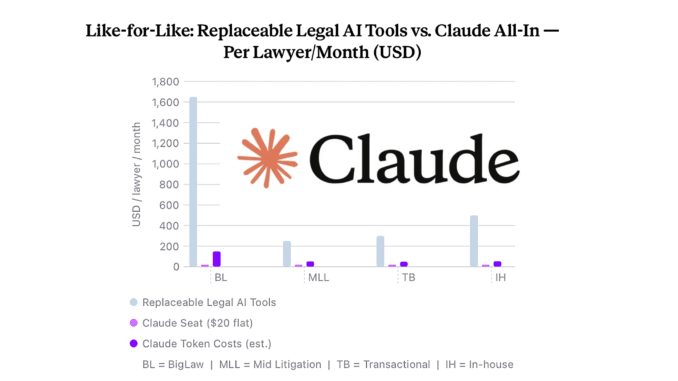
On face value Claude looks way less expensive than paying for a legal tech tool for the tasks that it’s able to do, such as relatively mundane document review. But, if you zoom out and look at the bigger picture, especially the realities of a firm’s entire tech stack – is it really cheaper, or even that widely applicable?
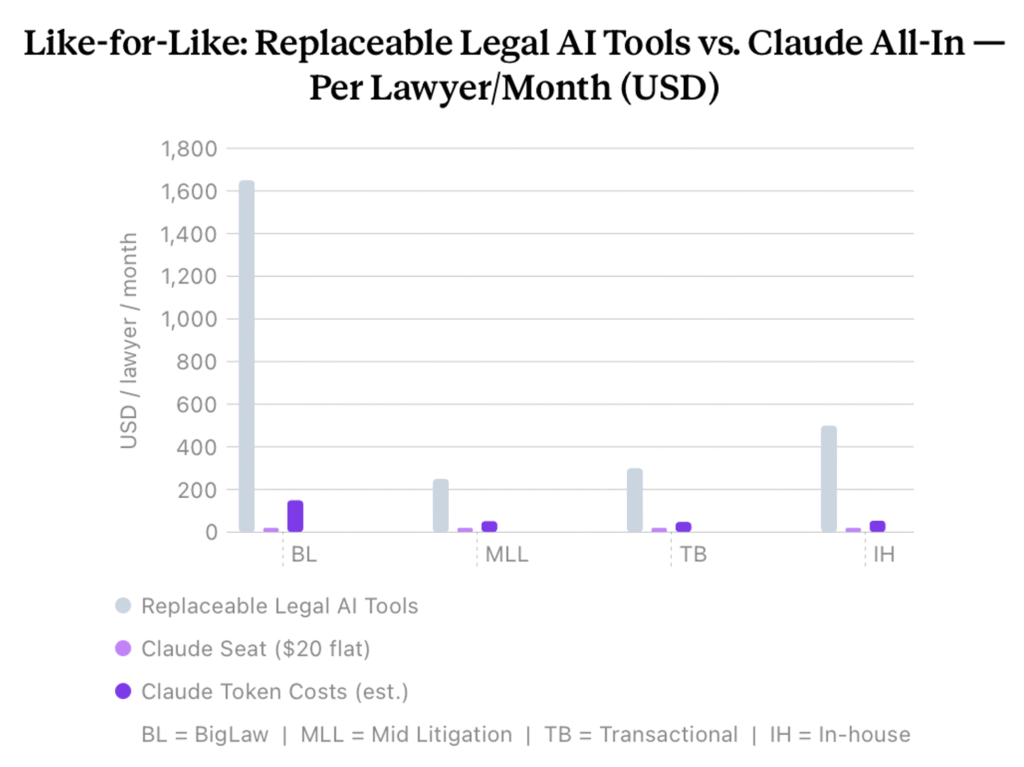
First, let’s consider some estimated data – from Claude (and below from ChatGPT also). AL went through a series of prompts and built charts that showed the differences between three elements:
- The cost of legal tech tools that we can reasonably say that Claude could have a go at replacing – at least in some circumstances, e.g. basic doc review.
- The cost of a standard Claude enterprise licence – which is what most legal teams or law firms would purchase per user. So, larger firms mean larger overall costs here.
- And the same as above, plus the token cost for using Claude for applicable work streams, relative to segments. E.g. Big Law firms are not just larger in terms of people, they handle more complex, voluminous legal matters, and that generates higher token costs.
However, it’s important to note that the table excludes those areas of activity that Claude cannot be expected to easily do, e.g. verifiable legal research, eDiscovery, and other legal tech tool tasks such as billing, or project management, or acting as a DMS. And that is a key point that needs to be kept front of mind.
And here is also a table from ChatGPT, but uses an annual estimate.
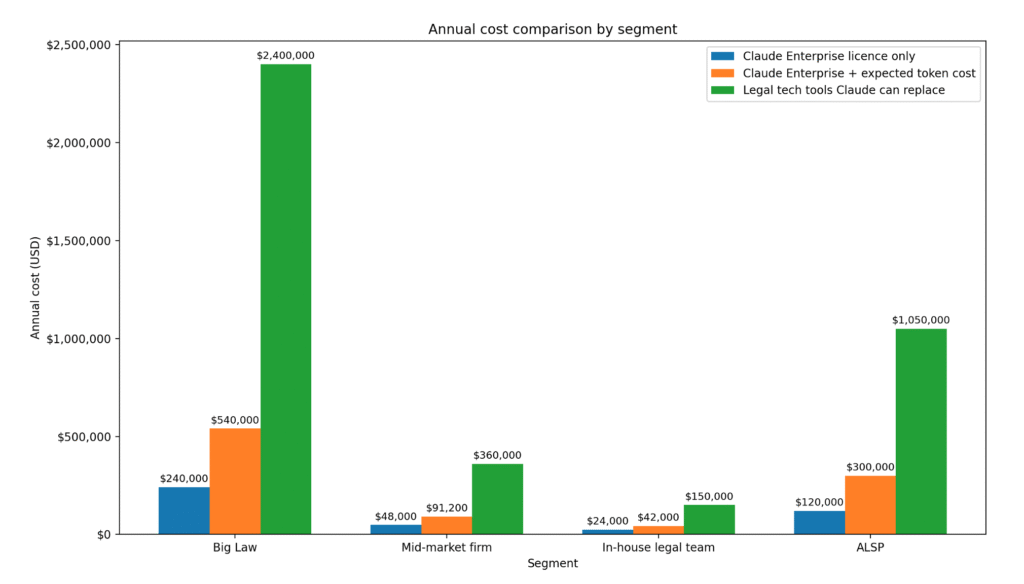
AL wanted to make sure the Claude result was not a one-off. As you can see, OpenAI’s estimates are not that different proportionally, although in this case it’s an annual approximation.
And it should be noted, that all of this is very much an estimation with wide variables around number of lawyers, how much work they do that Claude can help with, the cost of legal AI platforms and point solutions that are overlapping with Claude, and the token demand overall for each segment. It also doesn’t consider that you may still have to keep most of your current legal tech tools regardless, even if you do bring in Claude at scale.
Even so, and with all the many caveats above, it’s fairly clear that for certain, limited use cases, Claude does indeed come out cheaper – if you didn’t already have a broad tech stack that you need to keep and pay for.
The Bigger Picture
As explored before in AL – see story on what percentage of legal tech spend will go to Claude – here – it’s not a simple scenario. Here are some aspects to consider for Big Law.
- A large proportion of tech-assisted needs are not a great fit for Claude, from billing and project management, to eDiscovery, to verified legal research across curated datasets, and more.
- Many legal tech tools now come with a broad range of additional features. So, legal research often comes with a bunch of drafting and review tools, for example. You have to use the legal research tools, so you may as well get these other AI skills regardless. Or, Claude can do some things that a broad legal AI platform does, but the platform also does a dozen other things that you want to keep. So, again, there is no easy ‘swapping out’ here.
- While some may note the price differences with the major legal AI platforms, what is not priced in above is the huge investment companies have made in their application layers, their UI/UX, and in forward deployed teams, in customer service, and R&D to keep developing and improving features. Those costs are embedded in the price. It’s the same as people asking why a coffee in a nice restaurant is $5, when they could make it for less at home. The answer is: the restaurant is what you’re not factoring in – and that’s all around you, from the service to everything else on offer.
- Also, legal AI platforms are not just software – rather like law firms they are organisations that instil trust because they are run by people – people who you can meet and talk to.
- They also own the product and take responsibility for it. To build out a range of tools that you can really rely upon inside the super-demanding environment of a law firm is not a small task. Claude and some vibe-coding is not the same as a truly professional legal AI product built and designed by people who spend their lives focused on developing those features and engaging with the clients.
Other considerations:
- As mentioned, what Claude can really be 100% trusted to do as well as a sophisticated legal tech tool is quite limited, so you still have to buy all the other tools in any case in most scenarios, at least as a Big Law firm. Or rather, you have to keep them. So, ironically, there could be a duplication of costs by using Claude.
- Security will always be an area of concern in relation to general models. It’s unavoidable. Legal tech companies are of course operating off these models as well, but they’ve put in place a lot of security layers.
- Human service is not a small thing. If you rang up Anthropic and asked them to help with a plug in that you’d customised, would they leap to help you? Probably not. Maybe if you had an all-in deal like Freshfields they’d be more willing to help, but Anthropic doesn’t have a dedicated legal tech sales and support group – they have a handful of lawyers internally who are engaging with some lawyers at firms and inhouse, but that’s not the same thing.
- As Anthropic and other major LLM makers grow, will token costs drop, or rise? Will licence costs drop or rise? One argument is that more usage globally will mean lower prices, but if they gain a monopoly, or near monopoly, in the business world, maybe the prices get hiked more and more at some point in the future?
- Switching costs – what happens if in 12 months another LLM becomes the leader? What if Claude – which is ruling the roost today, drops away relative to rivals? If you are all-in on Claude, then you could be stuck.
Conclusion
The net result is that even though the main tables are startling, once you consider the broader details, it’s not such a simple thing. For smaller firms and small inhouse teams who have not yet really committed to legal AI products, then with their lower usage demands and no loyalty to any current tool, the move is easier.
For Big Law, as explored last week, even though there are some apparent savings on face value, the reality is that few large law firms will really go all-in with Claude, nor would it really be a major cost saving, because if we are realistic, they cannot leave their tech stack except for in certain areas where they are not already committed or where it makes sense to accept duplication.
Richard Tromans, Founder, Artificial Lawyer
—
Conference Advertisement:
A Legal Tech Conference For All of Europe
Legal Innovators Europe – Paris – June 24 and 25.
Express route to your ticket here.

And,
Express route to your Legal Innovators California June 10th and 11th ticket here.
Legal Innovators California, the landmark West Coast legal tech event, will take place on June 10 and 11, in the heart of the Bay Area, the home to many of the world’s leading AI businesses – and plenty of legal tech pioneers as well! More information and tickets here.

Discover more from Artificial Lawyer
Subscribe to get the latest posts sent to your email.