A new survey by World CC and CLM company Sirion has found that despite many promising legal AI offerings in the market, and great leadership from some GCs, many inhouse teams are still way behind where the ‘state of the art’ currently stands.
That’s both good and bad for legal innovators. The negatives are obvious: many inhouse teams are still operating with a fragmented mass of contracts, spread across different silos, operating usually without digital playbooks, or systems that talk to each other. In short, the opportunity that legal AI tools have to offer is really not being taken up yet at scale – or at least this survey says that.
The good news is that with a mass of products available, from CLMs, to more focused contract management systems, to broad legal AI productivity platforms, there are many ways to fix this, and for those legal tech companies to grow by addressing these needs.
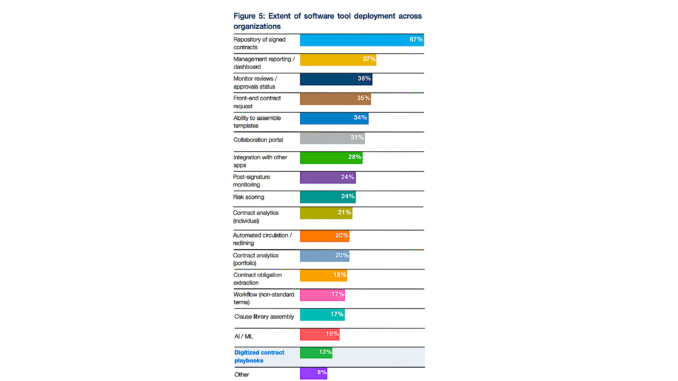
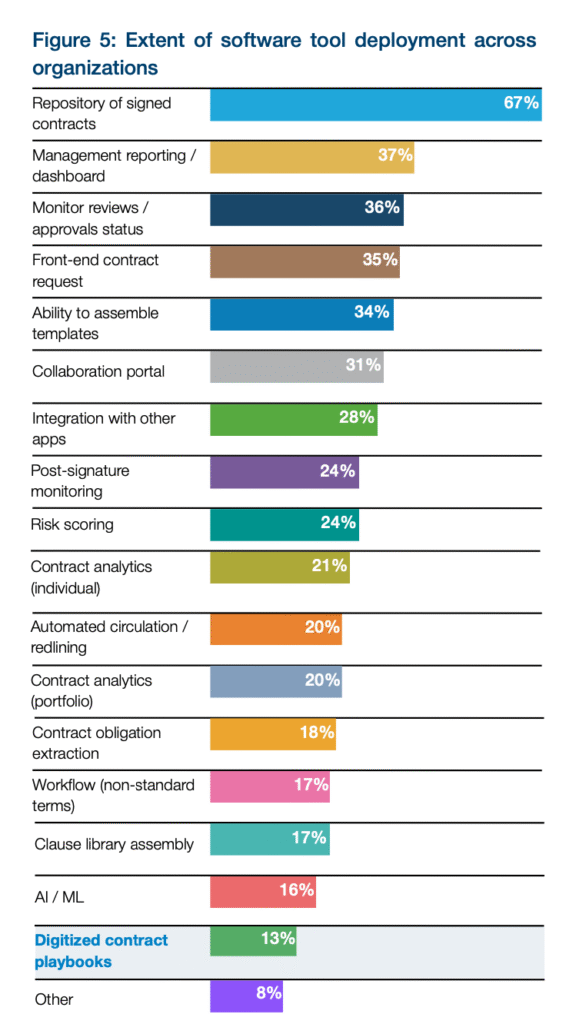
The report ‘Trusted Contract Data: From Repository to System of Record’, had one table that really stood out, (see below), ‘Extent of software tool deployment‘.
And the inhouse results are not great.
- While 67% have tools that help with forming a repository of signed contracts, that means that 33% – one third – do not. And if you are not even at this stage, then….wow.
- Only 16% said they were using ‘AI / ML’ – which seems a bit shocking in 2026, but then we can get a bit too focused on those GCs and companies that are moving with the times. Clearly many companies are still operating as if in the 1990s. And if that is the case, they must be totally baffled at conversations about agents and ‘harnesses’ and all the current legal tech lingo, let alone just bringing AI in at scale to make a difference.
- Given the above it makes sense that only 13% have digitized contract playbooks, or are using tools to help with that – and we don’t even know if those playbooks can really be leveraged by AI tools. And if you don’t have these, then again, any hope of making any real efficiency gains from AI technology – that now should be ubiquitous across the legal domain – remains a moot point. In short: it ain’t happening…yet!
- And to put this in context, only 34% have the ability to ‘assemble templates’, which one would assume was – beyond actually storing signed contracts – one of the most basic of all legal efficiency tasks.
The report also looks at a range of other aspects, such as linking up data streams across an organisation and who ‘owns’ contracts, but given the above we have way too much that is truly foundational to address first.
To conclude, AL would say: We have an incredible opportunity now to make a difference. Clearly the inhouse world – aside from a leading pack of very innovative GCs – needs way more help than many may assume, at least as far as this survey shows.
The tech is there, we have all seen it on AL TV and at conferences, the question then is: how do we get inhouse teams to fundamentally improve how they work by using AI, especially when the most essential needs are not even being met by a substantial number of teams?
One answer is the legal tech companies are going to have to really invest in Forward Deployed Engineers / Consultants. The challenge there is the cost to the software company and who pays for this. But, something has to be done, and looking at the wider tech world, e.g. OpenAI, the path at present seems to be that software companies are biting the services bullet and building their own ‘FDE’ teams. There are of course also many consultancies out there – but they need to be closely connected to your products, and few are willing to be exclusively linked to one offering.
Any road, here’s what World CC and Sirion had to say.
Sally Guyer, CEO, WorldCC, commented: ‘In today’s market, organizations need to know what was agreed, what has changed, what action is required, and whether the business can rely on that information. Trusted contract data is now the foundation for better execution. The organizations that move forward will be those that clean up their data, connect their systems, widen access, and define clear ownership.’
Ajay Agrawal, Co-Founder and CEO, Sirion, added: ‘GenAI is exposing a hard truth across enterprises: AI is only as reliable as the underlying data foundation.
‘Most organizations still manage contracts as disconnected documents spread across repositories, shared drives, and siloed systems. Contracting now requires a trusted System of Record that can transform legal language into structured, connected, operational data. Without that foundation, AI cannot reliably drive decisions, automation, or enterprise-scale execution.’
And on that last point, 100%.
More about Sirion here.
–
Come along to the Legal Innovators Europe conference in Paris – June 24 (Law Firm Day) and 25 (Inhouse Day).
Express route to your ticket here.

Discover more from Artificial Lawyer
Subscribe to get the latest posts sent to your email.