
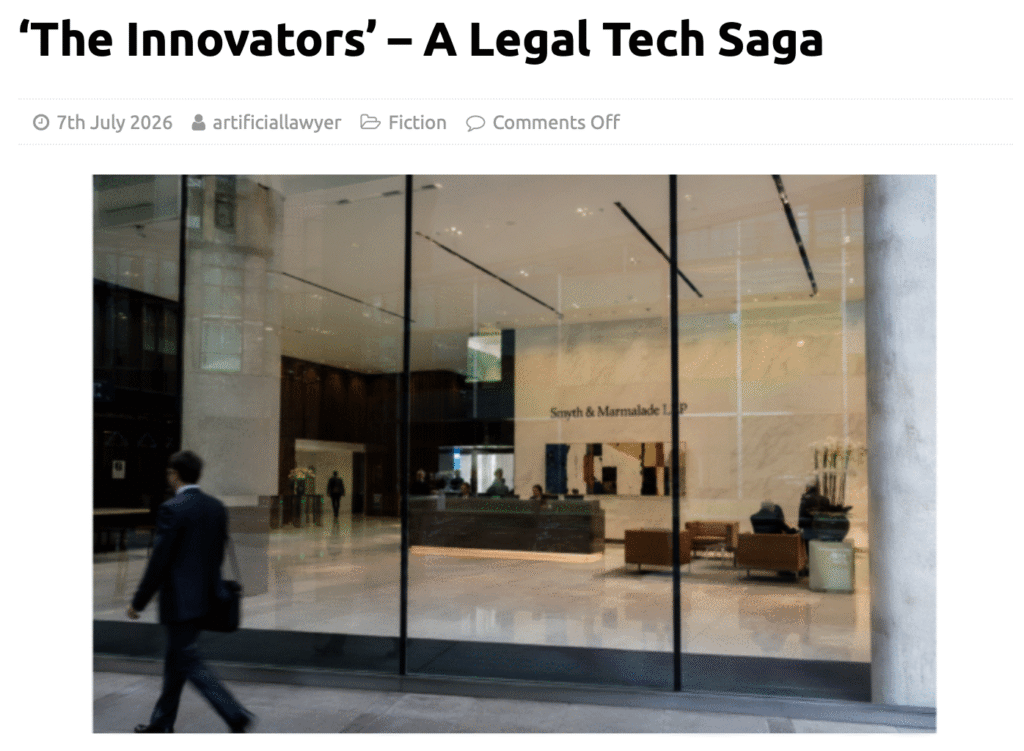
Katie Downer moved through the spacious marble lobby of Smyth & Marmalade with automatic motions. How many times had she traced this path? Through the revolving door – always a bit worried she’d get crushed; then a nod to one of the security guards – and a momentary feeling of guilt; then the glide across to the main gates – Beep!; then the first set of escalators up to the mezzanine lobby; a quick zip right to the elevators and another affirmative Beep! and then the strained morning small talk with a bunch of random people. (She’d tried just ascending in silence, but that was even more stressful.)
And on and on and on. Each step taking her deeper into an environment that was increasingly secure, and more likely to never be free from strained-looking humans working away at inscrutable documents on their computers no matter what the time of day.
It had both the air of great things happening, important things: multi-billion Pound deals and the strategizing of mega-litigation that could reshape entire market segments; and also – she had come to note – the gently flickering aura of transacted lives – one of which was her own, she freely admitted. You had to pause, take a deep breath and focus to feel it, but there it was, just like the security cameras: silently there.
But, what else was there to do? The plan to sell up and buy a classic wooden ski chalet in Switzerland – and to then merrily run a luxury B&B with her husband – was still taking shape. It was far too soon for that yet, and changing jobs to a less remunerated, and perhaps less intense, role would just push the start date further away.
And who was to say another job, doing something similar no doubt, in an office that was almost identical, probably no more than a mile away from this one in the heart of the City of London, would be any different? Timothy would be a Peter, perhaps at some firms a Rebecca. Emily would be a Priyanka or a Jeremy. And so on. A parallel universe. A little different in the details, but ultimately the same in all the ways that mattered. No, she might as well stay where she was. That is, if the firm’s grand legal AI vision – Project Rubicon – didn’t finish her off first.

When she got to the upper mezzanine lobby, where the nicer meeting rooms were and where those who worked here peeled away to a different set of escalators and elevators, she noticed something strange: the reception area was full of journalists. Not just a handful, but at least a dozen.
Katie was no expert on the media, but she had met a couple of the legal tech hacks over the years. She had even done an interview with one in 2023 and had her picture on a news website’s main page. She had shared the article on LinkedIn and received so many likes it felt as if she had finally cracked nuclear fusion, rather than having announced an ‘own-brand’ chatbot running off ChatGPT. But, hey, she’d take the accolades when they came – which was not often in this line of work.
She also recognised one quite tall journalist from a national broadsheet, his strangely anachronistic pin-striped suit and waistcoat standing out from the more casually dressed group. As she paused she realised one of the legal tech journalists had clocked her and was about to engage. She swiftly turned on her heels and hurried to the elevators.
As soon as she was inside she typed a message to Emily with one thumb. Her phone was in her spare hand – the other holding a double shot macchiato.
‘WTF? Journalists, lots of them?’
‘Yes. Saw. Something big going down.’
‘Yes. But. What. ? ‘
The elevator stopped at her floor. She was half-way along the corridor to the innovation team’s area when it hit her.
‘Oh, shit!’ she proclaimed out loud and spun around, accelerating back the way she had come.
–
‘You’ve done a tremendous job!’ Timothy Marks stated with enthusiasm in front of the firm’s head of public relations, along with the firm’s head of marketing. ‘I’m told we have nearly all the main legal press, plus some of the top business press today.’
Angela Akeju smiled with the appreciation. Running the press team at Smyth & Marmalade was usually a thankless task. The firm may have been working on huge deals, but getting the world’s press to pay attention was like getting blood out of a stone. Unlike most of the other major law firms in London, they hardly ever did a lateral hire, had not opened a foreign base in over a decade, and rarely really did anything that caught the media’s attention.
‘Why are we never covered in the FT? Or even the regular legal press?’ the partners would demand, hinting that she had somehow failed. ‘Because you never do anything the press wants to write about!’ was the answer she wanted to give, but decided never to say.
Of course, this time it was different. Smyth & Marmalade had really got something to say now and it was all about AI. Not just an API to an LLM either, something truly market-shaping.
She had personally rung every paper and news site she could think of and explained that ‘something massive is going to be announced, something game-changing, if you miss this you’ll regret it’.
Tabitha Grimes was also enjoying the moment. Marketing at Smyth & Marmalade usually revolved around setting up mind-numbingly dull seminars, occasionally lightened with a handful of client jollies to Wimbledon and Glyndebourne. But, this whole AI thing opened multiple new doors of opportunity. Her mind raced with the possibilities; the new types of event they could organise to showcase their message. She’d even had a look at flights to California this morning on the way in. Maybe something grand in the Bay Area? Fly everyone over. Try and get someone famous to take part? Yes. All kinds of opportunities.
‘Shall we go over the talking points one more time?’ Angela asked, leaning forward with her printout on her knees.
‘Game-changer. Yes,’ Timothy repeated as he noted the heavily underlined text and then read through all the key points again.
‘Please keep repeating that phrase. We are thinking of the headlines tomorrow. Embed it in their minds. Oh, and on that point. The press release comes out later today. So, the speech is an opportunity to set this all up. To build the excitement. Land key lines. And of course to take some….er… questions.’
The last word hung in the air uncertainly.
‘Do I have to do questions?’
‘They’ve come to us. We have to give something back to reward those who made an effort.’
‘But, everything is in the release and the speech is basically the same thing, but me talking it through?’
‘Yes. So, keep a little back. Keep a couple of fresh points for the live questions.’
Timothy sat back and made a temple with his fingers.
‘What if they ask me something I don’t want to talk about?’
‘Then side-step and talk about what you do want to. Just imagine you’re a politician. Easy as that.’
‘I see. I can think of a couple of things.’
‘Excellent. The key thing is this: Project Rubicon is the most important legal AI development in the UK’s history. No other firm in London has ever done what we have done: building from the ground up their own proprietary AI system.
‘Remember to stress that the clients will benefit, but don’t go into the details. Just say we are working with a select group of clients.’
‘Are we?’
‘I don’t know. I presume you are. But, that’s not the point. Every client we’ve ever had will want to know more. They’ll have crazy FOMO!’
Tim pondered the acronym for a moment, then understood.
‘I see.’
‘Oh, and underline the point that this is not about doing something new. Stress that we have always been a leader in innovation – always. We don’t want to look like we’re just trying to get attention.’
At this last bit, Tabitha looked over and raised an eyebrow. Timothy absorbed it all without any objection. He sat back up and tapped out a merry drum roll on the desk.
‘Right! When do we begin?’
‘In about five min….’
There was a commotion outside. Someone was trying to open the door and Debbie, Timothy’s assistant, was trying equally hard to stop them.
‘Tim, you have to cancel the press conference!’ Katie shouted from the other side of the door.
–
When everyone was settled and another chair had been pulled up, Katie began.
‘You asked me to ‘scope’ things out. That is what we are doing. We are not ready to announce anything. I mean, anything at all. We are not even at stage one.’
‘We don’t have to have finished the project to announce it,’ Angela quickly interjected – clearly annoyed at the intervention. ‘We just say we’re starting. Then we drip feed our progress. Maximum coverage. That’s the plan.’
‘And what if we then decide not to do it? We’ll look very foolish to say the least,’ Katie shot back and placed her phone on the edge of the desk and took whoever was on the line off mute. ‘This is Jacob, the tech consultant – and I mean a real one who actually understands AI infrastructure costs – who we engaged to help us cost this project out.’
‘Go on,’ Timothy said and leaned closer to the phone while picking up a pen.
‘Hello all,’ he began nervously, ‘I understand there is some….er…..confusion.’
‘Just please say your piece,’ the managing partner urged. ‘The press conference begins very soon.’
‘Well, Katie explained to me what you wanted to do. And it will be……er…..how can I put this…?’
‘Simply and quickly,’ Timothy instructed, his impatience showing.
‘OK, it’s like this. You wanted to post-train open source LLMs on all of your data, your past work product, client preferences and so on. You have seven main practice groups, each of which have three or four sub groups. But those in turn break down into multiple areas of work where there isn’t that much data overlap, despite appearances. It’s a vast project. I mean, truly gigantic.
‘At present, you have no team members with experience of doing anything like this. You have a fairly rudimentary – sorry, but it’s true – tech stack and minimal infrastructure especially for a firm of this size. In short, you are starting with almost nothing.
Timothy felt a strange flutter in his chest.
‘To do what I have been told you’re planning, will require – whether you rent or buy – access to a very large number of GPUs. The minimum cost – based on Katie’s estimates is around $15m – and sorry, prices are in US Dollars because they’re the market makers.
‘Now, even on a rental basis, if you want to stay current, i.e. you can’t just train once and then stop, you have to keep doing it, so you’re looking at least $5m after that per year, but, at least $10m if you’re doing this seriously.’
‘We can afford that,’ Timothy replied.
‘Sure, but that’s just the beginning. Then you’ll need the team. The people you will need for this will cost you about $15m or more per year as well – and they are hard to come by, especially so in the UK. So, $30m to start. But – and I need to stress this – a project like this will also need your lawyers’ input. Engineers are not legal experts, they’ll need a lot of your time – dedicated time.’
‘How much billable time?’
Katie leaned forward.
‘Jacob, thanks, I’ll pick this up now,’ she informed him and pressed mute. ‘We don’t know. No one has ever done this at such a scale. Plus, all of these costs are in addition to everything else we already use. This totally wrecks our budget. We don’t even have the office space for these new staff. So there is that as well.’
Timothy was looking into open space and thinking hard. Then he looked back at her.
‘But, we’ve seen in the press firmwide deals for AI platforms at around £1m.’
‘Yes, but that is not this. This is like building our very own legal tech company – from scratch and customised just for our needs. And then having to keep it going forever…on top of all the other tools and systems we need. Lexis and TR we still need. We still need our DMS…’
‘Billing systems,’ Tim added.
‘Ah,’ Katie said and smiled with pain. ‘Now you’ve really put your finger on it. I was talking to a friend – with total confidentiality obviously – and they told me their biggest problem with AI is the loss of billable time.’
‘How much?’
‘Best case scenario: 20%. So, the loss of a fifth of revenue – if you actually use what we’re building. And if you don’t – rather like our own AI sandbox that connects to ChatGPT, but which hardly anyone uses – then it’s a very, very expensive marketing exercise.
‘Of course, we could move the entire firm over to fixed fees – which I understand removes the time problem, at least in theory, but ironically many clients still want to be billed by the hour. Not to mention the firm’s entire financial system is based on the hour and we haven’t even started to think through how to make such a firmwide transition.
‘We’re talking about a highly complex and expensive venture that explodes our tech budget, significantly disrupts the firm, and leads us into business model territory we have only just started to consider. Not to mention how it will raise client expectations to a level we may not be able to deal with once it’s all public. Sir… this is a huge risk. We simply cannot announce it.’
The colour had drained from Timothy’s face. Angela and Tabitha were squirming in their seats. There was a quick tap on the door and Debbie stuck her head into the room.
‘Just to say the press conference is ready to begin.’
Debbie noted the look on everyone’s faces.
‘Everything OK?’
—
Part One is here. Part Three will arrive next week.
[ Copyright © 2026, Richard Tromans, Published by Artificial Lawyer Limited in the U.K. All rights reserved. This work of fiction may not be republished or reproduced without permission. The moral right of the author has been asserted. All characters are fictitious and any resemblance to any persons living, dead, or virtual, is purely coincidental. ]
Discover more from Artificial Lawyer
Subscribe to get the latest posts sent to your email.