By James Tuke, CEO, AI Futures Forum.
It is late September 2026. Sixteen months ago, our first report established that AI adoption was becoming inevitable across UK law firms. Since then, we’ve tracked the story through a hardening client mandate (September 2025), a warning about the collapsing training pipeline in ‘Broken Ladder’ (January 2026), and the reckoning with the billable hour in May. At every stage, the story has been usage curves climbing, budgets growing and tools proliferating.
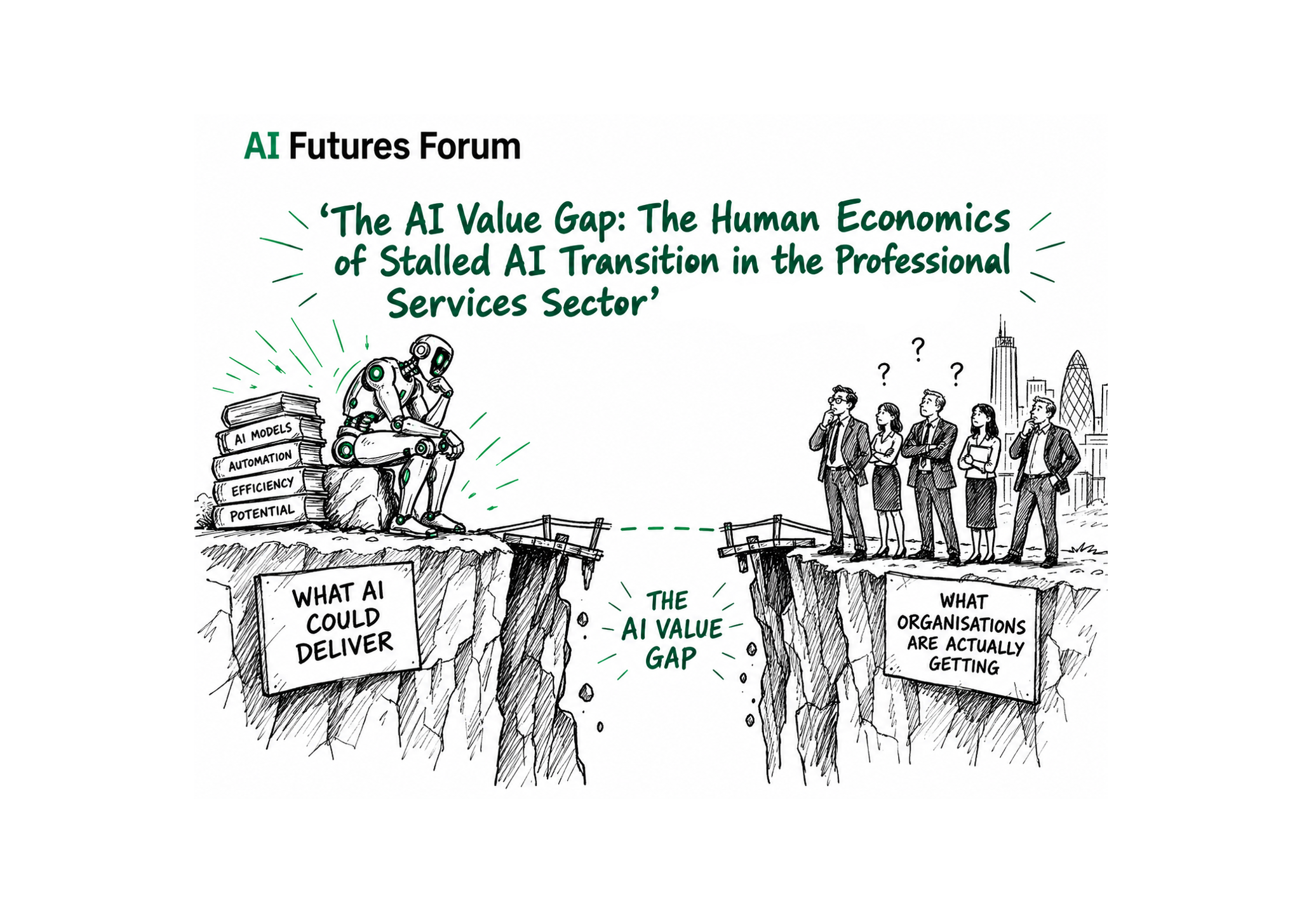
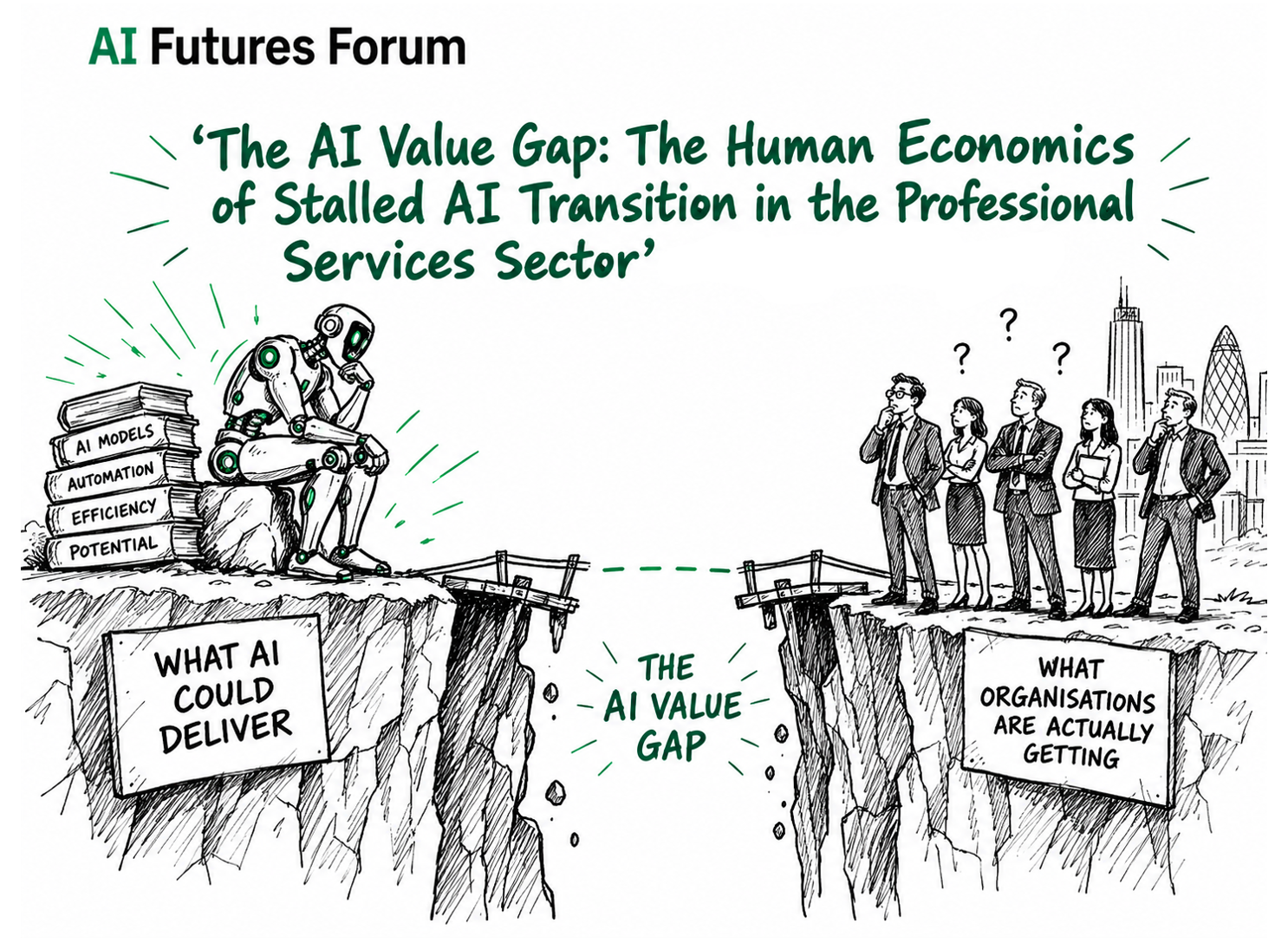
That story has now changed. Our new report, ‘The AI Value Gap’, asks a more uncomfortable question: your firm has probably already adopted AI, so why isn’t it paying off?
91% and Falling Short
Thomson Reuters’ 2026 Future of Professionals research found that 91% of fee earners believe their own organisations are falling short of what AI could realistically deliver. This is not a story about under-investment. Firms with a genuinely visible AI strategy are nearly four times more likely to see measurable return than those without one – and yet most firms and legal departments still cannot tell you what their return actually is. Only 18% collect ROI metrics in any systematic way.
Meanwhile, in several major US firms, billable hours are rising even as AI use grows – and nobody has offered a convincing account of where the promised time savings went.
It’s Not a Technology Problem
The instinctive explanation is that the tools remain immature, or that governance hasn’t caught up. Both are true, but neither explains a gap this size. Our research points somewhere less comfortable: the value gap is a confidence gap, and it sits squarely with leadership, not IT or HR.
The clearest evidence is uncomfortable reading for managing partners specifically. Thomson Reuters’ Stand-out Lawyers survey found that even among the heaviest partner users of AI, only around a third have discussed its impact with most of their clients. Partners are a firm’s commercial transmission mechanism – the people who set matter strategy and staffing expectations. A partner who hasn’t personally used the tools enough to talk about them credibly cannot sell that impact to a client, however good the firm’s official strategy claims to be.
The Ownership Question
There is a more self-interested reason for hesitation too. As firms train AI systems on their own partners’ accumulated judgement, a legitimate question of ownership arises: who benefits from the resulting asset? Neither the billable hour nor a profit share pays a partner for having supplied the raw material of a system that keeps generating value long after they’ve retired.
Kirkland & Ellis’s decision to commit US$500 million to a proprietary platform was read by commentators as being about ownership and control, not efficiency. We are now seeing firms weigh spinning off their own AI capability as a separate commercial entity – in effect, becoming their own NewMod rather than being disrupted by one.
A Competitor You Didn’t See Coming
Speaking of NewMods: the competitive threat is no longer confined to AI-first start-ups. In 2026, Anthropic’s launch of Claude for Legal – with direct connectors into major vendors and already live at Freshfields and Quinn Emanuel – signalled that foundation labs themselves are moving into the application layer built on top of them. Industry analysts openly asked how much further that expansion will go; this month OpenAI followed suit with the launch of Astra for Law. Firms comfortable with their current vendor relationship should not assume it’s permanent.
Closing the Gap
None of this is a case for retreat. It is a case for treating the next phase of AI strategy as a human problem before it’s a procurement one. The firms closing the value gap fastest are not necessarily spending the most – they’ve named someone accountable for adoption landing in practice, measured what they actually want, and had the ownership conversation before it sours into resentment.
The technology will keep improving regardless of what any single firm decides. Whether your teams are ready to use it well, and trusted to remain answerable for the result, is still, for now, a choice.
Our full report: ‘ The AI Value Gap: The Human Economics of Stalled AI Transition in the Professional Services Sector ‘, is free to download.
👉 Download the Full Report Here
–
About the author: James Tuke is the founder of multiple tech-related ventures, including Treat Digital, and is also the CEO and Editor of the AI Futures Forum, a site dedicated to in-depth discussion about AI, and writer of ‘A Short Walk in AI’. He also advises firms and senior management about their AI strategy.
–
[ This is an educational think piece by the AI Futures Forum for Artificial Lawyer. ]
—
Legal Innovators UK – Nov 4 and 5 / Legal Innovators New York – Nov 17 and 18
Cosmonauts have now opened Express Registration for Legal Innovators UK and New York. This means that if you are at a law firm or at an inhouse legal team you can now zoom directly to your tickets – which are complimentary as long as you qualify.
For London – Nov 4 and 5, at the Minster Building, see here:

And, for New York – Nov 17 and 18 – Midtown, please see here:

Discover more from Artificial Lawyer
Subscribe to get the latest posts sent to your email.