By Karen Waldron, LexisNexis.
Two of your best associates could review the same client document and reach slightly different recommendations, each reflecting their respective experience and judgement. That has always been true, but AI introduces another source of variation: the tools lawyers choose to use. A research tool can influence which authorities appear first; a drafting tool can shape the initial version of a client clause; and a summarisation tool can affect which facts, risks or obligations come to light.
Lawyers remain responsible for their final advice, even as AI increasingly influences the route they take to reach it. It’s critical, therefore, that firms retain expertise and judgment and continue to build the critical thinking skills necessary to work with AI tools responsibly and effectively.
Our latest research found that 94% of legal professionals now use AI, yet fewer than a third (29%) say it is embedded in their organisation’s strategy and operations. The largest group, 43%, say they are still experimenting and making slow progress.
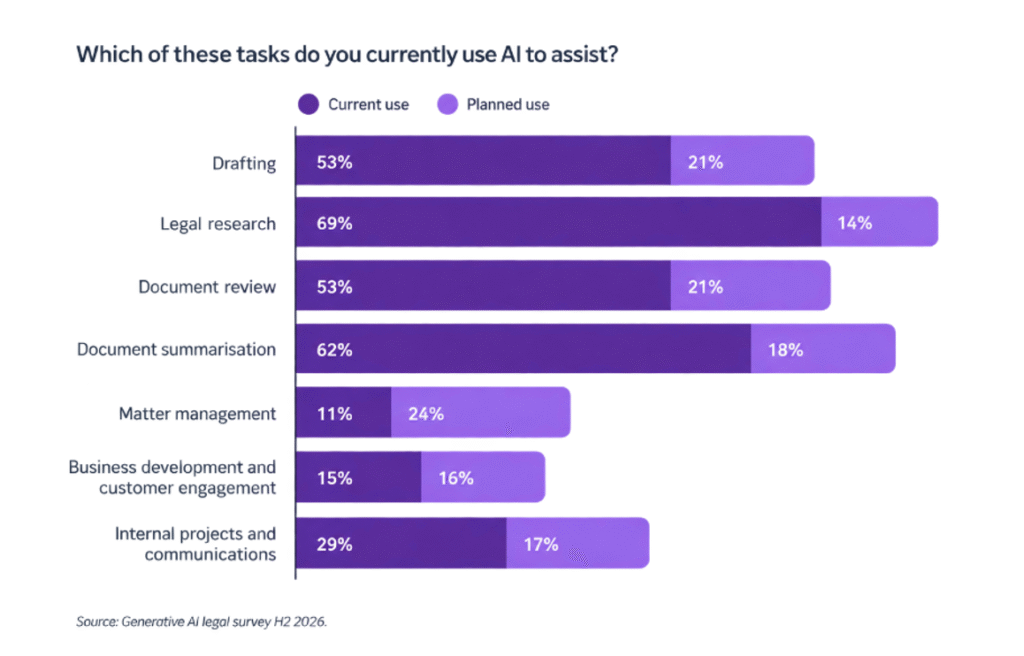
AI use extends well beyond reviewing meeting notes or polishing client emails. Lawyers are applying it to a wide range of tasks including legal research, drafting, document review and summarisation. Research is the most common use case, at 69%, followed by summarisation at 62%; more than half use AI for drafting and document review.
AI is therefore already part of substantive legal work, even where firms have yet to agree what effective governance should look like.
Give AI governance clear ownership
AI affects several teams at once. IT assesses the technology, while risk and compliance consider acceptable use, information security focuses on data, procurement and knowledge teams work with suppliers, and practice leaders identify where the tools can help.
When responsibility is spread across teams without a clear owner, it becomes difficult to see who is accountable for the whole. AI governance fails when everyone agrees it matters but nobody owns the decision rights to make it effective.
One finding I keep coming back to is that 18% of respondents say there is no clear owner for AI governance. That figure rises among smaller firms and at the Bar, whereas large firms and in-house teams are more likely to have clearer structures in place.
Firms do not need another large committee to govern AI, but they do need clear accountability. Someone must bring the right people together and make sure lawyers can get consistent answers to practical questions.
Those questions include which tools lawyers may use, what information they may enter, when they must check an output and whom they should contact when something goes wrong.
If the answers still depend on whom a lawyer asks, the governance arrangements need more work.
Accuracy remains the central concern
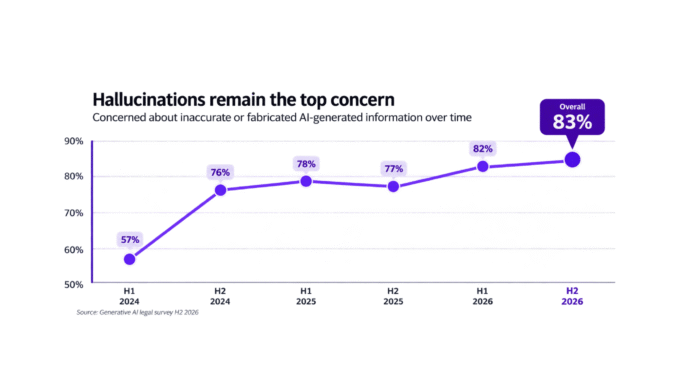
Lawyers have grown more familiar with AI, but familiarity has not eased their concerns about accuracy.
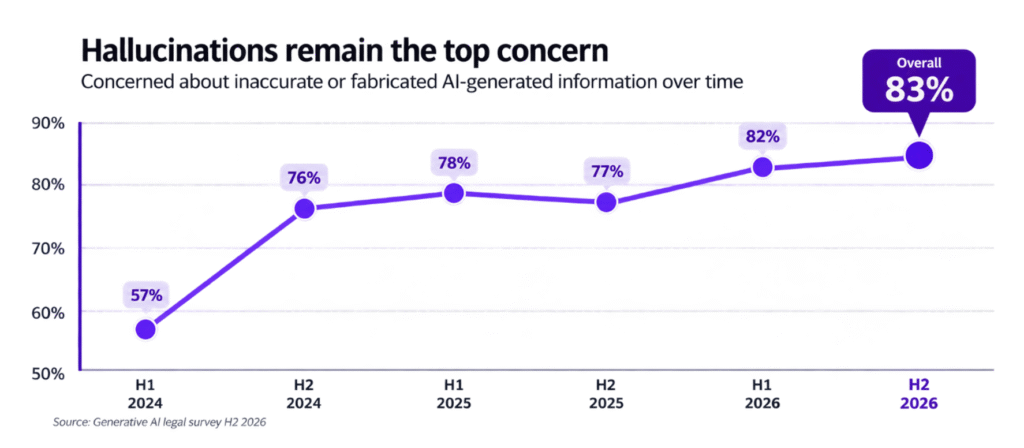
More than four-fifths (83%) are concerned about inaccurate or fabricated information. Confidential data leakage follows at 53%, with overreliance close behind at 52%.
These concerns also shape purchasing decisions. Data privacy and security are the leading considerations when lawyers assess technology providers, ahead of transparency around AI use and human oversight.
The material on which AI draws matters too: 81% say they feel more comfortable using AI when it is grounded in legal sources.
Approving a tool is only one part of governance. Firms also need to understand what sits behind it, how readily users can verify its answers, how it handles uncertainty and what level of human review different types of work require.
A confident answer is not always a reliable one.
Only 10% say they depend on AI to do their job, so the profession is far from unable to function without it. Nevertheless, more than half worry about becoming too reliant on AI, and 75% think junior employees who use it heavily may struggle to develop legal judgement.
A policy alone cannot resolve that concern. Legal judgement develops through reading the source material, noticing what is missing, dealing with ambiguity, understanding the client’s circumstances and weighing the strength of competing answers. In this way, legal work already involves judgement, uncertainty and review. The question is: where can AI assist, and what evidence do we require before its output becomes something a lawyer can rely on?
AI can accelerate that work, but it can also obscure parts of the process. Firms should therefore address training and supervision alongside risk and security. If junior lawyers use AI every day, senior lawyers need confidence that they are learning to challenge its output, rather than simply tidying it up. This means actively reflecting on what a junior lawyer needs and how they develop their critical thinking skills. The risk is not in losing the inefficient tasks that junior lawyers historically completed over time to develop their legal skills; it is instead in losing the learning opportunity itself. When used effectively, AI can accelerate learning by suggesting additional reading, linking to sources, considering other angles or giving additional guidance on a review of a first draft. More experienced lawyers when supervising junior lawyers can spend time questioning and discussing how they evaluated and checked the AI response, rather than the document or output itself.
The commercial reality
Firms must address these risks while keeping pace with change. Respondents identify keeping up with new technology as their biggest challenge, at 53%. More than half expect AI to affect law firm billing, and nearly half think their career would suffer if their organisation failed to embrace AI fully.
Firms cannot spend the next two years perfecting an AI governance framework while the technology and its use in legal work continue to develop.
Effective governance calls for clear ownership, practical rules, appropriate tools, closer scrutiny where risks are higher and regular review as the technology evolves.
AI already has a place in many legal workflows. The challenge now is whether firms’ governance and learning arrangements are keeping pace.
LexisNexis can help your firm put AI governance into practice through trusted legal AI, clear oversight and workflows designed to support confident use. Speak to us about how Lexis+ with Protégé can support your firm.

–
About the author: Karen Waldron is Product Development Director at LexisNexis UK.
—
[ This is a sponsored thought leadership article by LexisNexis for Artificial Lawyer. ]
Discover more from Artificial Lawyer
Subscribe to get the latest posts sent to your email.